Jamaica Public Sector Compensation Review Turned into a Political Payday
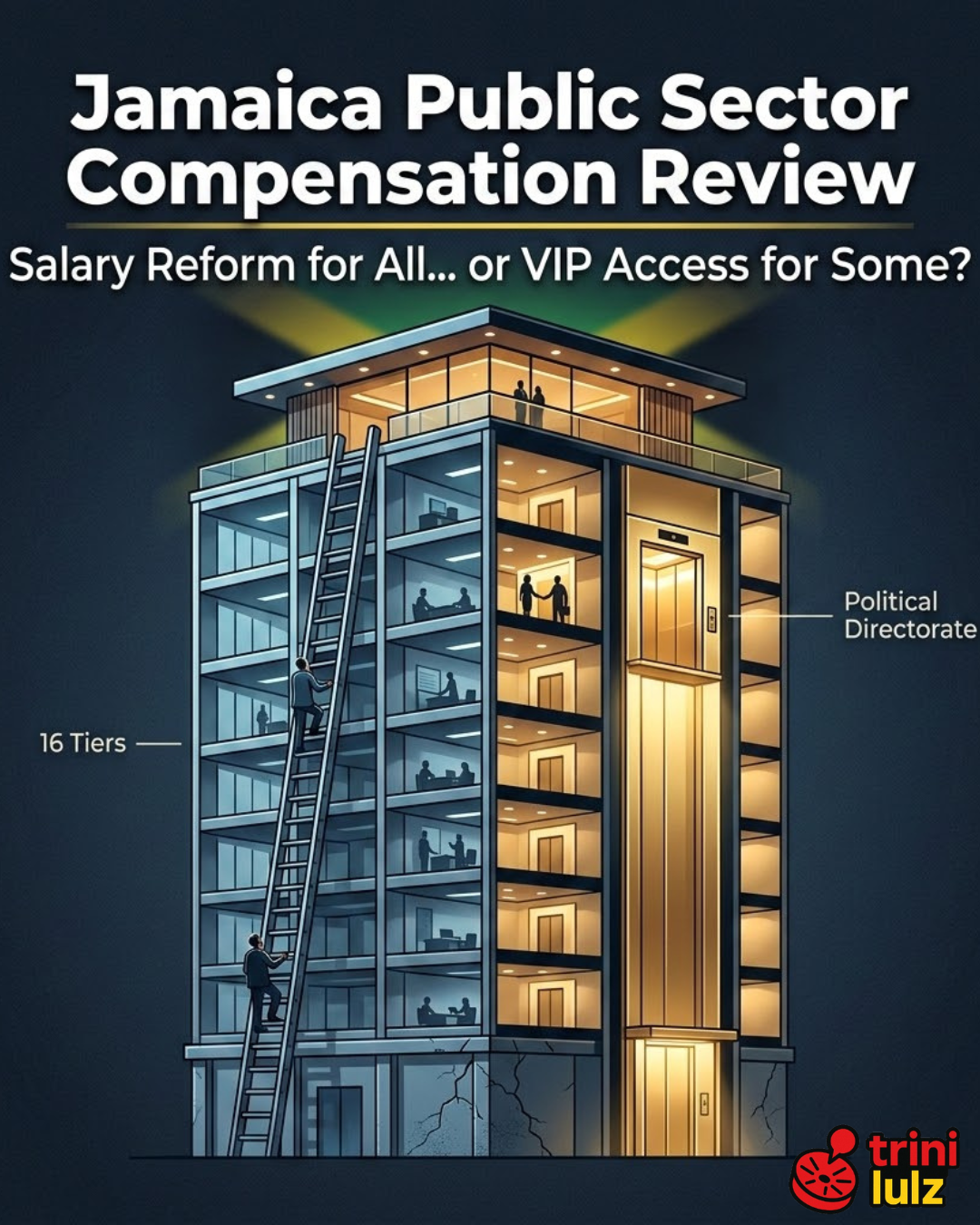
The Jamaica Public Sector Compensation Review was sold to the country as a necessary clean-up job. A modernisation. A long-overdue demolition of a 1970s-era salary maze that had 325 pay scales and roughly 185 allowances stitched together like a budget Frankenstein.
The government said the reform would make pay simple, transparent, fair — and crucially, pensionable. Nurses, teachers, and technical professionals who once relied on opaque allowances would now see clearer base salaries. The system would shrink to 16 tiers. Accountability would follow structure. Performance would follow accountability.
But somewhere between “system reform” and “salary implementation,” the public conversation took a hard left turn.
And it hasn’t recovered since.
The 16-Tier Ladder
At its core, the Jamaica Public Sector Compensation Review was ambitious. According to the Ministry of Finance’s official overview of the reform, the restructuring aimed to simplify pay architecture, eliminate fragmented allowances, and strengthen transparency across the civil service.
The total public sector wage bill expanded by $200 billion between FY 2021/22 and FY 2024/25. The government framed this as a structural investment — one that would stop the “brain drain” of critical care nurses and mathematics teachers who were quietly packing their degrees and leaving.
Registered Nurses (HPC RN 1–7) were projected to move from entry-level compensation of $3.24 million to top steps approaching $11.88 million by 2024.
Public servants were offered a 20% increase over three years. In FY 2025/26, wage movement of 7.5% reflected incremental adjustments.
On paper, the architecture looked rational. Reduce fragmentation. Consolidate allowances. Increase pensionable earnings. Link pay to performance.
In theory, this is what modern administrative states do.
Then Came the Elevator
The controversy did not erupt over the 16 tiers.
It erupted over the penthouse.
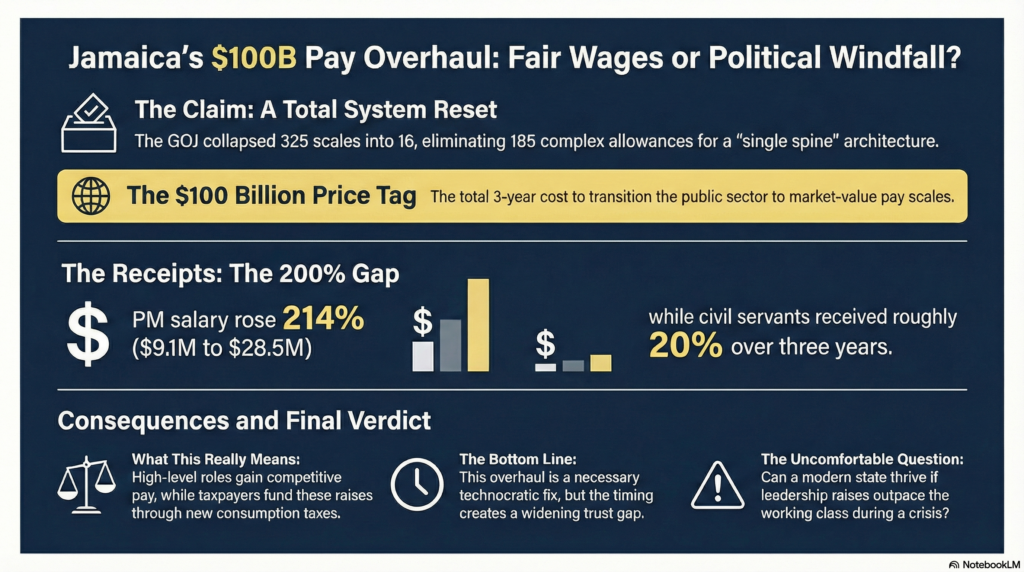
In May 2023, salary adjustments for the political directorate were announced. The Prime Minister’s approved salary was set at $28,582,942. Cabinet Ministers were positioned at $22,874,097. The Deputy Prime Minister and Opposition Leader were listed at $25,733,359.
The fiscal impact specific to the political directorate was estimated at $1.7 billion.
Relative to the overall $100 billion reform envelope, that figure appears small. But politically, percentages matter more than proportions.
While approximately 105,000 public servants were navigating phased 20% increases, leadership adjustments often exceeded 200%.
Optics outran arithmetic.
Public outcry followed.
Symbolic Solidarity, Then Retroactivity
On May 22, 2023, Prime Minister Andrew Holness announced he would forego the increase, describing it as a gesture of solidarity amid public concern.
The Office of the Prime Minister stated that the PM does not receive separate compensation as an MP or Cabinet Minister, suggesting the revised structure corrected long-standing inconsistencies.
Yet on February 20, 2026, it was announced that the Prime Minister would begin collecting the full $28.6 million package, retroactive to September 2025.
That decision landed differently.
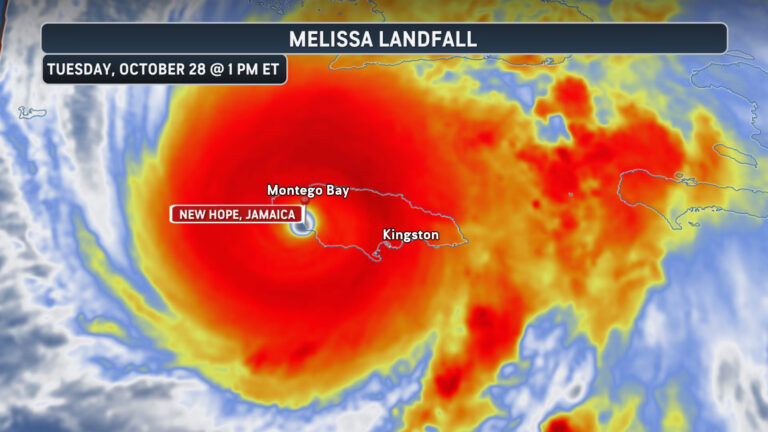
By then, Jamaica had endured Hurricane Melissa. On October 28, 2025, the storm inflicted an estimated US$8.8 billion in damages — roughly 41% of GDP. Infrastructure losses exceeded $130 million.
New revenue measures followed, including a $0.02 per ml Special Consumption Tax on sweetened beverages and the restoration of a 15% GCT rate for the tourism sector.
In a post-disaster recovery environment, retroactive political pay reads less like correction — and more like contrast.
Accountability vs Allegation
The administration maintains that higher compensation for political leadership was necessary to introduce formal job descriptions and performance metrics for parliamentarians, finalised in June 2024.
The argument is structural: if you want measurable accountability, you must formalise the job and compensate it accordingly.
But the Integrity Commission dispute complicated that narrative.
A Supreme Court case (SU2024CVO3844) has frozen certification of three years of financial declarations due to alleged nondisclosure of ownership in Imperium Holdings Limited. The Commission’s Director of Information and Complaints, Craig Beresford, filed a 76-page affidavit citing irregular banking activity and inter-company transfers.
The Prime Minister has characterised the investigation as a “weaponization” of oversight.
Regardless of legal outcome, institutional tension erodes public trust faster than policy reform can rebuild it.
The Labour Front
The Jamaica Teachers’ Association framed negotiations not as technical adjustments, but as a “fight for social justice.”
In February 2026, the JTA condemned a fraudulent social media claim alleging a 50% wage agreement had been reached — highlighting a breakdown in labour communication during an already sensitive fiscal period.
Meanwhile, the national poverty rate stood at 8.2% in 2023 — the lowest reported since 1989. Minimum wage had increased 158% since 2016, reaching $16,000 weekly by June 2025. Debt-to-GDP was projected at 69% by 2026.
These numbers complicate the narrative. Jamaica’s macro trajectory shows improvement. Yet economic data does not immunize governments from perception shocks.
Reform or Rebrand?
The Jamaica Public Sector Compensation Review was designed to fix a structural flaw in the civil service. That remains true.
It reduced 325 scales to 16. It eliminated 185 allowances. It increased transparency and pensionable income. It allocated $100 billion toward a long-term overhaul.
But politically, the reform became something else.
When citizens hear “performance-based accountability” while reading headlines about retroactive million-dollar packages during post-hurricane recovery, cognitive dissonance becomes political fuel.
The issue is not whether leaders should be paid competitively.
The issue is timing, transparency, and trust.
The 16-tier ladder may be rational.
But when the elevator appears to move faster than the stairs, the building gets noisy.
Open Questions That Remain
- What is the final legal resolution of Case SU2024CVO3844?
- How will “political performance” be measured in tangible terms?
- What specific condition of service item prevented full agreement in May 2024?
- How will new consumption taxes affect lower-income Jamaicans during recovery?
These questions will determine whether the Jamaica Public Sector Compensation Review becomes remembered as a structural reform — or as the moment administrative modernization collided with political optics.