FROM 4.5% TO 6.4%: THE US$1B BOND REFINANCE THAT FEELS LIKE NATIONAL CREDIT CARD DEBT
There are many ways to explain the Government of Trinidad and Tobago’s newly confirmed US$1 billion bond refinance.
You can explain it with charts.
You can explain it with investor jargon.
You can explain it with reassuring press releases about “strong demand” and “market confidence.”
Or you can explain it the way every household in Trinidad understands instantly:
This is what happens when you refinance debt later than you planned and the bank quietly raises the interest.
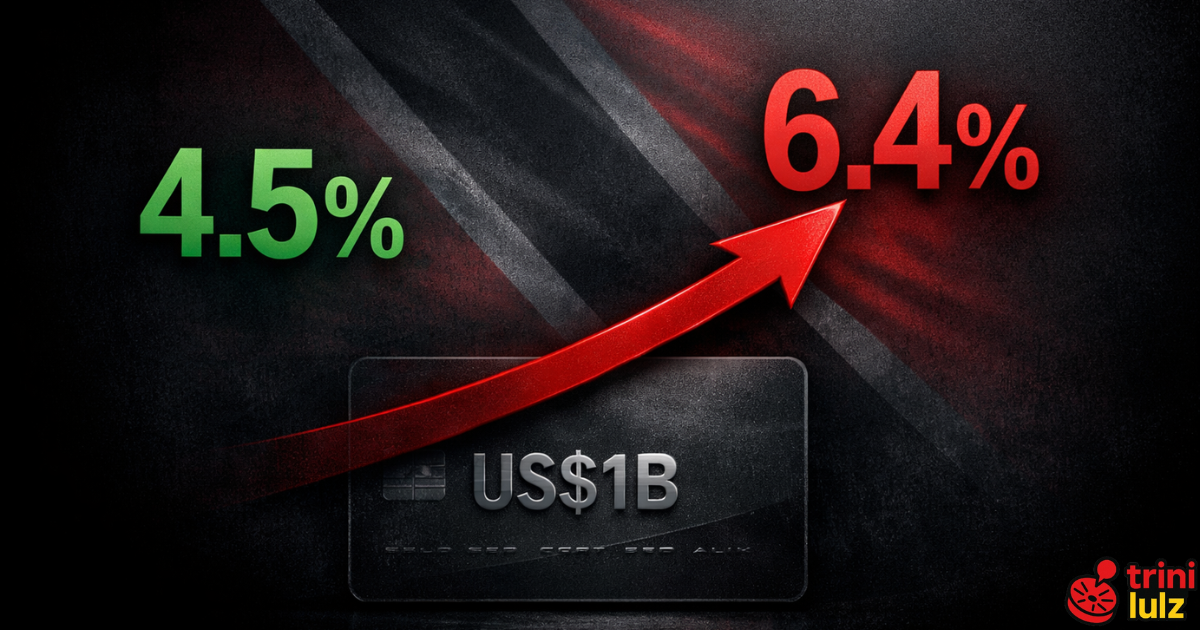
The Government has confirmed that it successfully issued a US$1 billion, 10-year bond priced around 6.4%–6.5%, with the main purpose being to refinance a 2016 bond that carried a 4.5% interest rate.
Same borrower. Same country. Same taxpayers.
Much higher bill.
The Bond Refinance, Explained Without the Spin
At its core, this bond refinance is simple.
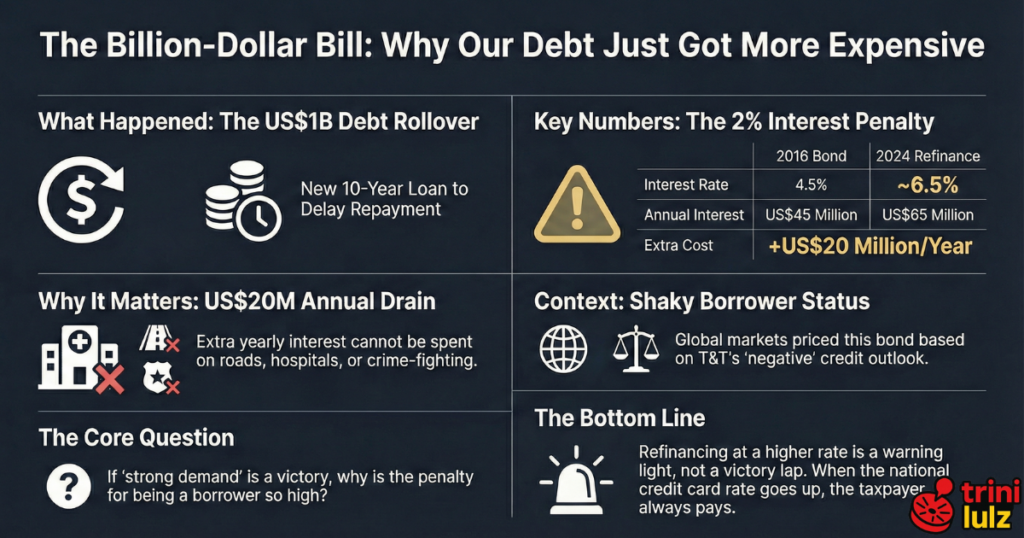
In 2016, Trinidad and Tobago borrowed money on the international market at about 4.5%, with repayment due in 2026. That bill is now coming due.
Instead of paying it off in cash, the Government has chosen to borrow again, using a new 10-year bond, and use that money to retire the old one.
This is not unusual. Governments do this all the time.
What is unusual is how much more expensive the replacement loan has become.
The new bond carries an interest rate roughly two full percentage points higher than the old one. On a US$1 billion loan, that difference is not abstract.
Even conservatively estimated, that is around US$20 million more per year in interest alone.
That money does not build roads.
It does not buy hospital equipment.
It does not reduce crime.
It services debt.
Why Is the Same Country Paying More?
This is where the story gets uncomfortable.
Globally, interest rates are higher than they were in 2016. The era of cheap money is over. The International Monetary Fund has repeatedly flagged rising debt-servicing costs as a growing risk for countries like Trinidad and Tobago, especially in a high-interest global environment.
But global conditions are only half the story.
Trinidad and Tobago is now borrowing with credit outlooks listed as negative, a red flag that investors take seriously and price aggressively—a concern we previously examined in detail when Moody’s revised the country’s outlook downward amid forex pressures and fiscal strain.
In simple terms, the country is being treated like a borrower whose finances look shakier than they did a decade ago.
And markets do not argue. They just price.
“Strong Demand” Doesn’t Mean “Cheap Money”
The Government has emphasized that the bond was oversubscribed, meaning investors wanted more of it than was available.
That sounds comforting. It also misses the point.
Oversubscription means investors were happy with the price they were offered. It does not mean the price was good for the borrower.
Plenty people are willing to lend you money at a high interest rate. That is not confidence. That is business.
The real test of confidence is whether you can refinance old debt without paying a penalty.
In this case, the penalty is baked into the interest rate.
The National Credit Card Effect
Here is where the analogy hits home.
Imagine refinancing your mortgage or credit card and discovering that, even though nothing about you changed overnight, the interest rate jumped sharply.
You did not buy a bigger house.
You did not get richer.
You just waited too long.
That is what this bond refinance feels like at the national level.
The debt did not disappear.
The bill got longer.
And the interest meter is now spinning faster.
Future governments will inherit this obligation. Future budgets will feel it quietly every year. And taxpayers will pay it invisibly through tighter fiscal space.
What This Means Going Forward
This bond deal does not mean the country is collapsing. It does not mean default is around the corner.
But it does mean the margin for error is shrinking.
Higher debt servicing costs reduce flexibility. They make every future budget harder. They turn policy mistakes into expensive ones.
Refinancing at a higher rate is not a moral failure. Sometimes markets simply turn against you.
But when it happens, it is a warning light, not a victory lap.
Because when the national credit card’s interest rate goes up, somebody always pays.
And it is never the bond traders.