The Most Dangerous Caribbean Islands for Tourists in 2026: Paradise, Panic Buttons, and the Places You Really Shouldn’t Freelance Your Common Sense
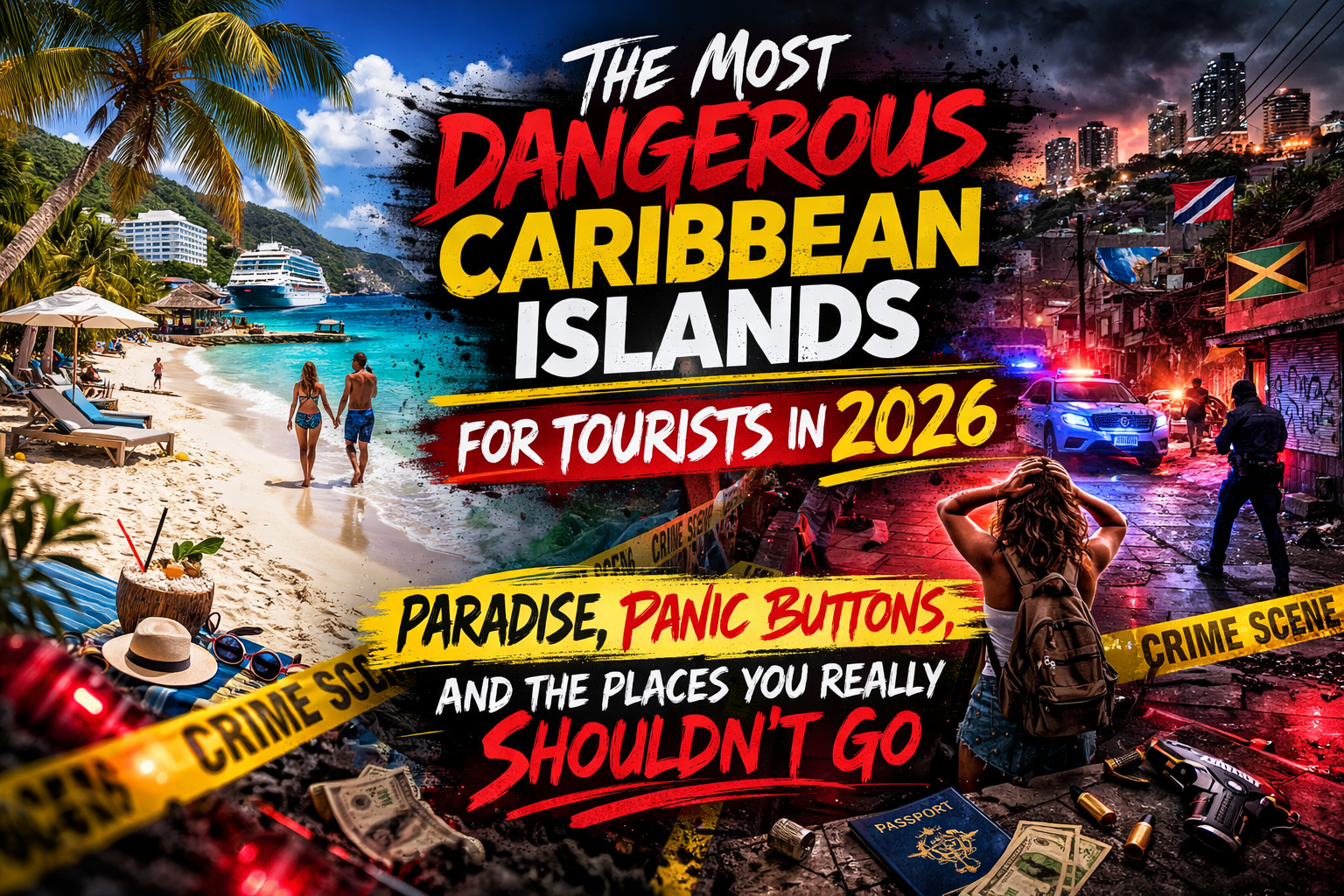
Paradise… With a Police Report Attached
The Caribbean is one of the most photographed regions on Earth. Turquoise water. White sand. Rum punches that taste like vacation itself.
But paradise occasionally comes with a police blotter.
Behind the Instagram glow lies a more complicated reality: some islands have managed to dramatically reduce violent crime, while others continue battling gang warfare, trafficking routes, and political instability.
For travelers in 2026, understanding the most dangerous Caribbean islands isn’t about fear, it’s about context. Crime in the region is highly uneven. Some destinations have risks concentrated in specific urban districts. Others face deeper national instability.
In fact, while Jamaica and the Bahamas saw major drops in murder rates in 2025, other parts of the Caribbean continue to experience significant security challenges linked to organized crime, firearms trafficking, and political collapse.
So where does that leave tourists?
Let’s rank the region honestly.
How We Ranked the Most Dangerous Caribbean Islands
Before anyone jumps into the comments section with pitchforks, here’s the methodology.
This ranking of the most dangerous Caribbean islands considers four factors:
- Recent homicide and crime statistics (see global data from the UN Office on Drugs and Crime)
- Official international travel advisories
- Whether crime is geographically concentrated or widespread
- How exposed tourists realistically are to the danger
A country with a high homicide rate but well-contained crime zones may actually be safer for visitors than a place where instability affects daily life nationwide.
Think of it like weather. Some islands have scattered showers. Others are hurricanes.
1. Haiti: A Category of Its Own
There’s dangerous.
And then there’s Haiti in 2026.
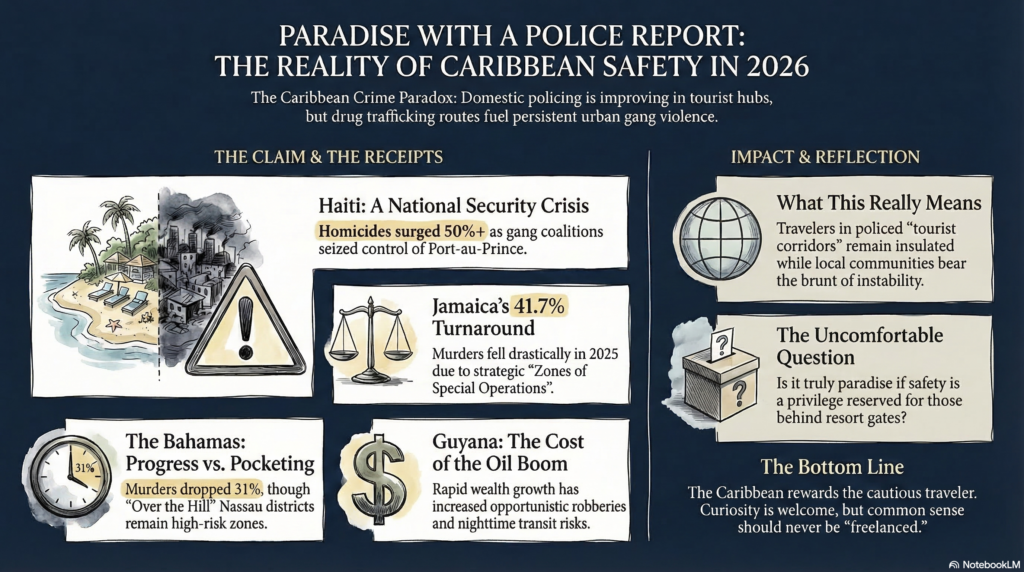
Gang coalitions now control significant portions of Port-au-Prince and surrounding regions. Kidnappings, road blockades, and armed clashes have turned parts of the capital into zones where the state’s authority barely exists.
The homicide rate surged more than 50% in recent years, according to regional security reports.
International travel advisories place Haiti in the “Do Not Travel” category due to crime, civil unrest, and kidnapping risks.
For tourists, the advice is simple.
Don’t go.
This isn’t about isolated crime hotspots or avoiding certain neighborhoods. The security environment itself is unstable.
“Haiti is not a typical tourism risk scenario. It is a national security crisis.”
2. Trinidad and Tobago:- High Crime, High Contrast
Trinidad and Tobago often surprises visitors.
The country boasts world-class Carnival celebrations, vibrant culture, and beautiful coastlines. But it also records one of the highest homicide rates in the Caribbean.
Violence is largely driven by gang conflicts and firearms trafficking linked to regional drug routes.
The key thing travelers must understand: crime is heavily concentrated in certain urban districts.
Areas often flagged by security advisories include:
- Laventille
- Sea Lots
- Beetham Gardens
- Certain sections of downtown Port of Spain at night
Tourists rarely wander into these areas accidentally. Most visitors stay within safer zones like:
- West Port of Spain
- St. Clair
- Maraval
- Tobago’s tourism belt
Still, opportunistic robberies and violent incidents do occur.
Avoid isolated beaches at night, don’t display jewelry openly, and use licensed transportation after dark.
3. Jamaica :— Dramatic Improvement, But Still Dangerous
Here’s the paradox.
Jamaica achieved one of the largest crime reductions in the region in 2025.
Murders fell 41.7% year-on-year, dropping to 666 incidents.
That’s a massive improvement.
But the country still carries one of the hemisphere’s highest homicide rates due to long-standing gang networks in specific urban communities.
The Jamaican government’s Zones of Special Operations (ZOSOs) have played a major role in stabilizing certain neighborhoods.
For tourists, risk is highly localized.
Areas visitors should generally avoid include parts of:
- Kingston inner-city communities
- Spanish Town
- Certain districts outside Montego Bay tourist zones
Meanwhile, Jamaica’s main tourism corridors of Negril, Ocho Rios, Montego Bay resorts have remained heavily policed and generally safe.
“Jamaica’s crime problem is real, but it is also extremely concentrated.”
4. Guyana :— Rising Wealth, Rising Crime
Guyana’s massive oil boom is transforming the country’s economy.
But rapid economic growth has also brought new security challenges.
Violent crime—including armed robbery and homicide—remains a concern in parts of Georgetown and along certain transit routes.
For visitors, the main risks come from:
- Nighttime travel in unfamiliar areas
- Cash robberies
- Opportunistic street crime
Tourists who stick to organized excursions and reputable hotels rarely encounter serious problems.
Still, Guyana’s crime rate places it among the more dangerous Caribbean destinations compared to tourism-heavy islands.
5. The Bahamas :— Safer, But Not Perfect
The Bahamas made major progress in 2025.
Murders dropped 31%, and overall crime fell roughly 15%.
That’s one of the most encouraging security trends in the Caribbean.
However, most crime still occurs in specific districts of Nassau, particularly south of Shirley Street, commonly referred to locally as “Over the Hill.”
Tourists staying in resort zones like Paradise Island are generally insulated from these areas.
Still, visitors should avoid wandering outside main tourist districts at night.
Jet ski scams, pickpocketing, and opportunistic robberies remain the most common problems tourists face.
The Caribbean Crime Paradox
The region currently sits inside a strange contradiction.
Local police forces in places like Jamaica and the Bahamas are achieving historic reductions in violence.
At the same time, drug trafficking routes across the Caribbean continue to fuel the illegal firearms trade, which drives gang violence in urban areas.
That means the Caribbean’s security environment is shaped by two opposing forces:
- Improving domestic policing
- Persistent transnational criminal networks
Tourists usually encounter the first.
Local communities unfortunately deal with the second.
How Tourists Can Stay Safe
Most visitors to the Caribbean will never encounter serious crime.
But common sense helps.
Practical rules include:
- Stick to well-known tourist districts
- Avoid isolated beaches after dark
- Use hotel-arranged taxis or licensed transport
- Do not flash expensive jewelry or large amounts of cash
- Avoid wandering into unfamiliar neighborhoods
In other words:
Don’t freelance your common sense.
The Bottom Line
The most dangerous Caribbean islands are not necessarily the ones tourists should fear the most.
Many destinations with troubling crime statistics still welcome millions of visitors safely every year because the risks are concentrated in specific communities.
The Caribbean remains one of the world’s most spectacular travel regions.
But like any destination, it rewards travelers who combine curiosity with caution.
Paradise is still paradise.
Just keep your eyes open.
For more destination guides, travel warnings, tourism updates, and plain-English Caribbean travel coverage, visit our Caribbean Travel hub.