Mia Mottley: The Caribbean’s Most Powerful Woman — Or Its Most Polished Political Paradox?
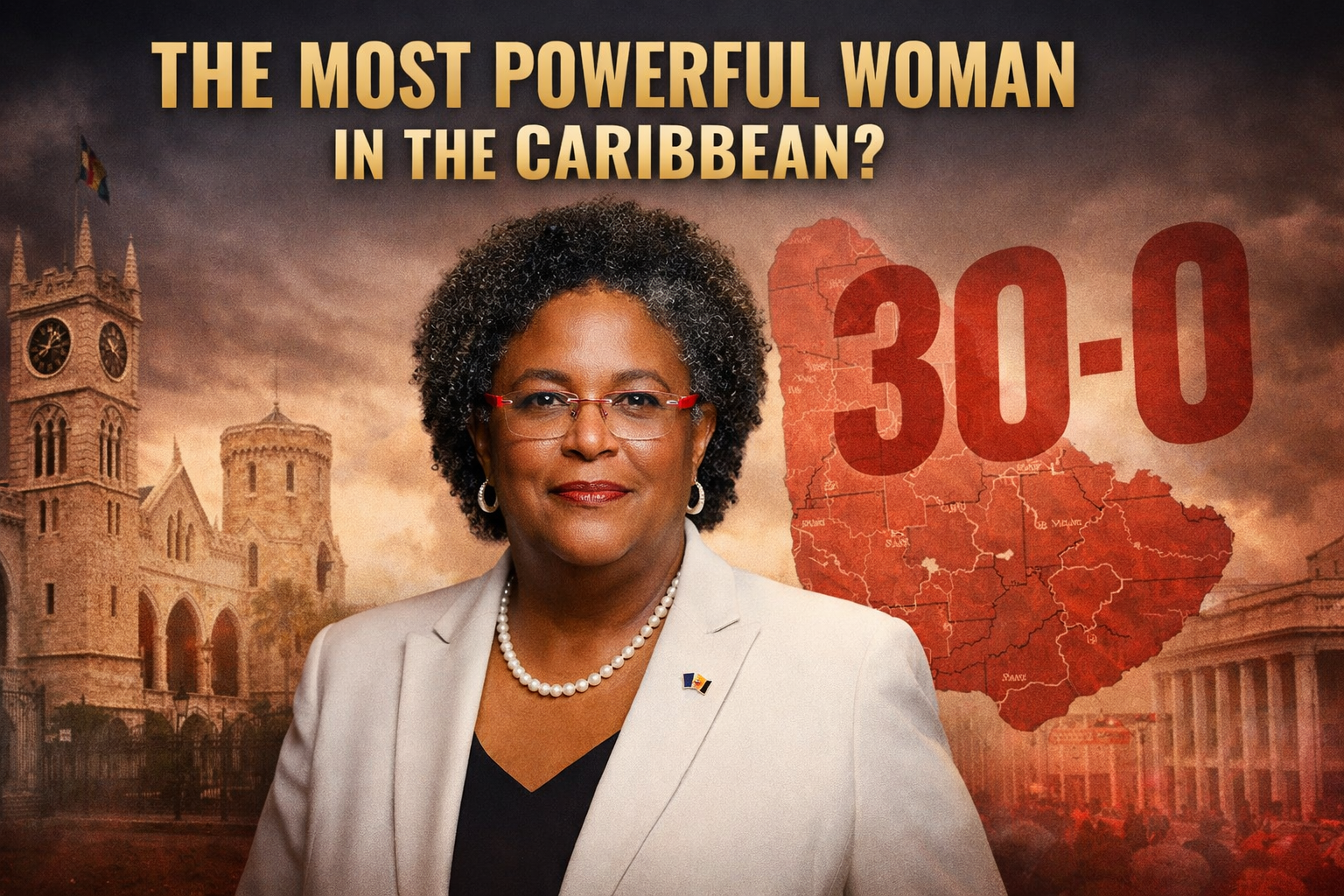
Barbados is a small island. Mia Mottley is not a small political figure.
In a region where many leaders struggle to command attention beyond their own shores, Mottley has done something extraordinary. She did not just become Barbados’ first female prime minister in 2018. She turned herself into one of the Caribbean’s most recognisable political exports, building a reputation as a fierce global advocate on climate finance, debt justice, regional integration and the unfinished business of colonial history. Then, in February 2026, she tightened her grip on domestic politics even further when her Barbados Labour Party pulled off a third straight clean sweep of all 30 seats in the House of Assembly.
That is where the fascination begins.
Because Mia Mottley is not just a success story. She is a contradiction wrapped in charisma, mandate and message discipline. She is the leader who helped remove the British monarch as Barbados’ head of state in 2021, completing the island’s transition to a parliamentary republic. She is also the leader critics accuse of pairing progressive symbolism with hard-edged fiscal discipline and top-down governance.
Mia Mottley and the Making of a Caribbean Colossus
Mottley’s rise has been years in the making. She entered Parliament in September 1994, led the Barbados Labour Party from 2008, and in 2018 became the first woman to hold the office of prime minister in Barbados after leading the BLP to a historic landslide. Official Barbadian government pages still list her as Prime Minister and Minister of Finance and National Security, a concentration of responsibility that says a lot about how central she is to the modern Barbadian state.
But her political mythology was not built on electoral wins alone. It was built on the image of a leader in a hurry.
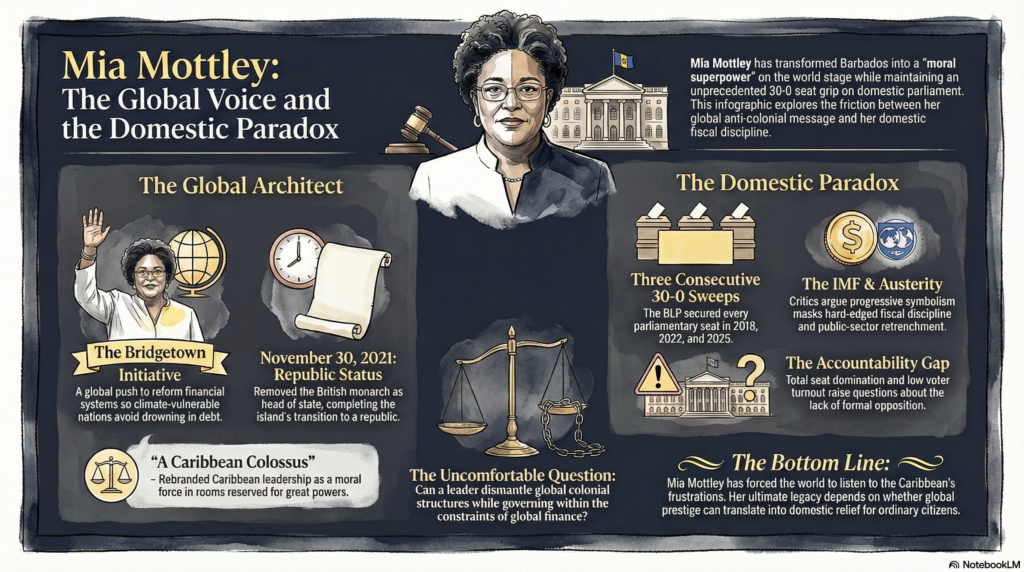
Mottley has consistently projected herself as a prime minister trying to drag Barbados out of inherited constraints, whether those constraints were constitutional, financial or psychological. The republic transition on November 30, 2021 was the boldest symbolic example. Barbados formally removed the British sovereign as head of state and installed Sandra Mason as its first president, turning a long-discussed constitutional ambition into reality. Mottley framed that moment as Barbados claiming its “full destiny,” and for many across the region it felt like more than a legal shift. It felt like a Caribbean country finally saying the quiet part out loud: political independence was never truly complete while the crown still sat at the top of the national architecture.
“Mia Mottley did not just run Barbados. She rebranded what Caribbean leadership could look like.”
That move gave Mottley stature. It told the world she was not content to simply administer Barbados. She wanted to redefine it.
From Barbados to the World Stage
If the republic cemented her place in Barbadian history, the Bridgetown Initiative is what turned Mottley into a global player. The initiative, launched from Barbados and championed by her administration, calls for urgent reform of the international financial architecture so climate-vulnerable countries are not left drowning under debt while richer nations preach resilience from a safe distance. Its argument is brutally simple: small island states did not cause the climate crisis, yet they are being asked to borrow at punishing terms to survive it.
That message has travelled.
Mottley’s speeches at the United Nations and other international forums have made her one of the most quoted voices from the Caribbean in global policy circles. In her 2021 UN General Assembly address, she famously invoked Bob Marley while demanding to know who would stand up for the rights of vulnerable people. In recent years she has continued pressing for reforms at institutions such as the IMF and World Bank, arguing that middle-income and climate-exposed nations need financing systems designed for survival, not punishment.
This is where Mottley’s influence becomes larger than Barbados.
She speaks not just as a Barbadian leader, but as a translator of Caribbean frustration. Debt vulnerability. Climate injustice. Colonial afterlives. Global rules written elsewhere. She has fused all of them into one political language and delivered it with the force of someone who knows the room cannot easily dismiss her.
And that matters in a region where too many leaders are heard politely and ignored quickly.
The Power, the Mandate, and the Uneasy Questions
Here is the part that makes the profile interesting instead of ceremonial.
Mottley’s dominance is now so complete that it raises uncomfortable democratic questions. The BLP’s third consecutive 30-0 sweep in the February 11, 2026 general election means parliamentary opposition has again been effectively wiped off the map. Supporters see this as proof of overwhelming trust. Critics see a danger in any political system where one leader and one party face so little formal resistance inside the legislature. Reuters reported that turnout in previous elections had been below 50 percent, a reminder that total seat domination does not automatically mean total national enthusiasm.
The second tension is economic.
Mottley’s international image is that of a climate justice warrior and anti-colonial moderniser. Yet her domestic record has long drawn criticism from voices who argue that her government’s economic management remains tied to austerity logic, IMF discipline, public-sector retrenchment and a style of adjustment that still asks ordinary people to carry too much of the burden. The IMF has praised Barbados’ reform programme for debt reduction, fiscal targets and macroeconomic stabilisation, including public debt declines in recent years. But critics have argued that this still looks like neoliberal housekeeping dressed in more sophisticated language.
That is the paradox at the centre of Mia Mottley.
She is trying to challenge the old world order while still manoeuvring through its institutions. She talks about justice, but governs inside constraints built by global finance. She speaks the language of emancipation, but some opponents insist the economic structure underneath has not been emancipated nearly enough.
“Mottley’s genius is that she makes Barbados sound like a moral superpower. Her challenge is proving that moral power always translates into relief at home.”
Why Mia Mottley’s Regional Influence Still Matters
None of that erases what Mottley has achieved. It sharpens it.
In an era of shallow politics and recycled talking points, she has managed to make Barbados feel consequential in rooms usually reserved for great powers and large economies. She has placed climate finance, reparatory justice, regional solidarity and sovereign dignity into the same conversation. She has also signalled repeatedly that Caribbean integration cannot stay a ceremonial slogan. Barbados’ move toward fuller CARICOM free movement implementation in 2025 reflected that wider belief that the region has to act more like a community and less like a collection of anxious little outposts.
And maybe that is why Mia Mottley remains so compelling.
She is not just governing an island. She is fighting over narrative. Over who gets to define seriousness. Over whether Caribbean leaders must remain local administrators or can become architects of global arguments. Over whether sovereignty means simply changing symbols or actually restructuring the terms on which small states live, borrow and survive.
That is why Mia Mottley is both admired and interrogated.
She is the Caribbean’s most polished political paradox because she embodies both breakthrough and contradiction at the same time. She is the republic-maker who still has to answer for economic pain. The climate reformer who must prove global applause can become local comfort. The dominant leader who has to show that overwhelming power does not become insulated power.
For now, one thing is beyond dispute: Mia Mottley has already forced the world to listen to Barbados. The harder question is whether history will remember her as the woman who transformed the Caribbean’s place in that world, or the woman who came closest.
For more rich lists, business power stories, elite profiles, and regional influence analysis, visit our Caribbean Power, Wealth & Influence hub.