Maloney Buildings Is T&T’s First Closed Area: Everything We Know About the Curfew and Permits
Maloney Buildings is T&T’s first reported closed area. Here’s what the 9 p.m. to 5 a.m. curfew, separate entry permits and police powers mean for residents.
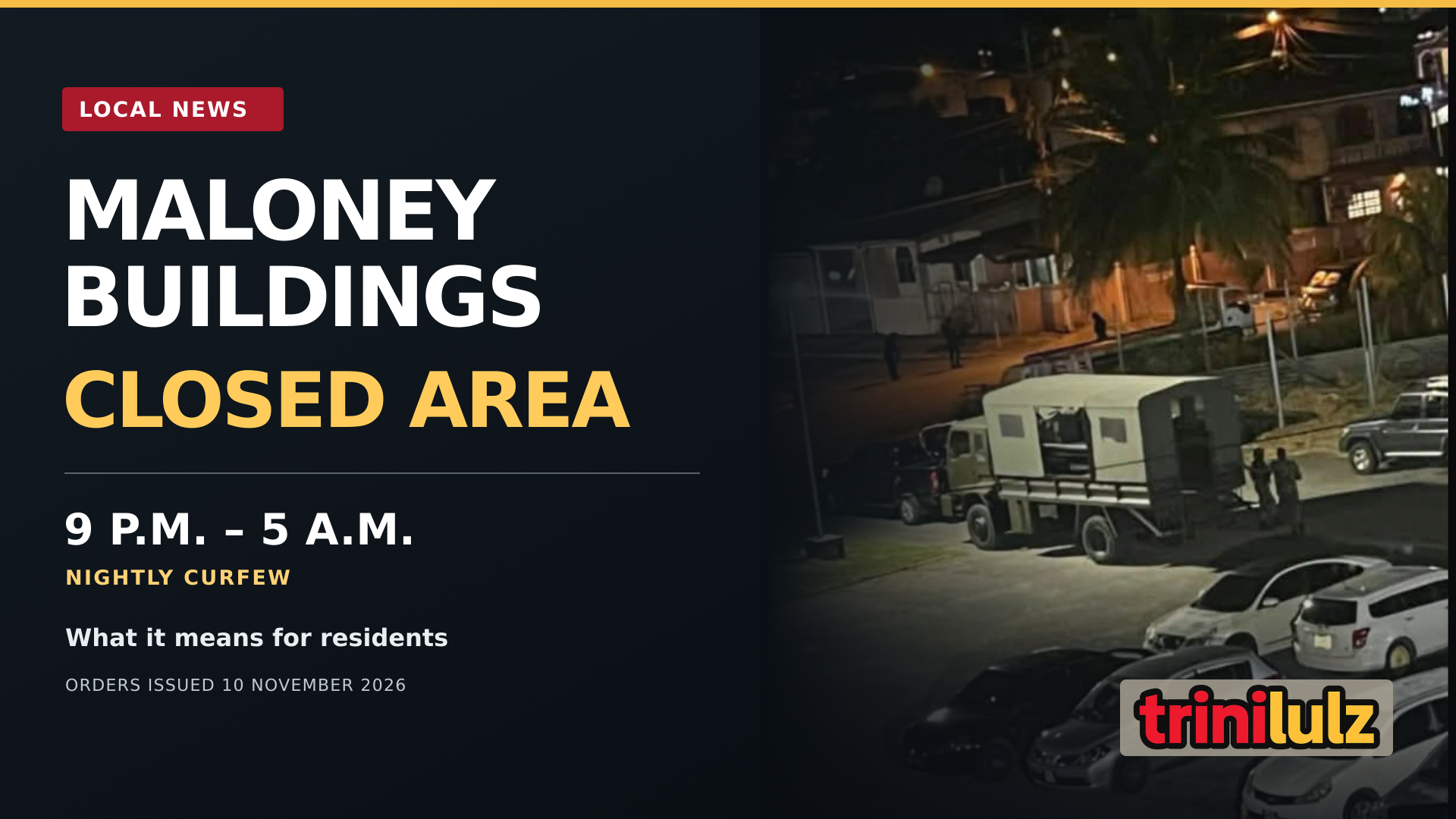
The Maloney Buildings Housing Development is the first reported closed area under Trinidad and Tobago’s Special Operations Act, 2026. Two orders dated Tuesday, November 10, put the development in Maloney Gardens under special restrictions and impose a nightly 9 p.m. to 5 a.m. curfew. The orders name the housing development within Policing District 2. They do not declare all of Maloney, or all of the policing district, a closed area.
The distinction matters to a resident trying to get home: the Maloney Buildings curfew governs when people must remain on their premises. A separate provision of the Act governs whether they can cross into or out of the closed area, including outside curfew hours. Here is what we know as of November 11 and what still needs a clear answer.
What happened, and why Maloney?
Monday, November 9: Guardian Media reported shootings in the Maloney Buildings community, including separate incidents on Monday. Those reports give the public some context for the operation. They do not establish which facts authorities relied on to make the declaration.
Tuesday, November 10: President Christine Carla Kangaloo made the closed-area declaration in Legal Notice No. 847. A second order, Legal Notice No. 848, set the overnight curfew. Guardian Media reported a heavy police presence and reports of roadblocks that evening. It also obtained a recording of a loudspeaker announcement telling people about the restrictions. Read the gazetted curfew order.
Wednesday, November 11: Residents were facing two sets of rules with different purposes. Trincity/Maloney MP Camille Robinson-Regis said on Tuesday night that people had contacted her unsure whether they needed permits simply to get home, and called for clearer communication. That is the MP’s account of what she was hearing from residents.
Section 11 of the Act requires reasonable grounds to believe public safety and peace are threatened by at least one of the listed conditions, including escalating violent crime, the prevalence of illegal weapons, or gang control or intimidation. It also requires a finding that ordinary policing cannot maintain or restore safety and peace in the area. The declaration states that the President was satisfied under section 11. The order does not list specific incidents or publish the underlying evidence. A separate statement of the specific grounds must be delivered to the Speaker within seven days of the order, for presentation to the House of Representatives. Read the enacted Special Operations Act.
Which restrictions apply, and when?
| Measure | What it means | When it applies |
|---|---|---|
| Closed area (sections 11–12) | Entering or leaving generally requires a permit, subject to statutory exemptions. | While the designation is in force, including during the day. |
| Formal cordon (section 13) | A cordon, if separately established, has its own boundary notice and entry or exit permit rules. | While the cordon is in effect. |
| Curfew (section 14 and Notice 848) | People within the designated area must stay on their premises unless exempt or authorised. | 9 p.m. to 5 a.m. nightly while the order is in force. |
The two November 10 orders do not give an end date. The President can revoke either, and the House of Representatives can annul either while it is in force, subject to the Act’s rules on repeat motions. The Act itself provides for two years in force from commencement on October 6, 2026. That is the duration of the law; it does not announce how long Maloney’s curfew or closure will last.
Can residents get home after work?
Section 12 generally requires a permit to enter or leave a closed area. It does not give residents a blanket exemption. Section 14 governs movement outside one’s premises during curfew. A night worker who lives inside the development may therefore need authorisation to cross the boundary and to be outside during curfew. Anyone relying on a permit needs to know what movement it covers and at what times. An employer’s letter or proof of address may help explain the trip, but the Act does not make either document a permit.
The Commissioner of Police can issue permits covering categories of people by Gazette notice. The Commissioner, Chief of Defence Staff or the relevant head of operations or military assistance can also issue individual permits under the applicable provision. Section 24 requires arrangements for both paper and electronic applications. That establishes how applications must be accommodated under the law. It does not tell residents which office or website is handling Maloney requests, what documents to bring or when to expect a decision.
The Act lists exemptions for specified officeholders and judges, and for police and Defence Force personnel on duty or travelling to or from duty. The orders reviewed do not set out a general exemption for residents, private-sector shift workers, carers or delivery drivers. The law provides for a TT$50,000 fine and one year’s imprisonment on summary conviction for specified breaches, including unauthorised entry or exit and breaching a curfew order. A permit’s conditions also matter.
What the law allows officers to do
Roadblocks and cordons. A Head of Special Operations can use barriers or roadblocks to close the designated area. A formal cordon under section 13 has its own notice requirement: the notice must state the boundaries and requirements, be published and prominently displayed, and appear in the Gazette within three days of issue. Reports that officers were blocking roads on the first night do not, by themselves, establish the terms or boundaries of a formal section 13 cordon.
Searches. Under section 15, an officer carrying out a special operation can search a person, vehicle or place in the area without a warrant where there is reasonable suspicion of an offence that has occurred, is occurring or is about to occur. The officer in charge must take reasonably practicable steps to let the person responsible for a place or vehicle, or their agent, attend and observe. The section provides for a list and receipt when property is seized. Living in the development does not by itself supply reasonable suspicion.
Detention and oversight. Section 17 requires the Head of Special Operations to be satisfied that reasonable grounds for suspicion exist. An arrested or detained person must be told why in a language they understand and brought before a magistrate as soon as reasonably practicable. A magistrate can order up to 48 hours of remand before High Court review; a judge may order further detention if the statutory test is met. Section 21 requires body cameras as far as resources allow. The law sets these safeguards; the initial reports do not establish how consistently they were used on the first night. Read our earlier explainer on the law and your rights.
What law-abiding residents are being asked to absorb
An eight-hour nightly curfew can affect an entire working day. A cleaner who starts before 5 a.m. or a restaurant worker who finishes after 9 p.m. may have to change shifts, find another ride or wait for a permit. Even during the day, a trip to school or work can become harder if the rules for crossing the boundary are unclear. Families arranging school drop-offs, home nursing or help for an older relative need to know what applies to the person coming in as well as the person living there.
Small businesses can also lose evening sales or have trouble getting stock and deliveries. In an apartment complex, residents need clear instructions about shared spaces such as car parks and corridors. These are foreseeable consequences, not verified accounts of individual losses or enforcement decisions. The cost falls on people who still have to earn a living and care for their families while the operation is underway.
For an emergency, the ordinary emergency numbers remain 811 for an ambulance, 990 for fire and 999 for police. The public orders reviewed do not explain how responders, a caregiver or a resident leaving for urgent treatment would be handled at the boundary. Residents need that procedure in advance.
What remains unanswered
As of November 11, the public material reviewed for this story did not verify a Maloney-specific permit desk or online form, processing hours, a category permit covering ordinary residents or shift workers, a detailed public boundary map, or an end date. The TTPS directory lists the Maloney Police Station at 646-6504 and 642-2054 for general contact; neither number is confirmed here as a dedicated permit line. Those gaps do not establish that no arrangements exist. They identify what residents need to see in writing, including whether a trip needs permission under more than one provision and where to go if access is refused.
The first test is whether the operation makes residents safer. The second is whether authorities can do that while allowing people to keep working, reach medical care and get home. Clear permit instructions, emergency procedures and a public explanation of why the restrictions remain necessary would give residents a way to judge both.
This explainer will be updated when official permit instructions, a change to the orders or the specific grounds for the declaration are publicly available.
Want the bigger picture? Explore our Trinidad Crime & Security hub for dashboards, explainers, updates, and deeper coverage of one of the country’s most urgent ongoing stories.