
THE HADEED FILES: FROM BLUE WATERS TO EMERGENCY POWERS
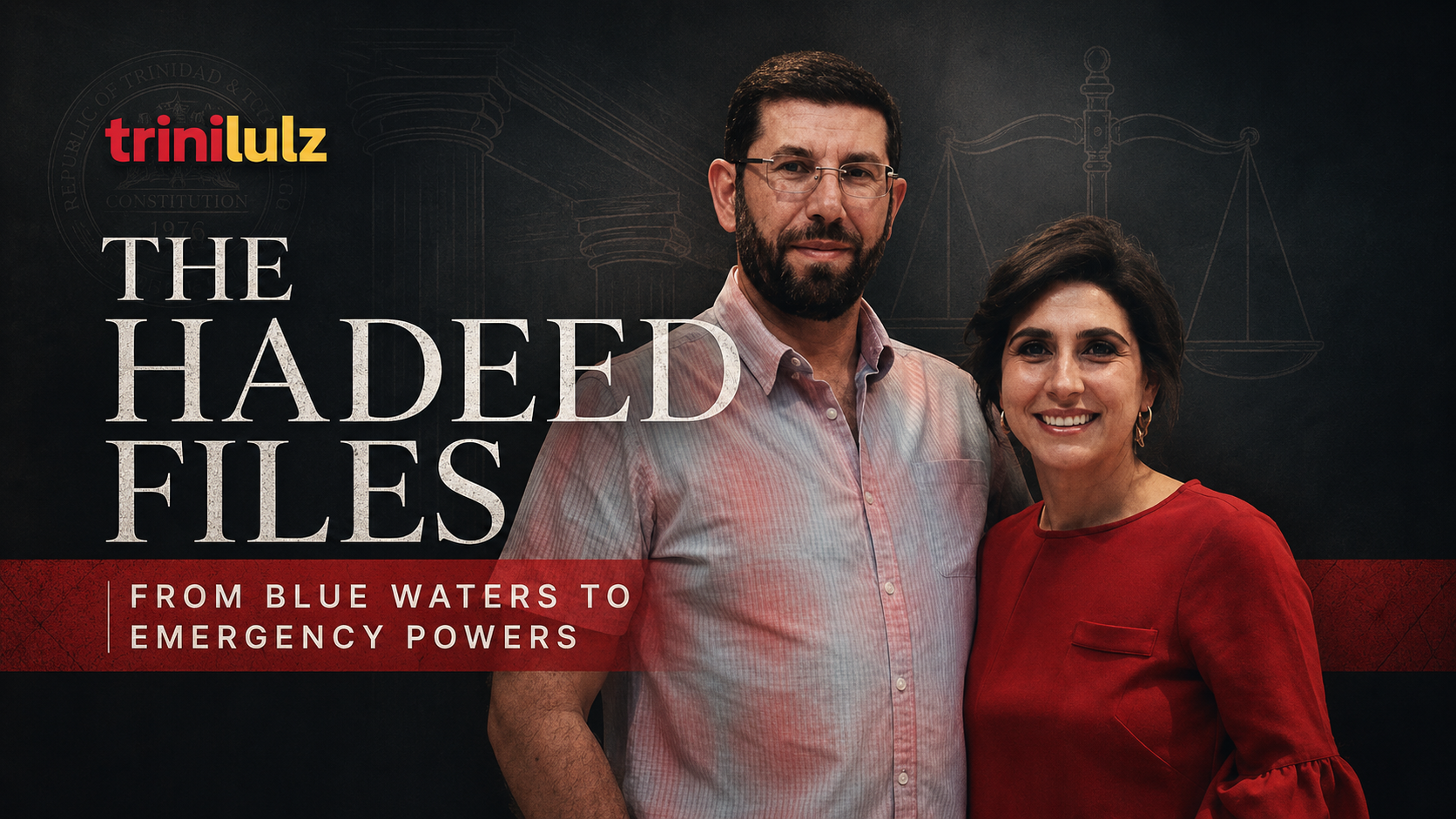
Everything publicly known so far about Dominic and Genevieve Hadeed—their businesses, community service, detention, Preventive Detention Orders, court challenge and the State’s decision to bring in British counsel.
UPDATE — JULY 26, 2026: Since this article was first published, Dominic and Genevieve Hadeed have been released from prison after Homeland Security Minister Roger Alexander revoked the Preventive Detention Orders issued against them. Alexander said their continued detention was no longer proportionate while the criminal investigation continues, citing legal, medical, constitutional and public-interest considerations. The minister also said the investigation remains active and has expanded beyond its original scope, including local and international law-enforcement cooperation.
This update also adds the Court of Appeal’s interim release order, the State’s Privy Council appeal, the SoE Tribunal recommendation, the revocation of the Hadeeds’ PDOs, and the emerging controversy over a leaked Sabga-Hadeed private conversation now central to the wider public debate.
In Trinidad and Tobago, a bottle of Blue Waters is about as ordinary as traffic on the Churchill-Roosevelt Highway.
The detention of the company’s founder, Dominic Hadeed, and his wife, Genevieve Hadeed, is anything but ordinary.
Within a matter of days, the Hadeed story travelled from early-morning searches and seized electronic devices to allegations of a conspiracy to murder, detention without charge under emergency regulations, an urgent High Court challenge and the State’s recruitment of one of Britain’s most senior government lawyers.
The public has consequently been presented with fragments: a police statement here, a court affidavit there, allegations contained in Preventive Detention Orders and political statements powerful enough to produce more heat than light.
This is the full story as it is publicly known so far.
Not what WhatsApp says. Not what party activists insist must be true. Not what social media has already tried, convicted or dismissed.
What is documented, what is alleged—and what Trinidad and Tobago still has not been told.
Who is Dominic Hadeed?
Long before the words “Preventive Detention Order” appeared beside his name, Dominic Hadeed was known primarily as the businessman behind Blue Waters Products Limited.
Hadeed attended Fatima College between 1986 and 1991 before earning a Bachelor of Science degree in Business Administration from Lynn University in Florida. Public profiles describe him as coming from a Syrian-Trinidadian family whose earlier business interests were concentrated in textiles and garments.
The idea for a bottled-water business reportedly began while Hadeed was at university. He later spent time in the family’s fabric business but believed changes in fashion, imports and consumer preferences would eventually weaken the traditional textile model.
In 1999, he stepped into a market that already contained dozens of water brands and established Blue Waters with 12 employees, one salesman, two trucks and approximately 800 square feet of operating space.
That gamble became one of Trinidad and Tobago’s most recognisable manufacturing success stories.
Blue Waters expanded through acquisitions and partnerships, including the acquisition of Aqua Pur in 2001 and a joint-venture arrangement involving the Pepsi franchise in Trinidad and Tobago. Its flagship Orange Grove facility, commissioned in 2008, has been estimated at approximately 250,000 square feet. The company eventually became one of the Caribbean’s largest bottled-water producers.
Hadeed’s publicly documented interests have also included Blue Waters St Lucia Limited, Fabric Land Limited, Domhad Investments or property companies and shareholdings in other businesses.
Industry leadership and recognition
Hadeed served on the board of the Trinidad and Tobago Manufacturers’ Association for seven years, including two years as president. At the time, his Fatima College Hall of Achievement profile described him as the youngest person elected to that position. He served as TTMA president from 2011 to 2013.
His documented recognitions include:
- EY Master Entrepreneur of the Year in 2015;
- induction into the Fatima College Hall of Achievement;
- a TTMA Excellence in Service Award in 2016;
- recognition connected to Blue Waters receiving Deloitte Best Managed Company status in 2019; and
- Blue Waters being named Manufacturer of the Year in the large-company category for 2022.
None of those achievements decides whether the allegations now being investigated are true. Accomplishment does not create immunity from investigation.
But background matters.
The person placed under emergency detention was not previously known to the public as an alleged underground figure. He was known as a manufacturer, former industry leader and the face behind a product found in groceries, offices, schools, hospitals, parlours and homes across the country.
That contrast is one reason the case exploded so quickly into national debate.
Genevieve Hadeed: charity, culture and community service
Genevieve Hadeed’s public profile has been less closely connected to corporate management and more closely associated with philanthropy and the Syrian Lebanese Women’s Association.
Before becoming its president, she reportedly served the organisation for six consecutive years in positions including cultural chairperson, social chairperson, corresponding secretary and vice-president. She was elected president in 2024, re-elected in 2025 and completed her term before Rosemarie Abed assumed the presidency in 2026.
During Genevieve’s period of leadership, the association reported distributing monthly food hampers, hundreds of school backpacks, baby-care packages, reusable menstrual garments and 1,800 Christmas hampers annually.
For 2024, the organisation said it contributed close to $1 million through feeding programmes, housing assistance, educational support and medical aid. In 2025, it reported more than $1 million in cash and in-kind support.
The association also marked its 75th anniversary under her leadership, celebrating an organisation that began in 1950 and grew into a body with hundreds of members and decades of charitable work.
Again, charitable service does not place any citizen beyond investigation. Neither should an allegation erase a person’s previously documented public contribution.
The full record requires both facts to exist at the same time.
The political backdrop: “the one per cent” and Teteron
The Hadeed detention did not occur in a political vacuum.
Trinidad and Tobago’s current State of Emergency began on March 3, 2026. The Government later sought and obtained an extension as the original period approached its June expiration.
During the parliamentary debate on that extension, Attorney General John Jeremie issued a pointed warning to wealthy and influential people whom he alleged may believe their status protected them from law enforcement.
Jeremie said infractions by powerful members of society should be treated no differently from criminal conduct involving poor communities. He referred to the so-called “one per cent,” warned that wealth would no longer guarantee protection and declared that Teteron awaited those who behaved like gang members.
He also referred to intelligence suggesting that more direct action may have been contemplated against him or the Prime Minister.
Those comments immediately became part of the public interpretation of what happened next.
Thirteen days after the parliamentary warning, police arrived at properties connected to Dominic and Genevieve Hadeed.
That proximity in time does not, by itself, prove that the detention was politically ordered. Homeland Security Minister Roger Alexander has denied political motivation and insisted that police intelligence led to the action.
But the timing created a perception problem the Government has been unable to avoid: first came the public warning aimed at wealthy citizens; then came the detention of one of the country’s best-known businessmen and his wife.
In politics, coincidence may be innocent. It is rarely quiet.
June 24: the searches begin
On June 24, police executed court-approved search warrants at locations connected to Dominic and Genevieve Hadeed.
The warrants, signed by High Court Master Valene Guerra-Abraham, were reportedly obtained by Corporal Eldon Calliste of the Special Branch. They identified an investigation into the indictable offence of conspiracy to murder under the Offences Against the Person Act.
The publicly reported warrants did not identify the alleged intended victim or victims.
Locations listed reportedly included properties at Orange Grove Estate in Trincity, Western Circle or Bayshore in Westmoorings and Golden Grove Road in Piarco.
Police seized electronic material that reportedly included mobile phones, laptops, flash drives, hard drives, portable storage devices and documents. Devices belonging to other family members were also reportedly taken during the operation.
Dominic and Genevieve were detained while the searches were carried out.
At that stage, the public had not been told that they were being held under full Preventive Detention Orders. The original operation appeared to be proceeding through an ordinary criminal investigation supported by judicially approved search warrants.
That distinction later became central to their legal challenge.
June 25: a third detention
The following day, police detained a 69-year-old Westmoorings businesswoman later identified in reporting as Genevieve’s maternal aunt, Star Sabga.
The TTPS initially described her only as someone assisting investigators. Sabga was subsequently reported as having also been placed under a PDO.
Her detention widened the investigation beyond the couple and intensified speculation about what information police believed they possessed.
Yet the State still had not laid a criminal charge.
From police custody to emergency detention
According to an affidavit filed by former attorney general Faris Al-Rawi, SC, in support of the Hadeeds’ initial court application, the couple was separated on the night of June 24.
Dominic was taken to the Carenage Police Station, while Genevieve was held at Woodbrook Police Station.
Their lawyers claimed police initially indicated that an extension of detention had been obtained but specifically suggested it was not connected to a PDO or the Emergency Powers Regulations.
The legal team said that position appeared to change when Genevieve produced a notice extending her detention for seven days under Regulation 13(3) of the Emergency Powers Regulations. Dominic was reportedly served with a similar direction.
The defence’s argument was therefore not simply, “Our clients should be freed.”
It was that the couple had been detained through an ordinary criminal investigation and that emergency powers were invoked afterwards to prolong their custody. Their lawyers questioned whether a later emergency detention could cure any alleged defect in the original arrest or detention.
Police records later supplied to the court reportedly contradicted parts of the defence account by indicating that the couple had been informed that the Emergency Powers Regulations were being used.
That disagreement over what was said, when it was said and which law was being used was one of the reasons police station diaries became important to the case.
June 27: the Preventive Detention Orders
Full Preventive Detention Orders were issued against Dominic and Genevieve on Saturday, June 27, by Homeland Security Minister Roger Alexander under Regulation 14 of the Emergency Powers Regulations.
A PDO allows the State, during an emergency, to detain a person without first laying an ordinary criminal charge, where the authorised decision-maker believes detention is necessary for public safety.
It is an extraordinary power precisely because it moves the loss of liberty away from the normal sequence of charge, bail hearing and trial.
According to information placed before the court, the PDO against Dominic alleged that intelligence had identified him as being involved in a developing conspiracy to assassinate senior government figures or serving Members of Parliament.
It further alleged that, following statements made during the parliamentary debate, he used words suggesting people would be shot and possessed the money, influence, access and resources to facilitate organised criminal activity.
The PDO against Genevieve alleged that she participated in a conspiracy directed at members of the Government and made statements suggesting the deaths of the Prime Minister, government members or parliamentarians were required. It also alleged that she was associated with others involved in the supposed conspiracy.
These are grave allegations.
They are also allegations based on intelligence that has not been tested in a criminal trial or fully disclosed to the public.
As of July 1, neither Dominic nor Genevieve Hadeed had been publicly charged with conspiracy to murder, threatening the Prime Minister or any other criminal offence connected to the investigation.
The State says intelligence, not politics
Roger Alexander has rejected the suggestion that the detentions were political.
He said ministers could not simply instruct police to issue a PDO against a chosen individual and urged the public to allow investigators to conduct their work without trying the matter through social media.
Critics have responded that the regulations make the minister the official empowered to issue a PDO, even where police intelligence initiates the process.
That dispute is partly semantic and partly constitutional.
The police may gather and submit the intelligence. But the minister signs the executive order that authorises continued detention.
The question is therefore not merely whether a politician personally selected a target. It is what safeguards exist when a political office-holder is legally empowered to approve detention without charge.
The Hadeed case has dragged that uncomfortable question out of constitutional textbooks and placed it squarely in the public square.
The Hadeeds’ complaints about detention
The affidavit supporting the initial habeas corpus application also contained complaints about the conditions in which the couple was held.
Al-Rawi alleged that Genevieve was placed in a small, unsanitary cell at Woodbrook Police Station with poor ventilation, no proper bedding and inadequate toilet facilities.
Dominic, who was said to use a CPAP machine for sleep apnoea and an orthopaedic leg brace, was allegedly unable to operate the machine in his cell at Carenage because an electrical connection was unavailable.
These descriptions came from the Hadeeds’ legal case. They were not independent judicial findings that every detail had occurred exactly as alleged.
The State and prison authorities are entitled to answer those claims.
But conditions of detention matter even where allegations are serious. The State’s obligation to investigate threats does not erase its responsibility to treat detainees humanely.
Habeas corpus: the first court battle
The couple’s attorneys filed urgent habeas corpus proceedings against the Commissioner of Police.
Habeas corpus is a legal procedure requiring the State to justify why a person is being deprived of liberty. It is not a trial of the underlying criminal allegation. It tests whether detention is lawful.
Justice Frank Seepersad initially declined to order the Hadeeds’ immediate release and directed the Commissioner of Police to clarify the legal foundation for their continued detention.
After the PDOs were issued, the judge questioned whether the original habeas proceedings had become academic because the couple was now being held under a new legal authority.
Their lawyers were given access to police records and allowed time to determine how the challenge should proceed.
June 30: release refused, larger challenge remains
On June 30, Justice Seepersad dismissed the habeas corpus writs and refused to release the Hadeeds while they pursued a wider judicial-review challenge against the PDOs.
However, he permitted their lawyers to amend the proceedings so the legality of the Preventive Detention Orders could be directly challenged.
The judge reportedly found no obvious defect on the face of the orders at that preliminary stage. He separated any possible unlawfulness in the original arrest from the minister’s later decision to issue the PDOs.
In other words, even if the Hadeeds eventually establish that some part of their initial detention was unlawful, that would not automatically invalidate the separate emergency orders.
Justice Seepersad also reasoned that damages could compensate the couple if they later succeeded in proving unlawful detention. He considered the potential risk of releasing them greater if the intelligence on which the police and minister relied eventually proved accurate.
The Hadeeds were ordered to pay the police service’s legal costs for the proceedings heard to that point.
Because the judge had made preliminary findings, he agreed that the continuing judicial-review case should be transferred to another judge.
That distinction is essential:
The Hadeeds lost their request for immediate release. They have not yet lost the substantive judicial-review case challenging the PDOs.
The appeal did happen—and it reached the Privy Council
The article originally noted that a formal appeal had not yet been confirmed. That has now changed.
On July 16, the Court of Appeal ordered that Dominic and Genevieve Hadeed be released from detention and placed under strict house-arrest conditions while their constitutional challenge continued. The court order required them to remain at their Bayshore, Westmoorings home, surrender passports, firearms and communication devices, restrict communication and visitors, submit to police inspections and accept electronic monitoring if required.
But before the couple could be released, the State secured a stay from another Court of Appeal panel while it moved to the Judicial Committee of the Privy Council. The Privy Council case was formally listed as JCPC/2026/0066, with the Commissioner of Police, the Minister of Homeland Security, the Attorney General and PC Eldon Calliste as appellants, and Dominic and Genevieve Hadeed as respondents. The case was issued on July 21, 2026, as an Appeal as of Right.
According to subsequent reporting, the Privy Council declined to hear the State’s appeal on an urgent basis before its annual vacation period. That decision became important because, had the stay remained in place, the Hadeeds could have remained in prison while the emergency period continued.
Hours later, Alexander revoked the PDOs against the couple. Their lawyer Faris Al-Rawi, SC, said the revocation meant they were not under home detention and did not need permission from the Commissioner of Police for movement or visitors, although several legal issues about the original detention and the intelligence behind it remain unresolved before the courts.
The accurate position now is therefore:
The Hadeeds are no longer detained under PDOs, but the criminal investigation remains active and the legal questions raised by their detention have not disappeared.
The SoE Tribunal recommendation
Another major development came through the State of Emergency Review Tribunal.
According to appeal documents filed before the Privy Council, the tribunal reviewing Dominic Hadeed’s PDO recommended that his continued detention was not necessary or expedient in the public interest. The tribunal reportedly received written submissions on July 9, heard oral submissions on July 10 and made its recommendation on July 19.
However, the State’s filing said the minister asked the tribunal to reopen the process, arguing that reasons had not been given for the recommendation and that he had not been notified of the hearing of Hadeed’s submissions or given an opportunity to make submissions himself.
Alexander later cited the tribunal’s recommendation as one of the factors considered before he revoked the Hadeeds’ PDOs on July 23. He also referred to medical evidence concerning Dominic Hadeed’s health and the fact that the Privy Council would not hear the State’s appeal on an expedited basis.
That sequence matters because it shows the Hadeed case was no longer simply a question of whether the State could issue a PDO. It became a test of the whole emergency-detention machinery: the minister, the police, the courts, the review tribunal and the final appellate court.
Why did the State bring in British lawyers?
Hours after the ruling, it emerged that the State had retained two British barristers for the Hadeed proceedings.
Legal Profession eligibility orders admitted Sir James Raymond Eadie KC and Robert Stephen Strang to practise in Trinidad and Tobago specifically for Dominic Hadeed and Genevieve Hadeed v The Commissioner of Police and related proceedings.
The orders were signed by Attorney General John Jeremie after consultation with the Chief Justice.
A correction is important here.
The State did not hire two King’s Counsel.
Sir James Eadie is a King’s Counsel. Robert Strang is a practising British barrister but is not identified as KC by the Bar Standards Board.
Eadie is no ordinary overseas recruit. He is the United Kingdom’s First Treasury Counsel and is described by his chambers as one of Britain’s leading public and regulatory law advocates. His role includes involvement in some of the British Government’s most significant litigation.
Strang’s registered practice areas include public law, international work, commercial and financial services and professional negligence.
Their involvement tells the public at least one thing: the State does not consider this a routine detention case.
The litigation could test the boundaries of ministerial power, police procedure, emergency regulations, constitutional protection and the level of evidence necessary to justify executive detention.
When the State brings in Britain’s top government lawyer to defend three Trinidad and Tobago PDOs, the legal stakes have clearly moved beyond an ordinary station diary dispute.
What has not yet been publicly disclosed is the total cost of retaining the foreign legal team.
That figure should become part of the public record.
The impact on Blue Waters
While the court battle intensified, Blue Waters management held a company-wide meeting to reassure employees that operations, salaries and jobs would not be disrupted by Dominic Hadeed’s detention.
Chief executive Pradeep Subrian reportedly led the management response. Employees described the atmosphere as subdued but were told the company remained stable and would continue operating normally.
The company did not publicly address the substance of the allegations.
That is understandable. Blue Waters is neither the accused nor the investigating authority.
However, the case now affects more than three detainees. It touches employees, suppliers, customers, charitable organisations and a manufacturing brand that has operated for 27 years.
The legal process must be allowed to proceed without converting every worker, business associate or relative into a suspect by association.
Replace the timeline with this updated timeline
| Date | Publicly documented development |
|---|---|
| March 3, 2026 | Trinidad and Tobago enters a State of Emergency. |
| June 10–11 | Parliament debates extending the SoE. Attorney General John Jeremie makes controversial remarks about the so-called “one per cent.” |
| June 24 | Police execute warrants at Hadeed-linked properties and detain Dominic and Genevieve Hadeed during an investigation into an alleged conspiracy to murder government officials. |
| June 27 | Preventive Detention Orders are issued against the Hadeeds under the Emergency Powers Regulations. |
| June 30 | The High Court refuses immediate release but allows the wider challenge to the PDOs to continue. |
| July 9–10 | The SoE Tribunal receives written and oral submissions in Dominic Hadeed’s review. |
| July 16 | The Court of Appeal orders the Hadeeds released from prison and placed under strict house-arrest conditions. |
| July 16–18 | The State obtains a stay of that release order while moving to appeal to the Privy Council. |
| July 19 | The SoE Tribunal recommends that Dominic Hadeed’s continued detention is not necessary or expedient in the public interest. |
| July 21 | The State’s Privy Council appeal is listed as JCPC/2026/0066. |
| July 23 | The Privy Council declines to hear the State’s appeal urgently before its vacation period. |
| July 23 | Homeland Security Minister Roger Alexander revokes the PDOs against Dominic and Genevieve Hadeed. They are released. |
| July 25–26 | A leaked Sabga-Hadeed private conversation triggers calls for an independent investigation into the handling of intercepted or confidential intelligence material. |
What the public still does not know
For all the headlines, several of the most important questions remain unanswered.
Who precisely was allegedly targeted?
What words were allegedly spoken, in what setting and to whom?
Was either statement recorded, witnessed or intercepted?
What conduct, beyond alleged speech, does the State say advanced a conspiracy?
Which national security body produced the intelligence?
What independent verification occurred before the PDOs were signed?
Why were ordinary criminal charges not laid?
Were investigators still analysing seized devices when the emergency orders were issued?
How long does the State intend to hold the detainees without charge?
What will Sir James Eadie KC and Robert Strang cost taxpayers?
And most importantly: will the intelligence eventually become evidence capable of surviving a criminal courtroom?
These questions are not a declaration that the allegations are false.
They are the questions a democratic society must ask whenever the State removes a citizen’s liberty without first proving an offence.
The Sabga-Hadeed audio leak
The story has also expanded beyond the Hadeeds’ release.
A private conversation involving Star Sabga and Genevieve Hadeed has since become the subject of intense public debate after audio material referenced in an affidavit by Homeland Security Minister Roger Alexander entered the public domain. Reports say the conversation included harsh criticism of the Government, the Prime Minister and Attorney General John Jeremie, as well as violent political language that the State says corroborated intelligence about a wider alleged assassination plot.
Alexander’s affidavit reportedly said the material relied upon included statements and audio obtained from Sabga’s landline and Genevieve Hadeed’s mobile phone shortly before the arrests. That has opened a second and equally serious question: not only whether the words justified emergency detention, but how confidential intelligence material was obtained, handled and leaked into the public domain.
Opposition figures and former law-enforcement officials have since called for an independent investigation into the release of the recording, raising questions about the legality of the interception, who authorised it and whether intelligence systems were breached.
For now, the Sabga-Hadeed audio does not close the Hadeed story. It widens it.
The case is no longer only about two people detained under emergency powers. It is now also about surveillance, intercepted communications, intelligence leaks and whether national security powers are being used with enough transparency and accountability.
From blue bottles to constitutional boundaries
So where does the Hadeed story stand now?
Dominic and Genevieve Hadeed are no longer in prison under Preventive Detention Orders. They have not been publicly charged in connection with the alleged assassination plot. The State says the criminal investigation remains active. Their lawyers say major questions remain about the intelligence, the legal threshold for detention and the extent of the court’s supervisory role over emergency powers.
Star Sabga’s related detention and the leaked private conversation have now pulled the case into an even larger national debate about surveillance, intercepted communications and the handling of confidential intelligence.
That means the Hadeed case is not over.
It has simply moved from prison gates to constitutional ground.
And the question Trinidad and Tobago must still answer is bigger than one family, one business or one political argument:
If emergency powers can take away liberty before a charge is laid, how much must the State show before the courts, the detainee and the public can be satisfied that the power is being used lawfully?
Want the bigger picture? Explore our Trinidad Crime & Security hub for dashboards, explainers, updates, and deeper coverage of one of the country’s most urgent ongoing stories.