VOTE WITH YUH NOSE: Is the Garbage Collection Budget Being Weaponised Before Local Elections?
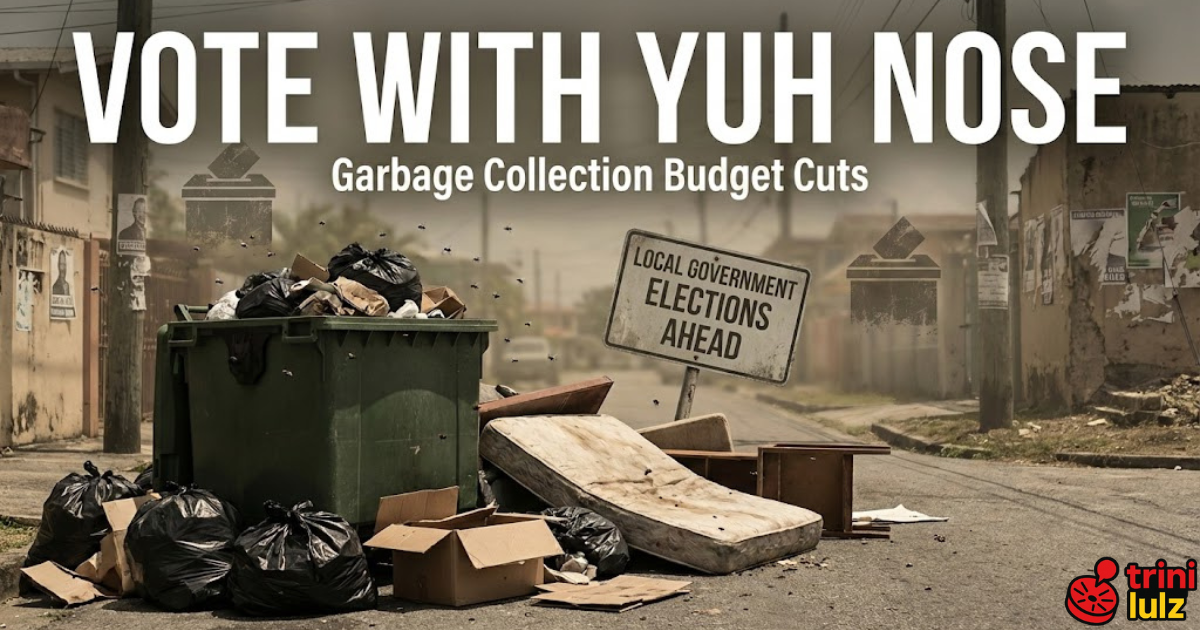
If you want to understand politics in Trinidad and Tobago, forget Parliament for a minute.
Forget press conferences.
Forget Facebook lives.
Just walk down your street.
If the bins full, the bulk waste still there, and the place starting to smell like something crawled under democracy and died, you might already be living inside the answer.
Because in fiscal 2026, garbage is no longer just garbage.
It is leverage.
When the Garbage Stops Moving, People Notice
Garbage collection is the most brutally honest public service.
You cannot spin it.
You cannot Photoshop it.
You cannot blame it on bad lighting.
When it works, nobody talks.
When it fails, everybody does.
That is why the Garbage Collection Budget matters more than any press release ever could.
And this year’s numbers are not subtle.
Under the 2026 budget crafted by the central government led by United National Congress, several major regional corporations saw deep, immediate cuts compared to 2025, when the budget was overseen by a People’s National Movement administration.
The sharpest reductions include:
- Port of Spain: –37.71%
- Diego Martin: –18.11%
- San Juan/Laventille: –16.92%
- Tunapuna–Piarco: –9.16%
These are not rounding errors.
These are operational gut punches.
The uneven pattern of reductions and increases has already drawn national attention, with independent reporting highlighting how regional corporations aligned with different political parties were treated very differently under the 2026 allocations.
You cannot cut a corporation budget by nearly 40 percent and then act shocked when garbage stops disappearing.
Cuts on One Side, Windfalls on the Other
At the same time that some corporations were being squeezed, others saw massive increases:
- Penal/Debe: +160.16%
- Chaguanas: +88.14%
- Mayaro/Rio Claro: +61.13%
- Sangre Grande: +57.42%
Nobody is arguing that those areas do not need resources.
The question is simpler and more uncomfortable:
Why are the cuts and increases falling so neatly along political control lines just months before local government elections?
This is where the smell starts to change.
This imbalance did not happen in isolation. It sits inside a wider fiscal narrative laid out in the 2026 national budget, which TriniLulz analysed in detail in our full breakdown of Budget 2026 and its promises, priorities, and political trade-offs.
The UNC PRO Claim, and Why It Falls Apart
As garbage complaints spread, a familiar talking point emerged from UNC representatives and surrogates:
PNM-controlled corporations are simply not collecting garbage. They are leaving the country in a mess.
It sounds decisive.
It also collapses under basic arithmetic.
Garbage collection does not run on vibes, loyalty, or political obedience. It runs on contracts, fuel, truck rentals, overtime, landfill fees, and payments to scavenging contractors.
When budgets are cut:
- Fewer contractor days are approved
- Fewer truck runs are scheduled
- Bulk waste collections are delayed or cancelled
- Backlogs pile up, visibly and quickly
This is not theory. It is how municipal sanitation works everywhere.
To suggest that corporations suffering double-digit budget cuts are choosing not to collect garbage out of spite asks the public to believe something extraordinary without evidence.
And extraordinary claims require receipts.
Starve the Service, Then Blame the Street
What the public is actually witnessing looks far more familiar.
You reduce the Garbage Collection Budget.
Service deteriorates.
Residents complain.
Then the same authorities responsible for the cuts point to the mess and say, “Look how badly that corporation is run.”
That is not governance.
That is narrative engineering.
Nobody had to sabotage anything.
The numbers did the work on their own.
If your street stinking, ask the budget before you ask the councillor.
Why Garbage Is the Perfect Political Weapon
Garbage hits every demographic.
It bypasses ideology.
It shows up at your gate whether you vote red, yellow, or stay home.
With local government elections approaching, few things generate faster anger than a missed collection day that turns into a missed week.
You do not need speeches.
You do not need legislation.
You just need fewer trucks on the road.
And the cuts ensure exactly that.
This Is Not About Party Loyalty. It Is About Math.
This article is not claiming that every UNC-controlled corporation will suddenly perform miracles, or that every PNM corporation is blameless.
It is saying something more basic and harder to argue with:
You cannot demand the same level of service after removing the money required to deliver it.
Budgets are policy.
Budgets are priorities.
Budgets tell the truth when speeches do not.
Right now, the Garbage Collection Budget is telling a story that smells a lot like electoral strategy.
So… Vote With Yuh Nose
You do not need a political science degree to understand this one.
You just need a working sense of smell.
As election season heats up, watch where the trucks go.
Watch where they do not.
Watch which areas are drowning in talking points and which are drowning in refuse.
Because when politicians argue, numbers whisper.
And garbage never lies.
This story is part of our wider Trinidad Politics Explained coverage. Explore the full hub for political analysis, key background, major controversies, and the latest updates.