Driving Just Got More Expensive: Legal Notice 471 Doubles Traffic Fines and Drops a $10,000 Penalty Bomb
If you thought January was just about new gym memberships and broken resolutions, think again. From January 1, 2026, drivers in Trinidad and Tobago will be operating under a brand-new price list, and it is not friendly to mistakes.
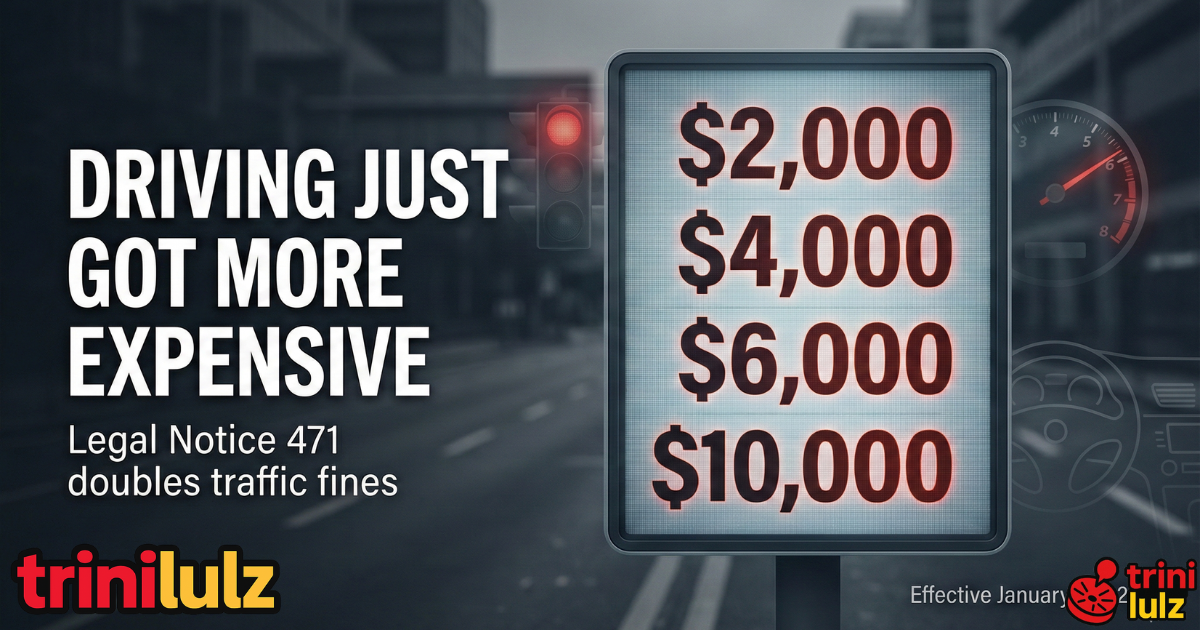
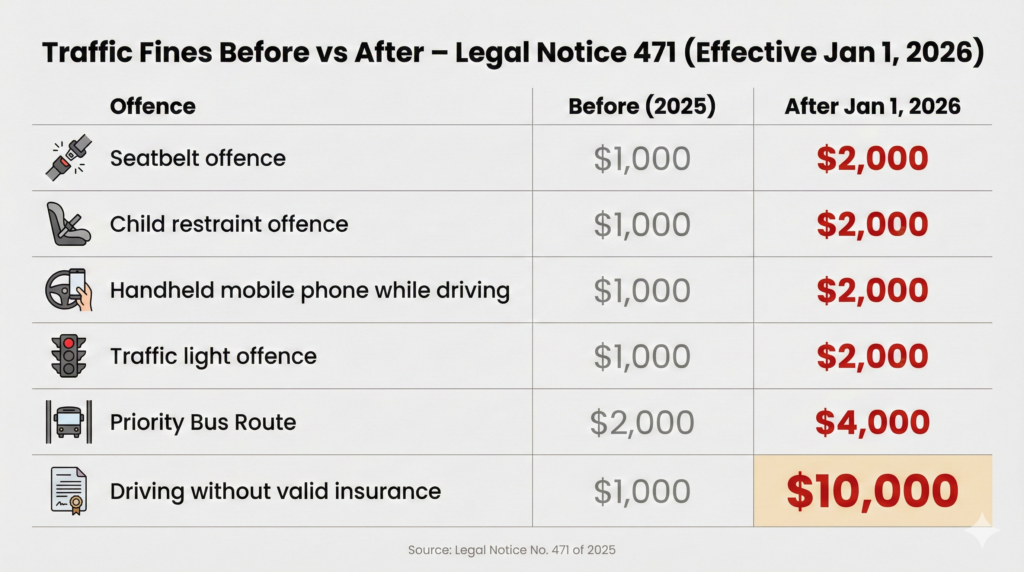
Buried quietly in the Christmas Day Gazette, Legal Notice No. 471 of 2025 does one simple but painful thing: it doubles traffic fines across a wide range of common offences and introduces a jaw-dropping $10,000 fixed penalty for driving without valid insurance.
No new crimes. No dramatic press conference. Just a recalibration of how expensive everyday driving errors are about to become.
And many drivers have no idea what’s coming.
What Legal Notice 471 Actually Changes
Legal Notice 471 amends the Ninth Schedule of the Motor Vehicles and Road Traffic Act. That schedule is the one that lists fixed penalties, meaning the amount you can pay instead of going to court (see the full text of Legal Notice No. 471 of 2025 here).
In plain English, this is not about new enforcement powers. It is about raising the price of being caught.
From January 1, a long list of offences that used to cost $1,000 will now cost $2,000. Several offences previously priced at $750 jump to $1,500. And some penalties leap far higher.
This is not inflation. This is a pricing reset.
Welcome to the “2K Club”
Here is where the shock really sets in. Many of the offences people commit without even thinking now land drivers squarely in what might as well be called the $2,000 club.
These include offences most motorists see daily:
- Seatbelt violations
- Improper use of child restraint systems
- Traffic light offences
- Using a handheld mobile phone while driving
Offences that once stung now bite hard.
For families already juggling insurance, fuel, maintenance, and loan payments, an extra $2,000 hit is not a small inconvenience. It is groceries. It is school supplies. It is rent.
Speeding Now Comes With a Price Ladder
Speeding penalties have also been restructured into a clear and unforgiving ladder. How far over the limit you go now directly determines how deep the damage runs.
The new fixed penalties are:
- $2,000 for minor speeding
- $3,000 for moderate speeding
- $4,000 for higher-range speeding
- $6,000 for the real flyers
That “just creeping up” excuse is about to get very expensive.
Speed limits did not change. The consequences did.
The Bus Route Fine Quietly Doubles
For drivers who occasionally risk the Priority Bus Route, here is the update nobody will enjoy.
The fixed penalty for driving on the Priority Bus Route jumps from $2,000 to $4,000.
That early-morning shortcut now carries the price of a small vacation, and enforcement officers will not need to argue. The number is already written into law.
The $10,000 Insurance Shock
Then comes the line item that changes the entire conversation.
Driving without valid insurance now carries a $10,000 fixed penalty.
Previously, that offence sat at $1,000. The jump is not incremental. It is explosive.
This move is clearly designed to force compliance. But it also means drivers with lapsed policies, administrative errors, or misunderstandings about coverage are stepping into dangerous territory.
No valid insurance is no longer a slap on the wrist. It is a financial collision.
Why This Matters Beyond Bad Drivers
Supporters will argue that tougher fines save lives and improve discipline on the roads. There is truth in that. But context matters.
Trinidad and Tobago is already dealing with:
- Rising cost of living
- High insurance premiums
- Vehicle maintenance inflation
- Increased fuel volatility
When traffic enforcement becomes significantly more expensive overnight, the impact is not theoretical. It lands directly on ordinary households.
This is not about reckless speed demons alone. It is about parents, workers, and commuters navigating roads that are often poorly marked, poorly maintained, and inconsistently policed.
January 1 Is the Real Deadline
Legal Notice 471 takes effect on January 1, 2026. That gives drivers time, but not much.
Before the year ends, every motorist should:
- Confirm insurance is valid and documented
- Ensure seatbelts and child restraints are compliant
- Mount phones legally or put them away
- Respect speed limits, especially in enforcement zones
Because once the calendar flips, excuses will not reduce the fine.
Legal Notice 471 Explained: How Trinidad’s New Law Doubles Traffic Fines in 2026
The Quiet Way Laws Get Loud
There is something distinctly modern about how this change arrived. No fanfare. No national debate. Just a legal notice published on Christmas Day that quietly reshapes daily life for hundreds of thousands of drivers.
The law does not need to shout. It just needs to be enforced.
And starting January 1, enforcement is going to be expensive.