UNC at One Year: More Taxes, More Pain, Less Prosperity
When people talk about UNC at one year, the real question is not whether the Government can point to a few technical wins on paper. The real question is whether ordinary people feel better off than they did on April 28, 2025. For many households, workers, small contractors and businesses, the answer looks painfully simple: no. One year after riding into office on a wave of anti-PNM frustration and hope, the UNC is heading toward its anniversary with a growing list of complaints tied to layoffs, weak growth, tax hikes, higher contribution burdens and a widening sense that relief never really arrived.
That is what makes this anniversary politically dangerous. Governments do not get judged by manifestos after twelve months. They get judged by the grocery bill, the job market, the number of people quietly falling behind, and whether the country feels like it is moving or dragging. On those tests, the first-year review is looking less like a honeymoon and more like a hard slap of reality. Even where the Government can claim progress, such as Trinidad and Tobago’s removal from the EU tax blacklist in February 2026, the official wording itself makes clear that this was the result of several years of sustained engagement and reform work, not some miracle produced overnight by a new Cabinet.
The jobs story is where the trouble starts
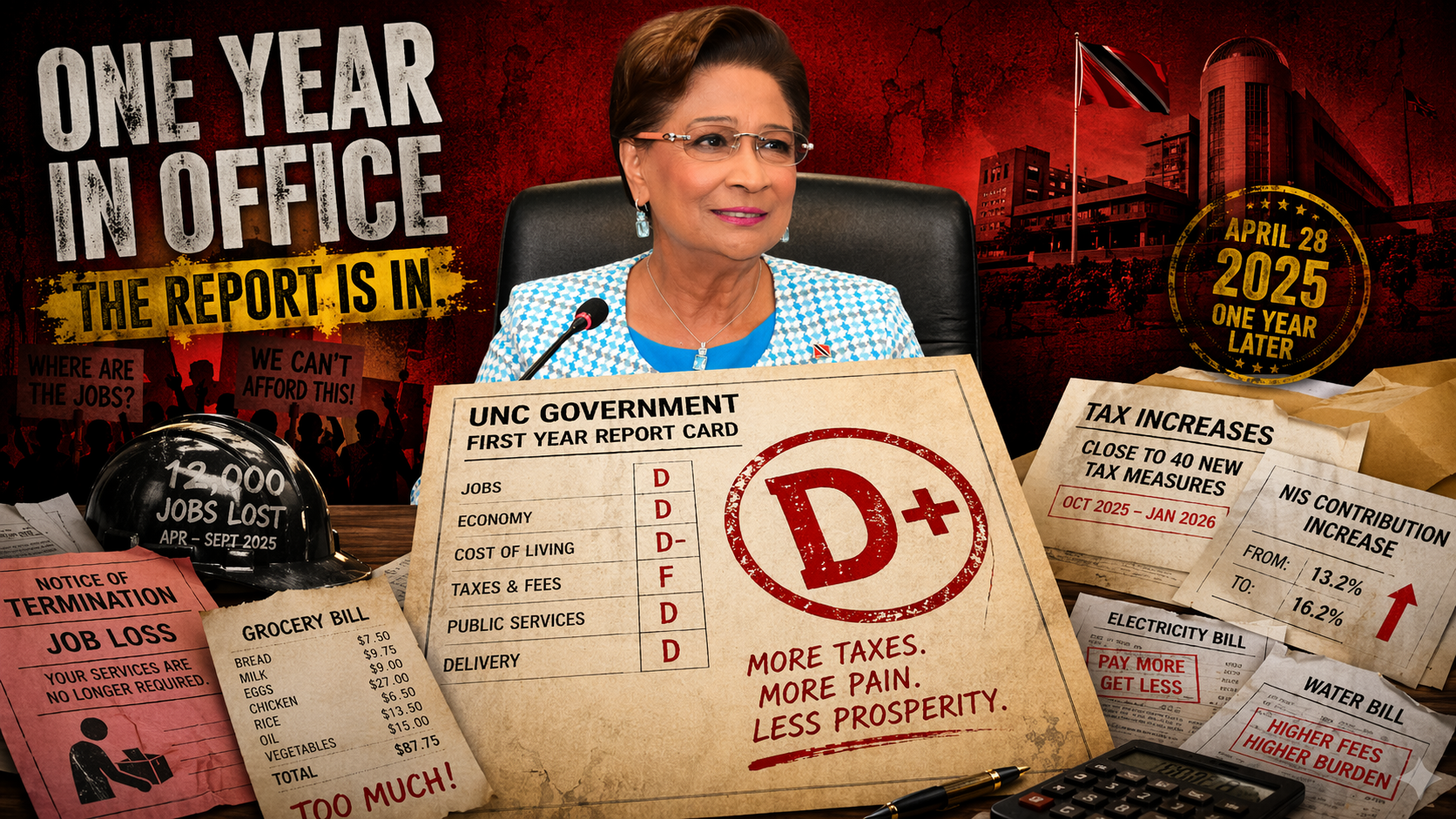
If a government wants applause at its one-year mark, it needs a jobs story. Instead, the UNC has spent much of its first year surrounded by headlines about people losing work and scrambling for scarce openings. CSO data cited by Guardian and CNC3 showed 12,000 job losses between April and September 2025. In June 2025, Newsday reported that the termination of CEPEP contracts left roughly 360 contractors and more than 10,500 workers without employment. Guardian also reported economist concerns that URP and CEPEP cuts could damage both communities and the wider economy.
That matters because this was not some abstract spreadsheet exercise. In Trinidad and Tobago, make-work programmes and temporary jobs may not be glamorous, but they keep food in kitchens, rent paid, children in school and village economies breathing. Strip away thousands of those incomes without quickly replacing them, and you do not just create unemployment. You create anger, anxiety and a visible feeling of abandonment. The Guardian opinion piece that inspired this article argues that the promised recruitment push badly underdelivered against expectations, and the wider reporting supports the broader point that far too many people are still waiting for the “everybody win” part to begin.
“A government cannot celebrate one year in office when too many citizens spent that year hunting for work that never came.”
UNC at one year and the economy still feels stuck
The Government can argue that economic turnarounds take time. Fair enough. But first-year public opinion rarely waits for a PhD dissertation on structural lag. People judge what they can see. And what they can see is an economy that still looks painfully sluggish. The IMF’s 2026 Article IV mission estimated Trinidad and Tobago grew by just 0.8 per cent in 2025 and projected growth of 0.7 per cent in 2026, calling near-term growth “subdued.” S&P also revised the country’s outlook to negative in September 2025 while affirming the rating, flagging ongoing fiscal and diversification weaknesses.
Local business sentiment does not exactly sound like a victory parade either. The TT Chamber and Arthur Lok Jack Global School of Business said in their Q4 2025 Business Outlook Index that 54 per cent of executives reported worsened financial performance over the previous six months. The Chamber described the private sector as facing short-term strain and ongoing economic pressures, while Newsday’s economic review said the economy had contracted in both the energy and non-energy sectors during the first quarter of 2025 and continued to struggle with forex shortages and structural pressures.
This is where the political optics get ugly. A government can survive tough numbers if citizens feel pain today for payoff tomorrow. But right now the public mood is not “we tightening belt for a brighter future.” It is closer to: “We tighten the belt, and allyuh tighten it again.”
More taxes, more fees, more squeeze
Nothing poisons goodwill faster than people feeling poorer under a government that promised relief. Guardian reported that from October 13, 2025 to January 1, 2026, the UNC administration implemented close to 40 tax measures, including higher fines and fees meant to raise billions. Around the same period, National Insurance contributions increased from 13.2 per cent to 16.2 per cent, effective January 5, 2026, with Guardian reporting that employees would pay roughly 22 to 23 per cent more in contributions under the adjustment.
That is the part the average citizen understands without reading a single budget appendix. More is coming out, but life does not feel easier. And the strain is not just at the household level. Guardian reported this week that regional corporations are seeking mid-year relief because they are under pressure to pay new salaries and higher NIS contributions. In the health sector, Guardian also reported a nurses’ sickout tied to staffing and pay disputes, another sign that frustration is spreading inside the machinery of the state itself.
Even the Government’s better headlines need context. Yes, the EU tax blacklist removal is a positive development. But the Finance Ministry’s own release said it reflected several years of sustained commitment, constructive dialogue and cooperation with EU authorities. In other words, UNC can take a photo with the trophy, but it cannot honestly pretend it built the entire stadium in nine months. That process was underway before the change in government.
“Trinidad and Tobago did not vote for a new government just to get a new set of people collecting more from a struggling population.”
One year later, the grade is negative
So what is the verdict? In pure Trini language: plenty speech, too little relief.
The UNC inherited real problems. Nobody serious can deny that. The PNM left behind economic fatigue, distrust and structural headaches that were never going to disappear in a few Cabinet meetings. But a first year is still a first year, and governments must be judged on whether they made daily life feel more hopeful, more secure and more prosperous. On that score, the ruling party is in trouble. The first-year picture is dominated by job losses, weak growth, business unease, tax-and-fee pressure, higher NIS contributions and growing complaints from workers and institutions.
That is why the fairest rating for UNC at one year is a negative one. Not because every single development has been a failure. Not because there were no inherited messes. But because after twelve months in office, the broad public feeling is not prosperity. It is pressure. And if a government wins power promising that everybody will finally get a chance to breathe, but one year later the country feels like it is paying more, waiting longer and worrying harder, then the report card writes itself.
This story is part of our wider Trinidad Politics Explained coverage. Explore the full hub for political analysis, key background, major controversies, and the latest updates.