Why Is Trinidad and Tobago Crime So Hard to Fix? The Brutal Truth Nobody Wants to Say
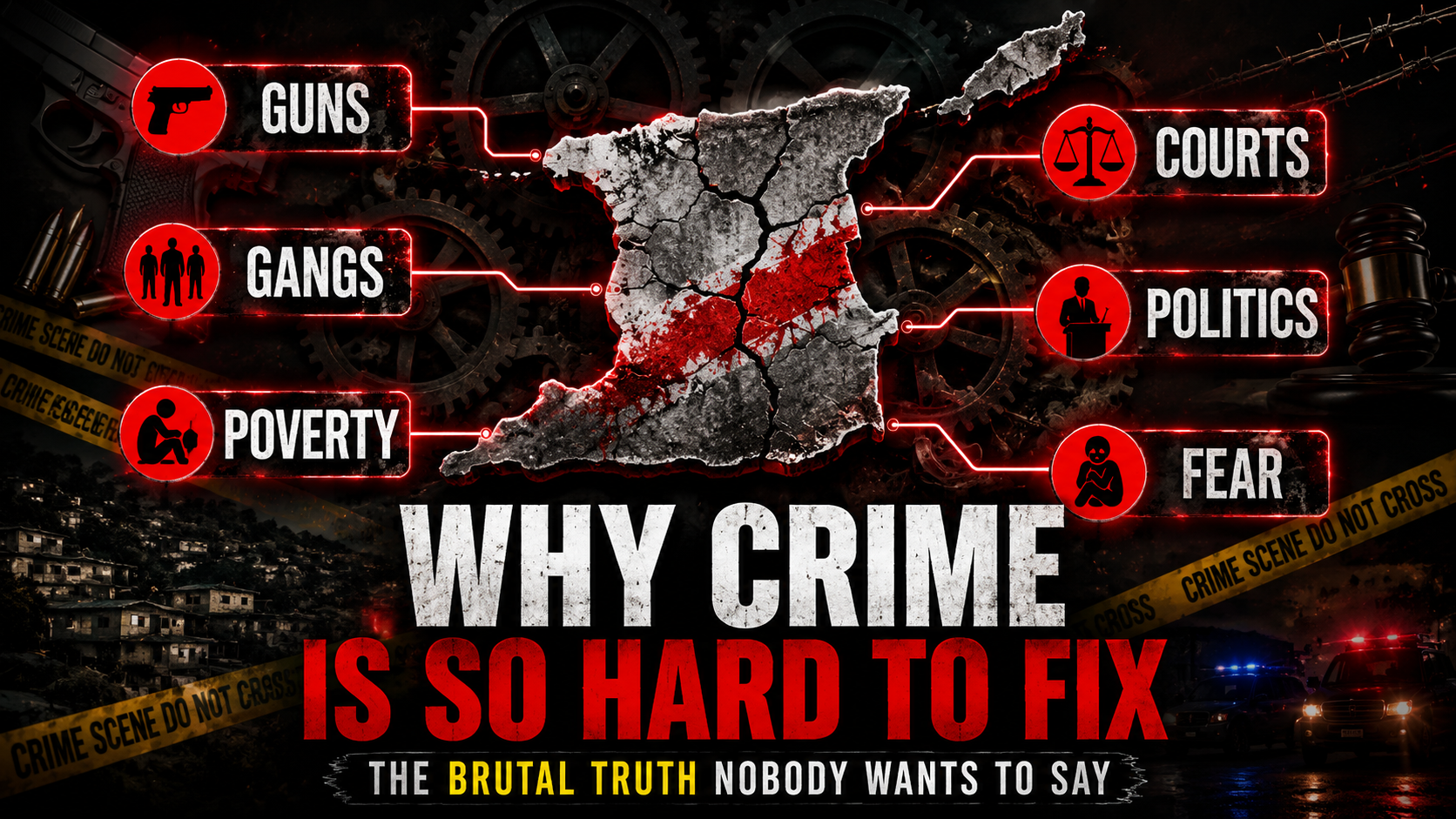
Why Trinidad and Tobago Crime Feels Impossible to Fix
Every few years, Trinidad and Tobago is told the same thing: the police have a plan, the army is ready, the Government is serious, the criminals must be afraid, and “this time” things will be different.
Then another family is shattered. Another community is locked down. Another child becomes a headline. Another mother cries into a microphone. Another minister promises action. Another commissioner gives statistics. And the country asks the same tired, angry, frightened question:
Why is Trinidad and Tobago crime so hard to fix?
The brutal answer is this: Trinidad and Tobago does not have one crime problem. It has a whole crime machine.
And that machine is fed by guns, gangs, slow justice, political theatre, weak institutions, broken communities, fear, silence, poverty, corruption, and a national addiction to short-term solutions.
Police can arrest people. Soldiers can patrol streets. Governments can declare States of Emergency. But none of that, by itself, fixes a society that keeps producing the conditions for violence faster than the State can contain them.
Trinidad and Tobago keeps treating crime like a police problem, when it is really a national systems failure.
The Numbers Can Drop, But the Fear Remains
There is no denying that murder figures can move up or down from year to year. According to Newsday, Trinidad and Tobago recorded 369 murders in 2025, down from 626 in 2024, a 42 per cent decline and reportedly the lowest murder figure since 2014. But the same report noted that the murder detection rate rose only from 15 per cent to 20 per cent. That means even in a year of improvement, the deeper accountability problem remained glaring.
That is why citizens remain uneasy even when the statistics improve. A lower murder count is welcome, but if people still believe killers can escape justice, then fear does not leave the country. It simply waits for the next headline.
Crime is not only measured in bodies. It is measured in cancelled plans, early curfews, parents tracking children by phone, businesses closing before dark, communities refusing to talk to police, and citizens feeling that the State is always reacting after the damage is done.
A country can celebrate a decline in murders and still be trapped in a crime crisis if the systems behind the violence remain untouched.
We Keep Asking Police to Fix What the Whole Country Broke
The easiest thing to say after every killing is: “Where were the police?”
It is a fair question. Law enforcement has a duty to protect citizens, investigate crimes, disrupt gangs, seize illegal weapons, and bring offenders before the courts. But Trinidad and Tobago has placed an impossible national burden on the police.
Police are being asked to fix what schools did not catch, what social services did not reach, what border security did not stop, what families could not manage, what the courts did not process, what prisons made worse, and what politics ignored for decades.
That does not excuse failure. It explains why the problem is bigger than patrol cars and press conferences.
A police service can arrest a gang member. It cannot, by itself, prevent the next neglected child from becoming a recruit. It can seize a firearm. It cannot, by itself, shut down the international supply chain that brought that firearm into the country. It can charge a suspect. It cannot, by itself, make the justice system move quickly enough to restore public confidence.
Police can catch criminals. They cannot raise children, secure every coastline, fix every school, speed up every court, and rebuild every broken community by themselves.
The Gun Problem Is Bigger Than the Street Corner
Any serious conversation about Trinidad and Tobago crime has to confront the gun problem.
The Caribbean Public Health Agency’s 2025 report on firearm violence and trafficking described firearm violence as a major regional security and public health challenge. The report said firearm homicides accounted for 86 per cent of aggregate homicides across CARICOM member states and associate members from 2023 to 2024. It also linked a major share of homicides in several Caribbean states to gangs and organised crime.
That matters because Trinidad and Tobago is not isolated from regional criminal networks. The World Bank and UNODC have long pointed to the Caribbean’s vulnerability because of its location between drug-producing areas and consumer markets, as well as the role of organised crime, youth risk factors, and weak justice systems in driving violence.
Trinidad’s geography also matters. The country sits close to Venezuela and South America, with porous maritime borders and many points of vulnerability. The Commonwealth notes that Trinidad and Tobago lies close to Venezuela and Guyana, a location that is beautiful for trade and travel, but also complicated for security.
So when people say, “Just take away the guns,” the question is: from where? From whom? At what border? Through what port? Hidden in what shipment? Protected by what corrupt contact? Funded by what criminal network?
This is why crime is hard to fix. The young man pulling the trigger may be local, but the weapon, the money, the network, and the opportunity may be part of something much larger.
Gangs Are Not Just Gangs. In Some Places, They Become Alternative Governments
This is one of the hardest truths to say out loud.
In some vulnerable communities, gangs are not only criminal organisations. They can become shadow institutions. They provide money. They provide identity. They provide fear. They provide protection. They settle disputes. They punish enemies. They recruit the young. They fill the space left behind when the State is too slow, too absent, or too mistrusted.
That does not make gangs noble. It makes the problem more dangerous.
A gang is not only selling crime. It is selling belonging to young men who feel invisible. It is offering status to boys who believe the country has no place for them. It is offering fast money in communities where honest opportunity feels like a rumour.
The Global Organized Crime Index’s 2025 Trinidad and Tobago profile described concerns involving gang violence, firearms, porous borders, corruption, and smuggling routes, including links to North America, Venezuela, and Haiti. It also noted that firearm markets in the country appear substantial relative to other Caribbean states.
That is the kind of problem that cannot be solved by one raid.
A raid may disrupt a gang for a week. But if the community still has no trust, no opportunity, no witness protection confidence, no safe path for young men, and no visible long-term State presence, the gang simply waits.
Where the State is absent, the gang does not just sell crime. It sells belonging.
The Justice System Is Where Public Confidence Goes to Die
The most dangerous thing in any country is not only crime. It is the belief that crime has no consequence.
When murders go unsolved, witnesses stay quiet. When cases drag on for years, victims’ families lose faith. When accused persons return to communities before justice is complete, fear spreads. When citizens believe the powerful are protected and the poor are disposable, respect for the law collapses.
This is why detection and conviction matter so much.
The public does not only want arrests. The public wants to believe that if someone takes a life, the State has the competence and courage to prove the case, protect witnesses, and deliver justice in a reasonable time.
When that belief disappears, the country begins to operate on street law. People stop calling police. Communities become silent. Criminals become bolder. Victims feel abandoned.
And once silence becomes normal, crime becomes easier.
This is one of the biggest reasons Trinidad and Tobago crime is so hard to fix: the justice system does not only punish offenders. It sends a message to the entire country about whether the law is real.
Right now, too many citizens are not convinced.
States of Emergency Can Interrupt Crime. They Cannot Cure It.
A State of Emergency may give law enforcement more power. It may help disrupt violent networks. It may temporarily slow criminal activity. In moments of acute danger, governments may argue that extraordinary action is necessary.
But emergency powers are not a crime strategy by themselves.
In March 2026, AP reported that Trinidad and Tobago had extended its State of Emergency for another three months, giving authorities powers such as arresting and searching without warrants. AP also reported that the country had spent roughly 10 of the previous 14 months under emergency conditions.
That is a serious national signal.
If emergency rule becomes routine, the question is no longer only whether criminals are dangerous. The question becomes whether ordinary institutions are strong enough to govern the country in normal times.
A State of Emergency can suppress symptoms. It cannot rebuild the court system. It cannot fix broken schools. It cannot create jobs. It cannot repair trust between police and communities. It cannot secure every coastline forever. It cannot replace prevention.
Emergency powers may buy time. But if that time is not used to repair the actual systems, the country ends up exactly where it started, waiting for the next crisis.
If emergency powers become normal, that is not proof the State is strong. It may be proof the ordinary system is too weak.
Politics Turns Crime Into Theatre
Crime is the easiest issue to campaign on and one of the hardest issues to govern.
In opposition, every party sounds fearless. They know what should be done. They know who failed. They know which minister must resign. They know the magic words: zero tolerance, tough action, bring back safety, take back the streets.
Then they enter government and discover that slogans do not secure borders, rebuild police intelligence, modernise courts, reform prisons, protect witnesses, prevent school dropouts, stop corruption, and dismantle gangs.
So the theatre begins.
Press conferences. Walkabouts. Task forces. Hot spot patrols. Emergency meetings. Big speeches. Bigger blame. Ministers looking stern. Commissioners quoting numbers. Opponents calling for resignations. Supporters claiming victory after one good month.
Meanwhile, the crime machine keeps running.
This is not a PNM problem or a UNC problem alone. It is a Trinidad and Tobago problem. Every political side has used crime as a weapon. Every political side has promised what it could not fully deliver. Every political side has preferred the immediate headline over the boring reform.
And the public, desperate for safety, often rewards the performance.
In Trinidad and Tobago, crime is everybody’s favourite campaign speech and nobody’s favourite long-term homework.
The Public Wants Safety, But Also Wants Simple Answers
Citizens are angry, and they have every right to be.
People are tired of mourning. Tired of being afraid. Tired of hearing that crime is “complex” while families are burying loved ones. Tired of watching politicians argue while communities bleed.
But another brutal truth must be faced: the public often demands simple answers to a complicated problem.
Lock them up. Bring soldiers. Declare an SOE. Hang them. Raid the area. Fire the minister. Change the commissioner. Pass a new law.
Some of those things may have a role in specific situations. But none of them, alone, changes the pipeline that keeps producing violence.
If a neglected boy becomes a gang lookout at 12, carries a gun at 16, becomes a suspect at 20, and is dead or imprisoned by 25, the country cannot pretend the problem began when he pulled the trigger. The trigger is the final stage. The failure started long before.
Crime prevention is not soft. It is strategic.
A serious crime plan must punish violence while also preventing the next generation from joining it. That means early childhood intervention, school retention, mental health support, youth employment, community policing, witness protection, court reform, prison reform, border security, anti-corruption work, and intelligence-led policing.
That is not as emotionally satisfying as a dramatic raid. But it is how countries actually reduce violence over time.
So Why Is Crime So Hard to Fix?
Because Trinidad and Tobago keeps wanting the result without accepting the repair bill.
We want safety without patience. Justice without court reform. Strong policing without community trust. Secure borders without sustained investment. Fewer gangs without saving vulnerable children. Fewer murders without dismantling the gun economy. Political accountability without admitting that every administration inherited and contributed to the mess.
The brutal truth is that Trinidad and Tobago crime is not hard to fix because the country lacks opinions. It is hard to fix because the real solutions are long-term, expensive, politically risky, institutionally demanding, and socially uncomfortable.
They require governments to do more than talk.
They require police to do more than patrol.
They require communities to do more than stay silent.
They require citizens to do more than rage online.
And they require the country to admit that crime is not just something criminals do to Trinidad and Tobago. It is something broken systems allow to grow inside Trinidad and Tobago.
The Final Truth Nobody Wants to Say
Trinidad and Tobago can reduce crime. It is not impossible.
But the country will not solve crime by pretending it is only a police problem, only a government problem, only a gang problem, only a poverty problem, or only a punishment problem.
It is all of them.
Crime is hard to fix because the country keeps looking for one button to press, when what it really needs is a full national rebuild.
Until Trinidad and Tobago faces that truth, the cycle will continue: outrage, promises, patrols, funerals, blame, silence, repeat.
And the crime machine will keep running.
Caribbean Crime Did Not Start Yesterday
This is also why Trinidad and Tobago’s crime crisis cannot be understood in isolation. The country is part of a wider Caribbean security problem that experts have been warning about for years.
A joint World Bank and United Nations Office on Drugs and Crime report warned as far back as 2007 that crime and violence were threatening development across the Caribbean, with the region’s location between drug-producing and drug-consuming markets creating serious risks for small island states. In other words, Trinidad and Tobago is not simply dealing with “bad boys in hot spots.” It is dealing with local violence connected to regional trafficking routes, organised crime, weak justice systems, and communities where young people can be pulled into criminal networks faster than the State can pull them out.
That wider Caribbean context matters because Trinidad’s geography also matters. The country sits close to Venezuela and South America, with porous maritime borders and many points of vulnerability.
Want the bigger picture? Explore our Trinidad Crime & Security hub for dashboards, explainers, updates, and deeper coverage of one of the country’s most urgent ongoing stories.