Youth Ministry Deleted: How Kamla’s Government Shelved Trinidad’s Youth Lifeline Programmes
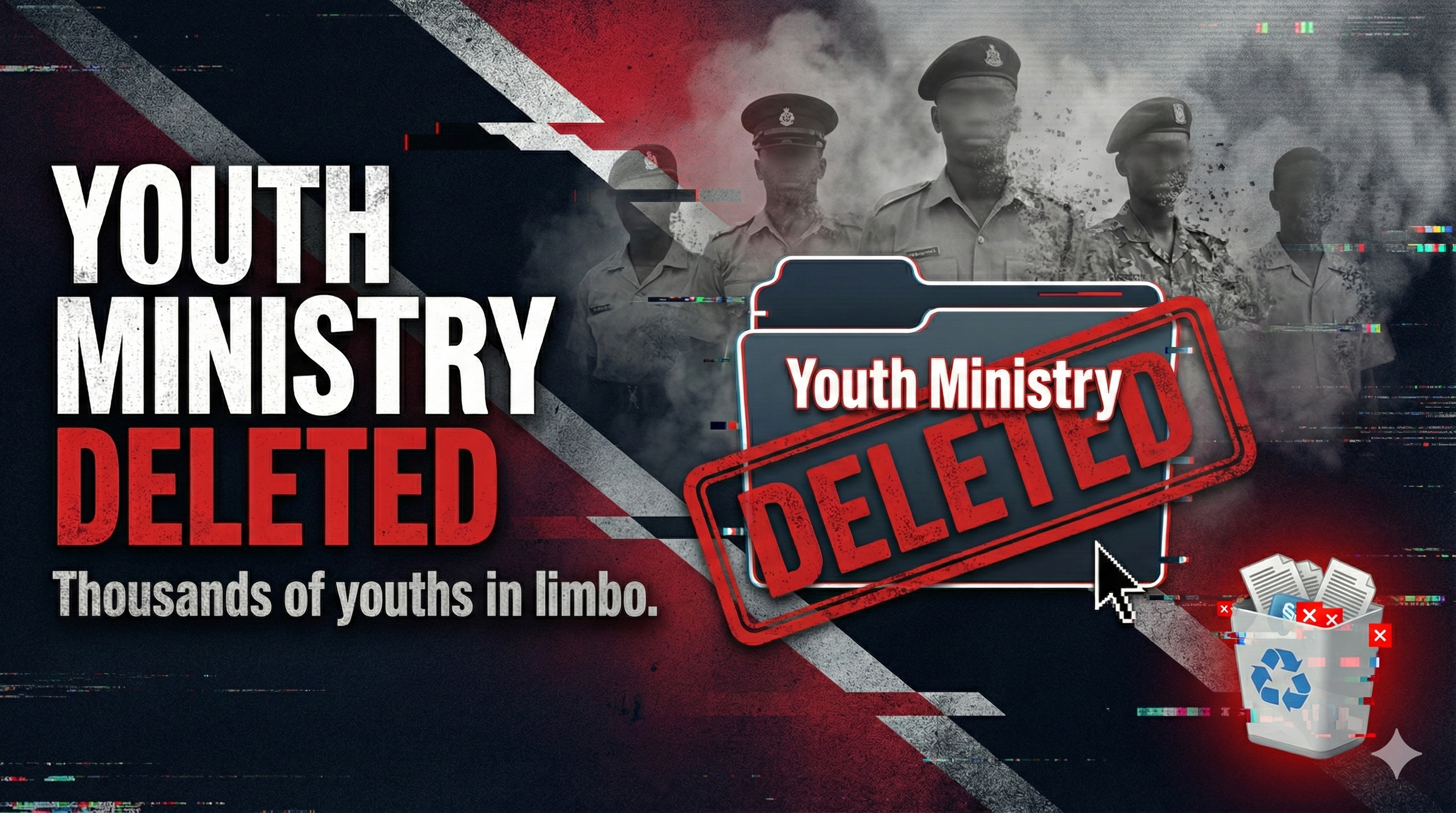
With a few strokes of a pen, one of the most important engines of national development simply vanished. Trinidad woke up to find the youth ministry deleted, and thousands of young people suddenly standing in line with no direction, no timeline, and no answers.
This wasn’t an obscure ministry. Before the new government arrived, the Ministry of Youth Development and National Service (MYDNS) was the country’s largest one-stop shop for second chances. It delivered education, training, discipline, agriculture, digital skills, trade skills, creative skills, and leadership development for roughly half the nation’s under-30 population.
Then the new government came in and quietly dragged the entire thing into the Trash folder.
“You can’t tell youths to stay off the block when the programmes meant to save them get deleted.”
What the Youth Ministry Actually Did Before It Vanished
Before anyone tries to rewrite history, let’s be clear. MYDNS was not a ceremonial ministry. It managed dozens of real programmes that changed real lives.
Education and Leadership
- Bridging Success Programme – A partnership with UTT that allowed young people without full CSEC to move into tertiary education.
- National Leadership Training Programme – A course built with UWI for young leaders in policy, strategy, and project management.
- National Youth Awards, Youth Week, Youth on Stage, Relationships 101, Youth Caravan – Cultural, community, and empowerment initiatives for 16–35 year olds.
Skills and Employment
- STEP TT – Training in app development, web design, coding, and tech-based careers.
- Project DRIVE – Automotive servicing and automotive electrical training.
- YOU-TEC – Vocational training in cosmetology, culinary arts, barbering, hairdressing, and other income-earning trades.
- CRISP, ALLSET – Essential life skills, soft skills, employment readiness.
- Technical Apprenticeship Projects – Including I-MAP, IAP, FUSE, DROP, PIPE, HOIST, and PLAR for hands-on trades.
Creative Economy
- AMPLIFY – A COSTAATT-backed programme for photography, videography, graphic design, voice coaching, and stage skills.
- Project Trending – Social media and digital marketing training for micro-entrepreneurs.
National Service and At-Risk Youth
- Civilian Conservation Corps (CCC) – Roughly 1,000 participants every cycle, focused on conservation, discipline, and work readiness.
- MYPART – Youth reorientation and apprenticeship training.
- NSPTT, GAPP, RAPP – Programmes connecting youth to civic service, elder care, tutoring, and mentorship.
In one ministry, Trinidad was training web developers, welders, cooks, cadets, artists, social media entrepreneurs, crane operators, carpenters, conservation workers, and first-generation university students. It was the closest thing the country had to a national youth ecosystem.
Then came the election.
The Morning After: Youth Ministry Deleted in the Cabinet Shuffle
When the UNC was sworn in at the end of April 2025, the country expected a few renamed ministries, maybe a new portfolio or two.
Nobody expected this:
The Ministry of Youth Development and National Service did not appear anywhere in the new Cabinet lineup.
Instead, youth affairs were tucked under a newly formed Ministry of Sport and Youth Affairs.
A whole ministry, with dozens of programmes, hundreds of staff, and thousands of beneficiaries, was reduced to a “division”.
The UNC created a Ministry of Defence, a Ministry of Homeland Security, and a Ministry of Technology, but somehow the one ministry designed to keep young people away from crime and hopelessness was demoted to the kids’ table.
The Programmes Now Frozen, Abandoned or “Under Review”
Here is where the story moves from political comedy to national tragedy. Once the youth ministry deleted moment happened, the programmes collapsed into a strange limbo.
MYPART and the Youth Service Collapse
The “Specialised Youth Service Programme” that was meant to replace MYPART still has not launched.
Students remain in limbo with no clarity on placement, graduation, or certification.
Shade House Agriculture Project Shut Down
Over 300 young agricultural trainees in Tucker Valley found themselves locked out of the Shade House site they built with their own hands.
The gates were locked.
The farms were left overgrown.
The daily stipend disappeared.
Amplify, ALLSET, CRISP, Project DRIVE, YOU-TEC and Others
Participants across these programmes report receiving:
- No restart dates
- No communication
- No indication that the programmes will continue
- No alternative placement
The digital economy, the creative economy, the second-chance programmes, and the micro-enterprise support systems all froze.
A deleted ministry tends to do that.
The Government’s Position: “Review”, “Assessment”, “Pending Gazette”, “Inherited Issues”
To be fair, the new government has said:
- The programmes are under review
- Structural and procurement issues existed before
- A formal announcement will come after Cabinet deliberation
- Some programmes may move to Defence or be restructured
But young people do not live in Cabinet cycles.
They have rent, bills, dreams, and lives that cannot be paused.
A review does not replace a stipend.
A committee does not replace a classroom.
A pending Gazette does not replace a future.
What the Deletion Really Cost Trinidad
When a ministry disappears, headlines appear.
When programmes disappear, young people fall.
The CCC, Youth In Agriculture and shade house trainees who were preparing for jobs, qualifications, and stability are suddenly idle.
Idle youth in a country facing violent crime is not a small issue.
It is a policy failure with a body count.
Let’s be blunt:
“If the UNC government wanted to increase youth participation in crime prevention, deleting the youth ministry wasn’t the way.”
The economic cost is massive.
The social cost is larger.
The human cost is immeasurable.
Where Trinidad Goes From Here
If Trinidad is serious about youth development, it must treat youth policy as a backbone of national security and economic growth, not an afterthought.
The country needs:
- A dedicated ministry or agency
- Transparent reporting on each programme
- Guaranteed continuity for trainees
- Public timelines and budgets
- Youth voices at the table
Youths do not need slogans.
They need systems.
The UNC promised revitalisation.
But right now, the only thing revitalised is confusion.
And until someone hits “restore”, the youth ministry deleted moment is shaping a lost generation.
This story is part of our wider Trinidad Politics Explained coverage. Explore the full hub for political analysis, key background, major controversies, and the latest updates.