John Bates, Track Changes and the Political Trap Beckles Refused to Walk Into
The John bates controversy became a national resignation watch, but Pennelope Beckles refused to rush. Now the Privileges Committee outcome has changed the politics.
John Bates, track changes, and the resignation Trinidad was told had to happen immediately
In Trinidad politics, nothing excites the national blood pressure quite like a resignation watch. The moment the John Bates controversy exploded, the country was handed a familiar script: outrage first, facts after, execution by press release before lunch.
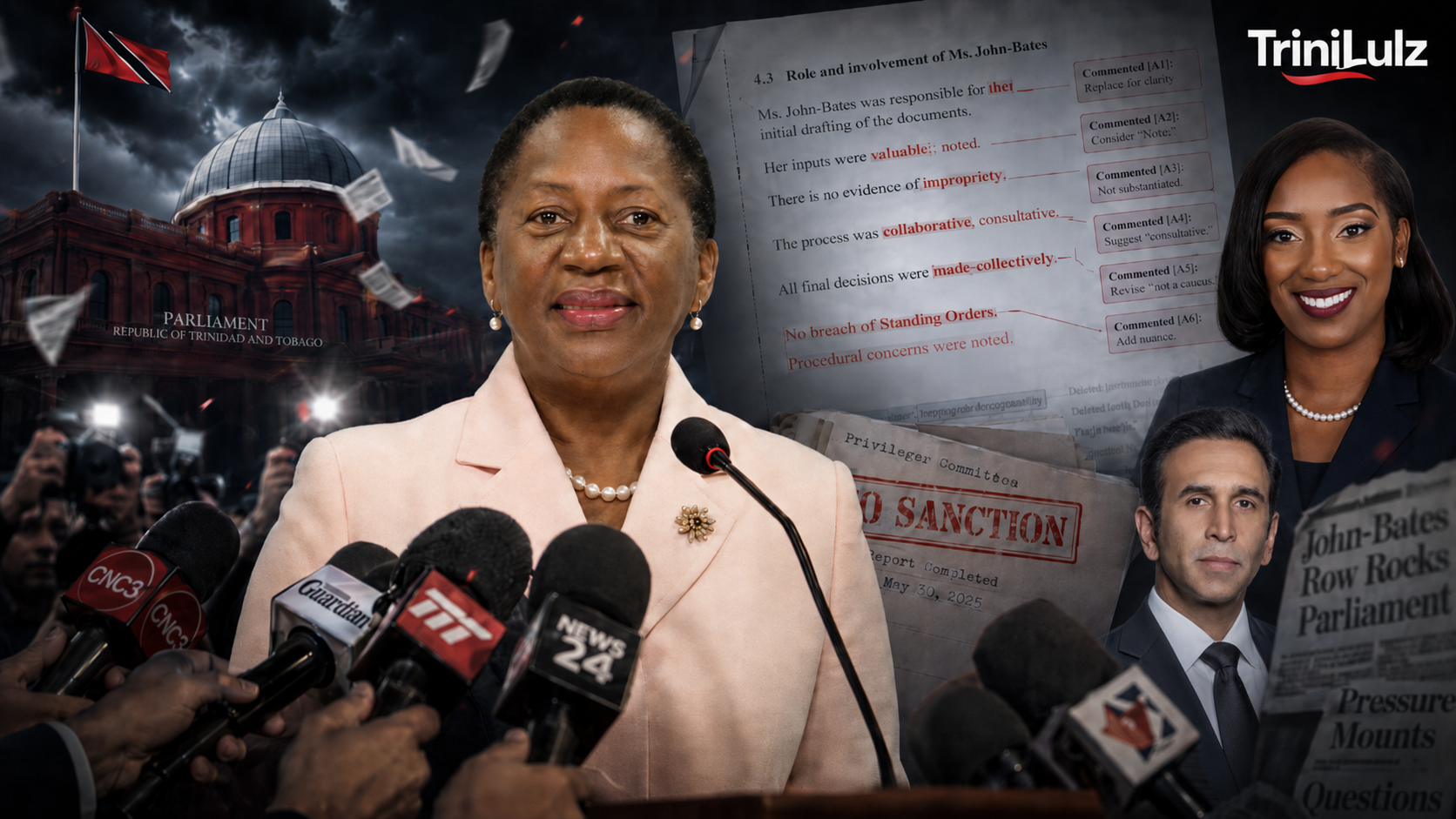
The allegation was serious. Senator Janelle John Bates was linked to edits on a witness statement connected to former health minister Terrence Deyalsingh and the Public Administration and Appropriations Committee. Reports said electronic track changes pointed to her involvement, while former attorney general Faris Al-Rawi was also pulled into the storm. John Bates was a member of the PAAC, which made the matter politically explosive because the committee was examining issues tied to public accountability.
But while the Government benches, commentators and political spectators started beating the tassa drum for an instant firing, Opposition Leader Pennelope Beckles did something very unpopular in Trinidad and Tobago.
She refused to panic.
She did not sprint to the microphone. She did not throw John Bates into the political sea to satisfy the hungry crowd. She did not allow the Government to set her timetable. And now, after the Privileges Committee route ended with no disciplinary action before the parliamentary session closed, Beckles’ caution looks far less like weakness and far more like the one thing our politics rarely rewards: discipline.
Everybody wanted Penny to swing the axe immediately. Instead, she watched the whole bacchanal walk itself into parliamentary quicksand.
The John Bates controversy began with a document, a committee, and one dangerous little feature: Track Changes
This entire saga is a reminder that in politics, the most dangerous witness is not always a whistleblower. Sometimes it is Microsoft Word.
The controversy reportedly centred on a witness statement submitted by former health minister Terrence Deyalsingh to the PAAC. According to reporting on the issue, electronic edits and comments in the document allegedly showed involvement by Janelle John Bates and Faris Al-Rawi. That alone was enough to light the political match.
Why? Because John Bates was not just some casual political observer helping a colleague format a document. She sat on the committee connected to the matter. That raised the obvious question: should a committee member be involved in shaping a witness statement linked to the same committee’s work?
That is where the scandal found oxygen.
John Bates was later removed from the PAAC, and the issue escalated into a full parliamentary and political spectacle. She also publicly apologised and offered her resignation to Opposition Leader Pennelope Beckles.
But the key political moment was not the apology. It was what Beckles did next.
She did not immediately accept the resignation.
And that is when the real trap was set.
The trap was simple: force Beckles to act before the process was finished
Once John Bates offered her resignation, the pressure machine went into overdrive.
Political analysts said Beckles’ hesitation could send the wrong signal to the PNM membership. The Government smelled weakness. The commentary class started circling. And the public was encouraged to view anything short of immediate dismissal as political cowardice.
But Beckles had a problem that her critics were conveniently ignoring.
The matter was already moving through parliamentary channels. Senate President Wade Mark had ruled that there was a prima facie case for both John Bates and Al-Rawi to be referred to the Committee of Privileges. In plain English, Parliament had taken hold of the matter.
So what exactly was Beckles supposed to do?
Fire first and ask questions after?
Accept the resignation immediately and allow the Government to turn her decision into an admission of guilt?
Let the same political opponents attacking her decide the moral standard, the timing, the punishment and the headline?
That was the trap.
If she fired John-Bates instantly, Government would say, “Look, even Beckles knows she guilty.” If she waited, they would say, “Look, Beckles weak.” Either way, the Opposition Leader was being invited to walk barefoot across broken glass while the other side held the broom.
She chose not to walk.
Pull Quote: Beckles’ real offence was not indecision. It was refusing to let her opponents write the ending before the process had finished.
Government wanted the big public punishment, but Parliament delivered procedural fog
The Government’s political argument was easy to understand. The integrity of parliamentary committees matters. If members of oversight committees appear to be helping witnesses prepare responses, public trust takes a hit. That part cannot be brushed aside.
But politics is never only about principle. It is also about timing, advantage and theatre.
The Senate later voted to remove John-Bates from the Joint Select Committee on National Security. Government senators argued her continued presence could undermine public confidence. Opposition senators pushed back, defending Beckles’ right to handle the matter on her own timetable.
Then came the twist.
Reports later stated that there would be no disciplinary action by the Senate’s Committee of Privileges against John-Bates and Al-Rawi.
Politically, that matters because the same Privileges Committee process that was held up as the proper arena for judgment ended without delivering the punishment that critics wanted. And Beckles, who was being pressured to make an irreversible decision before that process played out, can now say: “I waited.”
That is not nothing.
That is political survival.
Beckles was mocked for caution, but caution may have saved her from a bigger mistake
In Trinidad and Tobago, we often confuse speed with strength.
A leader who rushes to fire someone is called decisive. A leader who pauses is called weak. A leader who asks for process is accused of hiding. A leader who refuses to be stampeded is treated as if they are asleep at the wheel.
But in this case, Beckles’ delay may have been the smartest move available.
John-Bates had already been removed from the PAAC. She had apologised. She had offered her resignation. The matter had gone to parliamentary privilege. There was no urgent national emergency requiring Beckles to satisfy a political mob by midnight.
What existed was pressure.
And pressure is exactly where political traps live.
Had Beckles accepted the resignation instantly, she would have handed the Government a clean victory. They would have used it as proof that the Opposition had admitted wrongdoing at the highest level. They would have converted a procedural controversy into a leadership indictment.
Instead, Beckles absorbed the criticism.
She allowed the parliamentary process to breathe.
And when that process fizzled without disciplinary action, the political picture changed.
Suddenly, the question was no longer only, “Why did Beckles not act faster?”
It became, “Why were so many people demanding final punishment before the final process had produced anything?”
Pull Quote: Sometimes the strongest political move is not to swing the cutlass. Sometimes it is to keep your hand steady while everybody else chopping air.
The real issue is bigger than John-Bates
Let us not pretend this controversy raised no serious questions.
Parliamentary committees must be protected. Oversight bodies cannot work if members are perceived to be assisting witnesses behind the scenes. Public confidence depends not only on actual fairness, but on the appearance of fairness.
That is why the original concern around John-Bates was legitimate.
But the political feeding frenzy around the issue also exposed another problem: selective outrage.
In Trinidad politics, ethical standards often arrive wearing party colours. One side discovers integrity when the other side is under pressure. The other side suddenly discovers due process when one of its own is in trouble. Everybody talks about institutions, but many people only respect institutions when the result benefits their team.
That is why this saga became so revealing.
If the concern was truly parliamentary integrity, then the focus should have been on a transparent process, clear rules, and future safeguards for committee members. Instead, much of the public debate became a race to see who could demand Beckles act faster, louder and harsher.
But Beckles’ refusal to be rushed has now complicated that narrative.
She did not erase the controversy.
She did not magically make the questions disappear.
But she did avoid being boxed into a Government-scripted ending.
Final word: Beckles refused the bait
The John-Bates controversy will not disappear from the political memory bank anytime soon. The words “track changes” may now live rent-free in the heads of every senator, adviser and political assistant who touches a document before sending it anywhere near Parliament.
But the larger story may be about Beckles.
She was pushed to act immediately. She was told hesitation was weakness. She was pressured to accept a resignation before the process had fully settled. And now that the Privileges Committee matter has ended without disciplinary action because of the close of the parliamentary session, her caution looks politically justified.
Not because everything was perfect.
Not because John-Bates was formally exonerated.
But because Beckles refused to let political opponents turn outrage into a remote control for her leadership.
That is the part that will sting.
Because in the end, the Government wanted a firing. The commentators wanted a clean dramatic ending. The outrage machine wanted a scalp.
Instead, they got procedure.
They got lapse.
They got smoke.
And Penny Beckles, bruised but still standing, got to walk around the trap.
This story is part of our wider Trinidad Politics Explained coverage. Explore the full hub for political analysis, key background, major controversies, and the latest updates.