
Mighty Sparrow’s Legacy: The Songs That Explained Us
Mighty Sparrow’s songs helped T&T argue about itself. Following his death at 91, we revisit the politics, independence, gender debates and diaspora connections behind the familiar choruses.
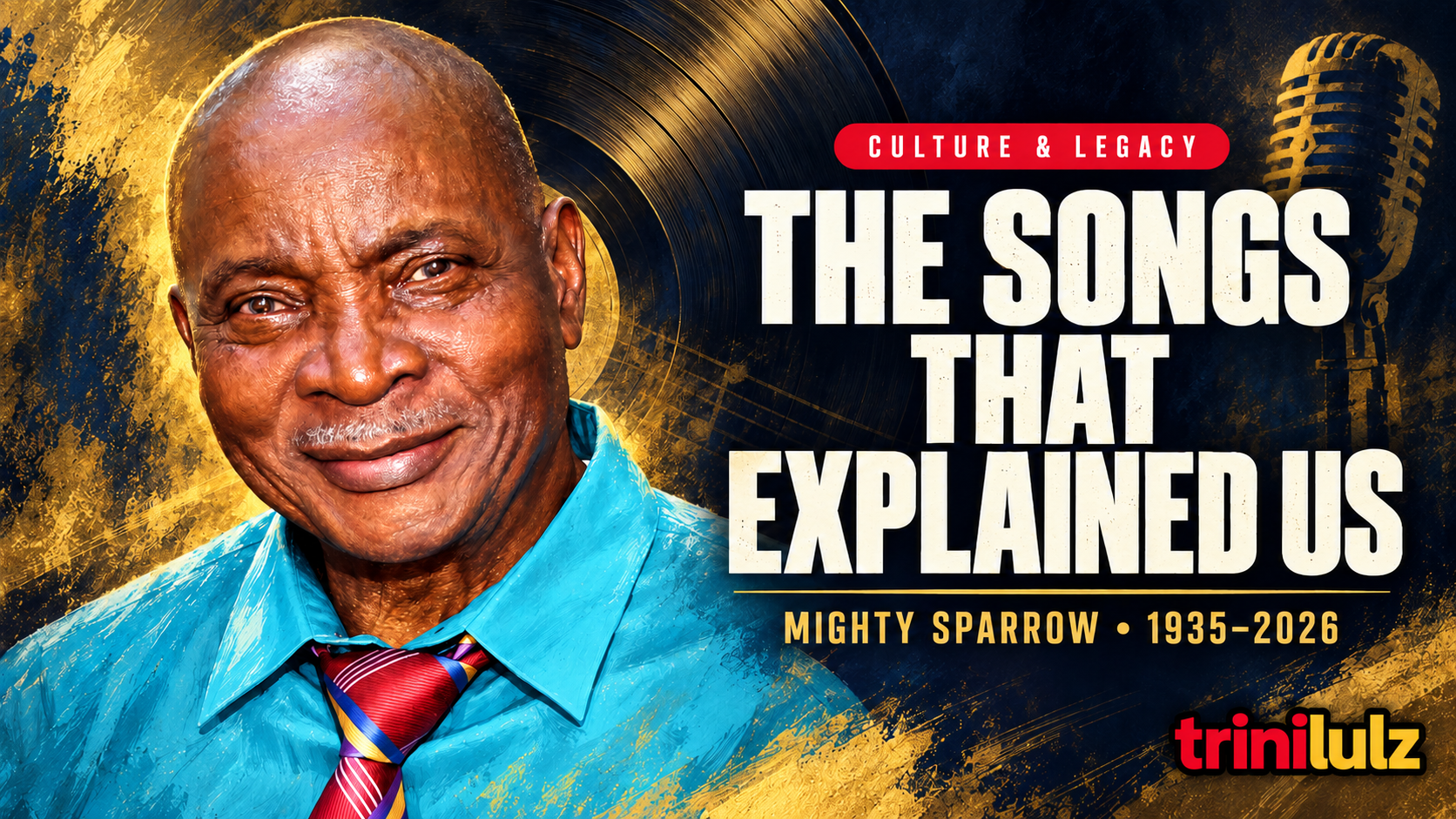
Following Slinger Francisco’s death at 91, the familiar choruses invite a closer listen—to independence, political power, class, gender and the Caribbean’s place in the world.
For many Trinidadians, the Mighty Sparrow entered our lives before we could understand him. We knew the melody. An older relative knew every verse. A line could bring laughter, a knowing glance or an instruction to stop singing that particular song.
Only later did the stories become clearer: the American presence in Trinidad, the promises of independence, the price of everyday life, the vanity of powerful men and the negotiations taking place between men and women.
Slinger Francisco’s family announced that he died in New York on 27 September 2026, after a brief illness. He was 91. Government announced a state-assisted funeral on 30 September, and public condolence books opened on 1 October.
The mourning is national and regional. The work he leaves behind asks for something more lasting than a ceremonial tribute: a closer listen.
We know the choruses. What were they telling us?
Mighty Sparrow made the country audible
Born in Grenada in 1935 and brought to Trinidad as a child, Sparrow belonged to the movement of Caribbean people that helped shape this country. His eventual place in Trinidadian culture also tells a regional story about migration, belonging and the making of a home.
His eight Calypso Monarch titles and eight Road March victories establish the scale of his competitive success. They cannot fully explain why the songs stayed with people who never attended a calypso tent.
Part of the answer lies in performance. Sparrow could inhabit a character, turn a complaint into a conversation, and make a pause do the work of a paragraph. Humour made complicated questions memorable. The voice carried an argument into places a speech or newspaper editorial might never reach.
Yet hearing a society in his songs requires care. A fictional speaker is not automatically the singer confessing his beliefs. Nor is a popular chorus a poll of the entire country. Calypso argues, exaggerates, provokes and takes sides. Its value as a cultural record includes those distortions.
“Jean and Dinah”: the economy beneath the celebration
The 1956 breakthrough that brought Sparrow both the Calypso King and Road March titles remains an irresistible starting point. “Jean and Dinah” sounds like triumph. Its story is considerably less comfortable.
The song draws on the sexual economy associated with American servicemen in Trinidad and the changing fortunes of women who earned money from it. Local male resentment becomes a boast about regaining control as the lucrative wartime market recedes.
Historian and art historian Lawrence Waldron’s examination of this period highlights the gender conflict beneath the celebration. The women’s declining bargaining power supplies the male narrator with his opportunity. What sounds like liberation to him can sound like vulnerability from their side of the transaction.
The song’s claim that the Americans were gone also needs to be heard as rhetoric, rather than a precise historical timetable. American military facilities and their presence did not simply disappear in 1956.
This is why returning to the song matters. A crowd can share a chorus without sharing the consequences described in its verses. Sparrow’s breakthrough lets us hear the struggle over foreign power, money and masculinity together—and ask who actually gets to celebrate.
Independence: pride, promises and regional disappointment
“Our Model Nation” offers the confidence of a country imagining its future. Its celebration brings cultural diversity, resources and leadership into an optimistic portrait of Trinidad and Tobago.
Heard around independence in 1962, that confidence made sense as an aspiration. Heard now, it also becomes a question: how much of the promised model did the country build?
Appreciating the song does not require pretending that racial, religious or class divisions vanished. Its optimistic account gives us a standard against which to examine the distance between national ceremony and everyday experience.
“Federation” supplies a different emotional register. Sparrow’s response to the failed West Indian union carries disappointment and accusation. As UWI historian Dr Gelien Matthews explains, its criticism extended beyond Jamaica to the members’ collective failure, including Trinidad and Tobago.
Placed beside “Our Model Nation”, the song reveals a tension that remains recognisable. Caribbean people can take pride in national independence while wondering what regional cooperation might have made possible. Sparrow gave both feelings a tune.
“Dan Is the Man”: what should an education teach?
The jokes in “Dan Is the Man” target the schoolbooks and lessons associated with colonial education, particularly J. O. Cutteridge’s readers. Their authority becomes something an ordinary pupil can question.
The deeper challenge is about relevance: who decides what children should know, and how well does that knowledge help them understand their own world?
It would be a mistake to turn that criticism into a rejection of education. “Education a Must”, which Gordon Rohlehr identified with the educational opportunities of the independence period, points in the other direction.
Read together, the songs make a productive distinction. Education can open a life. An inherited curriculum can still deserve scrutiny. The criticism is strongest when it asks schooling to do more, rather than treating learning itself as the enemy.
For today’s T&T, that is an unusually useful legacy. We can value qualifications while asking whether students encounter enough Caribbean history, language, literature and thought to recognise themselves as people who produce knowledge.
Politics: sympathy did not guarantee silence
Sparrow’s early relationship with Eric Williams and the PNM formed an important part of his political repertoire. A serious account should acknowledge that sympathy without turning every song into uncomplicated party endorsement.
Matthews’s UWI study of Sparrow’s criticism of the Williams government provides a useful route into the contradictions.
“No Doctor No” complained about rising everyday costs. “PAYE” turned taxation into a drama of resistance and eventual compliance. “Get to Hell Out” used biting impersonation to mock autocratic leadership and Williams’s handling of the Solomon affair.
The distinction matters because satire can borrow a leader’s voice to expose it. A listener who treats every commanding line as Sparrow’s own instruction can miss the joke—and its political force.
His catalogue invites a harder understanding of loyalty. Admiration for a leader need not settle every argument about how that leader governs. National confidence need not eliminate impatience with taxes, prices or the treatment of power.
That makes the songs especially relevant in a country where criticism is frequently sorted by the assumed party allegiance of the speaker. They remind us to examine what an argument says, as well as who is making it.
Gender: an honest tribute must hear the uncomfortable parts
The songs about women and sex require the same attention. Sexual boasting, suspicion and humiliation helped generate some of the repertoire’s memorable humour. That does not make their implications disappear.
The racial caricature and sexual violence in “Congo Man”, for example, deserve direct examination. Calling something a joke does not answer every question about whom the joke diminishes.
At the same time, Sparrow’s fictional women cannot all be reduced to silent objects. Patricia Mohammed’s study of his treatment of Caribbean relationships examines a more contradictory exchange, in which women also argue, desire, manoeuvre and challenge men.
“Stella” complicates the encounter between desire, intoxication and a male narrator’s professed restraint. “No Money No Love” makes economic power central to an intimate dispute. “Obeah Wedding” turns the struggle over marriage and sexual expectation into theatrical conflict.
Mohammed’s analysis acknowledges the repertoire’s patriarchal and misogynistic elements while resisting a reading that makes every song say exactly the same thing.
The tribute should hold those considerations together. Historical context can explain a song’s conditions of production; it does not oblige a present-day listener to endorse its values. A compelling performance can invite pleasure and objection at the same time.
That tension belongs in the legacy. Younger listeners should have room to ask difficult questions without being told that understanding calypso requires leaving their judgement at the door.
Class, respectability and the right to be paid
In “The Outcast”, the artist’s position within society becomes part of the story. Sparrow’s career also challenged the separation between enjoying calypso and respecting the people who created it.
In 1957, he and Lord Superior helped lead a boycott of the Calypso King competition over the inadequate rewards offered to calypsonians. Rohlehr’s historical account connects that struggle with a wider demand for professional dignity.
It remains a familiar Caribbean problem: culture is praised as a national treasure while the work behind it is treated as something that should be supplied cheaply.
Remembering Sparrow therefore means remembering a performer who helped press the material question behind the applause. Who earns from the entertainment? Who controls the recordings? What does national appreciation mean when a musician has bills to pay?
The answers also require other names. Rohlehr acknowledged contributors including Bertram Innis, Reginald “Piggy” Joseph and Winsford “Joker” Devine. Writers, arrangers, musicians and fellow performers belong in the account of the sound audiences associate with Sparrow.
From T&T to the diaspora—and a conversation with the world
Calypso had an international life before Sparrow. Earlier performers and recordings had already carried Trinidadian music abroad. His achievement belongs within that history, and helped extend it.
UWI’s memorial records decades of performances across the Caribbean, North America, Britain, Europe, Africa and Japan. The scale of that movement matters. A song could leave Trinidad while retaining the speech, humour and social detail that made it recognisable.
“Mas in Brooklyn” speaks to the cultural gathering that migration makes possible. For diaspora audiences, the music can become a meeting place: people from different islands hear familiar experiences in the same performance.
His gaze also travelled beyond Caribbean migration. “Russian Satellite” brought the space race into calypso’s field of attention. International events could be examined from a Caribbean vantage point, rather than left to voices elsewhere.
There is a significant difference between carrying music overseas and making Caribbean people audible within world affairs. Sparrow’s work did both. Its international reach did not depend on abandoning the particulars of home.
For children and grandchildren of migrants, that offers another way into the songs. The music is an inheritance of language and argument as well as a reminder of a place they may visit only occasionally.
Preserving Mighty Sparrow means preserving the arguments
The work of preservation has already begun in several forms. UWI has supported scholarship and public programmes around his repertoire. Smithsonian Folkways’ First Flight collection of early recordings, with Rohlehr’s notes, gives listeners a route into the formative years. Authorised remasters also keep older material available.
A meaningful next step would build on that work: preserve masters and alternate performances, document credits, and explain the references that once required no explanation.
A recording alone cannot always tell a teenager why a politician’s name made a crowd roar. Nor can an isolated lyric convey the performance that complicated its meaning. Archives need context, and audiences need access.
Teachers, libraries, broadcasters, researchers and cultural institutions can help create that access. Oral histories with collaborators and listeners would add memories that official honours cannot capture. Family stories matter too, provided memory is distinguished from documented fact.
Honouring Sparrow should make it easier for the next generation to encounter the work in its fullness: beautiful, funny, partisan, inventive and sometimes objectionable.
That is the size of the legacy. The songs let us hear a country in the act of becoming, and in the act of disagreeing with itself.
Sparrow’s voice has fallen silent. The arguments remain ours.
Which Mighty Sparrow song taught you something about Trinidad and Tobago—and what did it reveal?
How to leave a public tribute
Published arrangements allow the public to sign condolence books at NAPA’s hotel lobby, the Culture Ministry at the International Waterfront, SAPA and Shaw Park Complex through 14 October, from 10am to 4pm daily. Books at Trinidad’s 14 municipal corporations were announced for 5–14 October.
As at 4 October, this feature has verified the state-assisted funeral announcement, but not a confirmed funeral date or programme. Readers should check subsequent official notices before making arrangements.
Reporting note: This is a researched cultural analysis, drawing on published announcements, recordings and scholarship. Song narratives are distinguished from biography; release dates are omitted where recording histories differ. Funeral information reflects announcements checked on 4 October 2026.