BALISIER HOUSE: THE HOUSE THE PNM BUILT: FROM A QUEEN STREET ROOM TO A POLITICAL MONUMENT
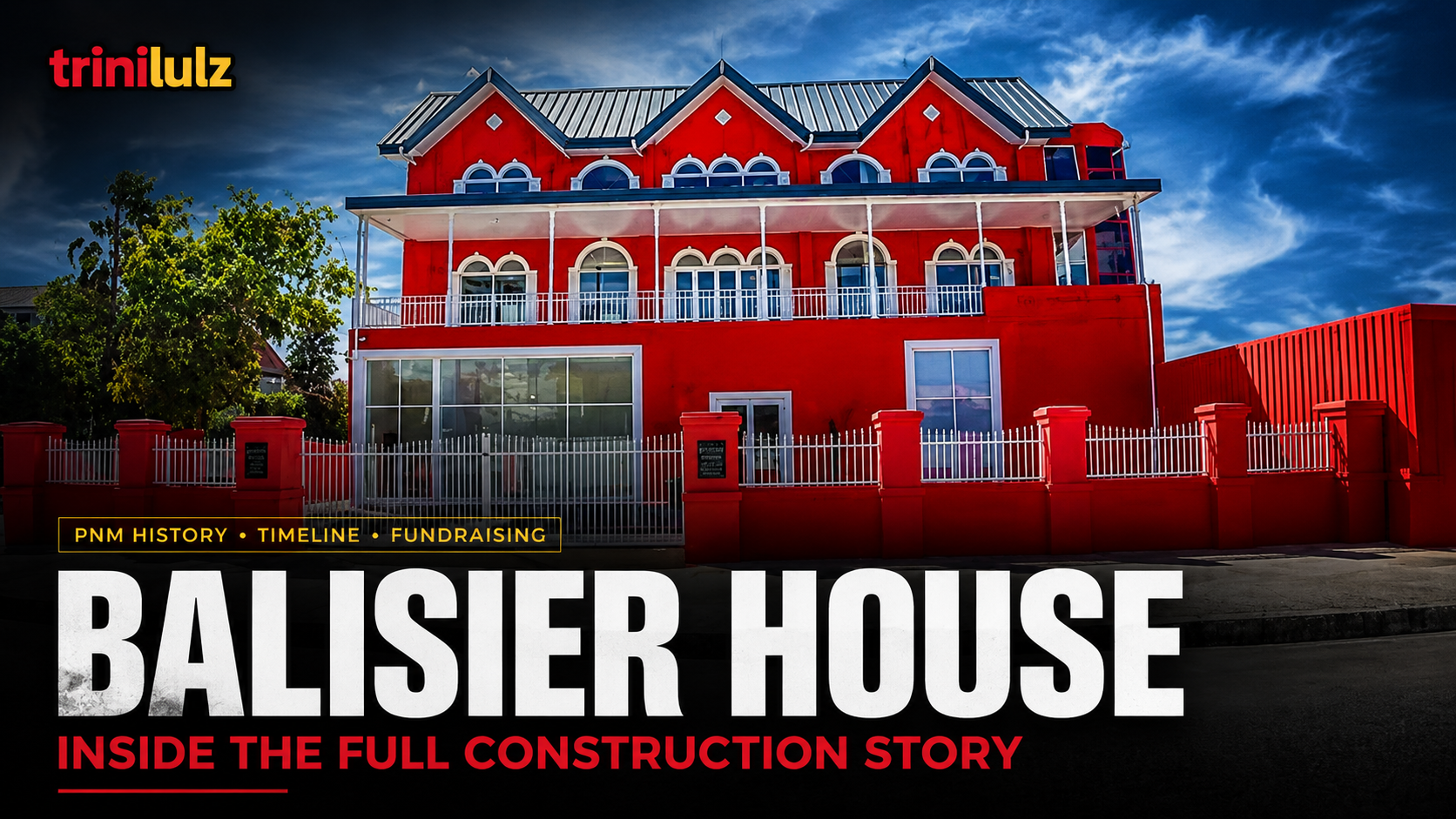
Balisier House did not begin as a towering red-and-white political landmark near the Queen’s Park Savannah.
It began with the People’s National Movement operating from the second floor of 67 Queen Street in Port of Spain.
Before the steel beams, executive offices and proposed commercial spaces, there was an old colonial house, a mortgage, raffle books, cocktail tickets, boat cruises, jewellery, $10 bricks and supporters contributing whatever they could afford.
And before it became the physical headquarters of one of Trinidad and Tobago’s most enduring political organisations, it was an idea held by Dr Eric Williams: that a serious political party should own a permanent home capable of surviving elections, leaders and generations.
This is not simply the story of a construction project.
It is the story of how the PNM attempted to build something designed to outlive everybody who helped create it—a headquarters, an archive, a source of income and, ultimately, a monument to itself.
Before Balisier House, There Was Queen Street
The PNM emerged in January 1956 under historian and future prime minister Dr Eric Williams, who transformed his popular public lectures into an organised political movement.
Williams would later lead Trinidad and Tobago into independence in 1962, but at the beginning, his new party did not possess an imposing national headquarters. Founding PNM member Ferdinand “Ferdie” Ferreira recalled that the organisation operated from the second floor of 67 Queen Street, Port of Spain.
Even at that early stage, however, the ambition was reportedly larger than an upstairs office.
According to Ferreira, Williams wanted the party to own a proper headquarters with administrative offices, conference facilities, a cafeteria, accommodation for delegates travelling from Tobago and rental spaces capable of generating income.
It was a surprisingly modern concept: a political headquarters that would not merely consume donations but eventually help finance the organisation occupying it.
The problem was money.
The plans existed. Architects reportedly produced drawings at different points. The party, however, repeatedly lacked the funds required to turn Williams’ wider vision into concrete and steel.
The dream would take decades to materialise.
The Colonial House at Tranquillity Street
Through fundraising activities and donations, the PNM acquired the property at 1 Tranquillity Street.
Ferreira recalled that the property was purchased in 1961 and occupied the following year. The party’s own historical account states that it was registered under Deed No. 6045 of 1962, that operations began there in November 1962 and that Balisier House was officially opened on April 22, 1963.
The building was already an ageing colonial-style house when the PNM moved in.
There was no immediate luxury makeover. Ferreira said the party simply did not have the resources to undertake extensive modernisation.
What it did have was location.
The property sat close to the Queen’s Park Savannah in an established Port of Spain district. Over time, the address became inseparable from the party itself.
Candidates would be screened there. General Council meetings would be held there. Leaders would emerge from behind its doors. Supporters would gather there for celebrations, announcements and political rituals.
The building was no longer simply located at Tranquillity Street.
In the national political imagination, Tranquillity Street had become Balisier House.
Balisier House and the Symbol of the PNM
The name was especially fitting because the balisier flower was already the party’s political symbol.
Bright red, recognisable and associated with the PNM’s colours, the flower appeared on flags, clothing, campaign material and constituency offices across Trinidad and Tobago.
Balisier House therefore became more than a convenient name for a building. It became a physical extension of the party’s identity.
The PNM was launched as a highly organised political movement during a period when many political groupings were temporary alliances built around individual leaders. Williams’ party was designed differently: with a constitution, formal internal structures, organised party groups and a vision extending beyond a single election.
That institutional approach helps explain why ownership of a headquarters mattered so much.
A rented office could disappear when the money dried up. A temporary campaign room could be abandoned after an election defeat.
A property owned by the party represented permanence.
Leaders could change. Governments could fall. Supporters could become disappointed. The building would remain.
That was the promise embodied by Balisier House: not that the party would always win, but that it intended to survive.
The $200,000 Property Next Door
The next major step came between approximately 1968 and 1971, when the PNM acquired the neighbouring property.
Ferreira placed the purchase price at approximately $200,000. The house on that property was eventually demolished and the land converted into a car park. Decades later, that same adjoining lot would become the construction site for the proposed multi-storey headquarters complex.
The purchase is an important part of the story because it demonstrates that expansion at Balisier House was not invented during the Keith Rowley era.
The land required for a larger headquarters had been assembled more than half a century earlier.
Ferreira said donations received during the politically turbulent Black Power period helped the party service the mortgage on the second property. According to his account, sections of the business community increasingly supported the PNM during that period, helping to produce one of the organisation’s strongest fundraising stretches.
Yet even with the additional land, the grand headquarters envisioned by Williams remained unfinished.
The car park was there.
The plans were there.
The money required to combine them into one major complex was not.
Before Rowley Could Rebuild It, the Party Had to Save It
When Keith Rowley became PNM political leader in 2010, the party was not immediately ready to launch a grand construction project.
According to Ferreira, it was carrying a substantial bank mortgage and had to raise money to prevent Balisier House from being lost.
In other words, before Rowley could rebuild the headquarters, the party first had to save it.
Ferreira said car raffles were conducted in 2011 and 2013 alongside other fundraising exercises to reduce the party’s debt and stabilise its finances.
This period is essential to understanding the PNM’s official account of what followed.
The new headquarters was not presented as a project financed by one cheque, one fundraiser or one mysterious overnight windfall. The party’s position is that resources were accumulated gradually over many years through organised fundraising and private contributions.
The construction campaign would eventually become one of the most ambitious internal fundraising efforts undertaken by a political party in Trinidad and Tobago.
But it began from a much less glamorous place: debt, mortgage pressure and the possibility that the party could lose the headquarters it already possessed.
The Eric Williams Memorial Complex
By the PNM’s 60th-anniversary celebrations in April 2016, the wider redevelopment was being publicly promoted as the Eric Williams Memorial Complex.
Rowley appealed to party members to contribute “beyond their means” towards the project. Plans discussed at the time included administrative offices and commercial facilities, with technical work and soil testing expected to begin at the compound.
The fundraising was already reaching into constituencies.
One southern constituency reportedly donated the full $15,000 earned from an event. Rowley’s Diego Martin West constituency advertised a “Cocktails on the Hill” fundraiser with tickets priced at $600.
The vision was clear: the project was to be presented not merely as Rowley’s building, but as the completion of an institutional ambition traced back to Eric Williams.
That historical framing carried political value.
Williams had wanted a headquarters with offices, meeting facilities, Tobago accommodation and rentable space. The new proposal was larger and more modern, but its underlying philosophy was remarkably similar.
The party would create a permanent home and use part of the property commercially to help support its future operations.
After decades of drawings and delays, the old plan was being taken off the shelf.
Sod Turning, Steel and a Two-Year Promise
On August 30, 2018, Rowley and then-party chairman Franklin Khan ceremonially turned the sod for the new development during an event at the Balisier House compound.
The proposed building was described as a five-storey, approximately 25,000-square-foot structure with basement parking, offices and additional space. The historic Balisier House was expected to be refurbished and preserved as a museum and archive devoted to the party’s history.
At the time, Guardian reporting produced a preliminary estimate of between $12.5 million and $25 million, based on an estimated construction cost of $500 to $1,000 per square foot.
A completion timeline of two years was announced.
Other reporting later referred to an estimated figure of approximately $38 million. These numbers should be understood as preliminary projections reported at different stages—not as a publicly confirmed final cost.
Formal construction activity began in 2019.
The building that Williams had imagined in principle, that several generations of party officials had drawn on paper and that Rowley had promoted for years was finally rising from the former car park.
Then the fundraising campaign moved into full public view.
Raffles, Cruises, Jewellery and the $10 Brick
The PNM said the project would be financed through contributions from its membership, supporters and the wider business community.
The party promoted boat cruises, constituency events and a highly publicised ten-car raffle. The raffle offered nine Honda City CNG vehicles and a BMW sedan as its grand prize, with proceeds directed towards the building fund.
The party also launched its “buy-a-brick” initiative.
Members were encouraged to contribute towards individual construction blocks so that ordinary supporters could feel a personal sense of ownership in the finished headquarters. One widely publicised appeal encouraged supporters to purchase a symbolic brick for $10.
Then came the Balisier Collection: rings, tie tacks, necklaces, earrings and other branded jewellery reportedly produced as part of the fundraising effort.
The project was being financed through politics’ version of a national barbecue sale—except this barbecue had car raffles, cocktails, jewellery and a five-storey building at the end of it.
Not every supporter could write a large cheque.
But somebody could buy a ticket. Somebody could purchase a brick. Somebody could attend a cruise. Somebody could contribute $10.
One Compound, Two Different Construction Projects
Much of the public confusion surrounding Balisier House comes from the fact that two related projects were taking place on the same compound.
The first involved the historic headquarters facing Tranquillity Street.
The second involved the new five-storey complex rising on the adjoining property that had previously been used as a car park.
Rowley later said that separate financial accounts were maintained for the two projects. The funds used to restore or reconstruct the historic headquarters were not, according to him, mixed with the account used for the multi-storey building next door.
That distinction matters.
References to “the new Balisier House” have sometimes been used to describe the entire compound, the reconstructed historic building or the five-storey development.
They are connected, but they are not identical.
The historic building was intended to preserve the party’s institutional memory and provide executive and meeting facilities.
The larger structure was intended to give the organisation more administrative space, parking and commercial rental capacity.
One compound.
Two buildings.
Two construction accounts, according to the PNM.
And one very long political dream.
COVID-19, Termites and a Project That Outgrew Two Years
The announced two-year timeline did not survive contact with reality.
Construction continued through the COVID-19 pandemic, when building projects around the world encountered labour restrictions, shipping delays, material shortages and price increases. These disruptions were cited among the factors affecting progress at Balisier House.
The historic building also presented another challenge: termites.
Ferreira said he was informed that the original structure had become so badly affected that it could not be preserved in the manner originally intended.
When Newsday visited the site in 2023, it reported that much of the original colonial-style house appeared to have been demolished or replaced by a substantially reconstructed red-and-white building. The separate five-storey structure remained under construction next door.
The most accurate description is therefore not that the original headquarters was simply given a fresh coat of paint.
Balisier House was restored and substantially reconstructed, with its historic appearance and symbolic role carried into a new physical structure.
The house survived.
But not every old piece of wood survived with it.
January 2024: The Return to Balisier House
The reconstructed historic headquarters was formally reopened during the PNM’s 68th-anniversary celebrations in January 2024.
The event included the unveiling of a plaque, the placement of a time capsule and a ceremonial return to the address that had served as the party’s institutional home for more than six decades. Regular party business resumed shortly afterwards.
During a media tour, Rowley said the historic building’s renovation had started with small contributions from party members and regular benefactors.
He acknowledged that the original budget had been exceeded because of additional finishing work and said the final figures would eventually be reported through the party’s internal structures.
The reopening was not the completion of every element of the wider compound.
The multi-storey development next door remained a separate undertaking.
But politically, the reopening represented something larger than the return of office furniture and General Council meetings.
The PNM had returned home.
The old colonial house had been transformed into a modern political headquarters, and the building that once appeared vulnerable to debt, age and termites was again ready for party business.
How the PNM Says Balisier House Was Funded
In March 2026, Rowley provided the most detailed public explanation of the project’s financing offered by the party.
He said ordinary members contributed small amounts according to what they could afford—whether $10, $15 or $20.
He said wealthy and well-off party members made larger contributions.
He said several raffles, authorised through the required process, raised approximately $15 million over a number of years.
Rowley also said that he personally contributed five per cent of his salary while serving as opposition leader and prime minister, and described the wider fundraising effort as one that extended for approximately 15 years.
That is the PNM’s official account:
Not one fundraiser.
Not one donor.
Not one year.
A prolonged accumulation of small contributions, major private assistance, raffles and organised party ventures.
The model was part grassroots collection, part support from wealthy members and part commercial fundraising machine.
From the pensioner buying a ticket to the benefactor writing a substantial cheque, the party’s case is that Balisier House was built by layers of contribution accumulated over time.
What the Public Record Still Does Not Establish
The public record contains multiple estimates, but it does not provide one definitive, consolidated and independently verified final cost for the entire redevelopment.
The figures reported in 2018 were early estimates. The project later encountered design work, additional finishes, pandemic-related disruption, increased construction costs and the substantial reconstruction of the historic building.
Rowley acknowledged in 2024 that the renovation had exceeded its original budget. Guardian reporting in 2026 stated that an audited project receipt had not been publicly released.
That does not require speculation.
It simply means the responsible description is this:
The party has provided increasingly detailed explanations of how the money was raised, but the final consolidated cost of the entire redevelopment has not been publicly established.
The distinction is important because an article can accurately document what is known without filling the remaining gaps with rumours.
There is already enough of a story in the confirmed history: decades of planning, land acquisition, debt, raffles, benefactors, termites, pandemic delays, reconstruction and the eventual reopening of one of the country’s best-known political addresses.
More Than a Building
Balisier House has existed under every PNM political leader since Eric Williams.
It has seen the party govern, lose, rebuild and return.
It has witnessed the transition from Williams to George Chambers, from Chambers to Patrick Manning, from Manning to Keith Rowley and into another generation of leadership.
Its rooms have held candidates waiting to learn whether they would receive the party’s approval. Its yard has hosted supporters waiting for results. Its name has appeared in political reporting so often that it functions almost like a person: “Balisier House decided,” “Balisier House responded,” “Balisier House met.”
That is what happens when a building becomes an institution.
Other parties have established offices, rented buildings and operated campaign headquarters.
The PNM attempted to build a permanent political estate.
The significance of that achievement depends, naturally, on where one stands politically. To supporters, the complex represents sacrifice, discipline and institutional strength. To critics, it remains a building whose complete final costs should be placed more fully in the public domain.
But both sides recognise the same basic truth.
Balisier House matters because the PNM matters to the history of Trinidad and Tobago—whether one celebrates that history, opposes it or spends every election trying to defeat it.
The House the PNM Built
The story began in an upstairs room on Queen Street.
It moved into an old colonial property near the Savannah.
It expanded through the purchase of the house next door.
It survived mortgages, financial pressure, political defeat and physical deterioration.
It was supported, according to the party, by raffles, fêtes, cruises, jewellery, bricks, small donations and wealthy benefactors.
Then it became concrete, glass and steel.
Before the five-storey complex, there was a drawing.
Before the ceremonial sod, there was a car park.
Before the reopening, there were termites and delays.
Before the political monument, there was a party trying to own a home.
Balisier House is therefore not merely the headquarters the PNM constructed.
It is the physical expression of what the party has always tried to project: organisation, permanence and the belief that political institutions should be built not only for the next election, but for the people who will arrive long after the current leaders are gone.
Whether that monument lasts another 60 years will be determined by history.
But the house is standing.
And the PNM can say it finally built it.