A Trump Official Floated Giving Venezuela Part of Essequibo, Reuters Reports. Here’s What We Know
Reuters says a Trump official raised the idea of Venezuela taking part of the Essequibo. Here’s what Guyana and the U.S. say, where offshore oil fits, and why T&T should pay attention.
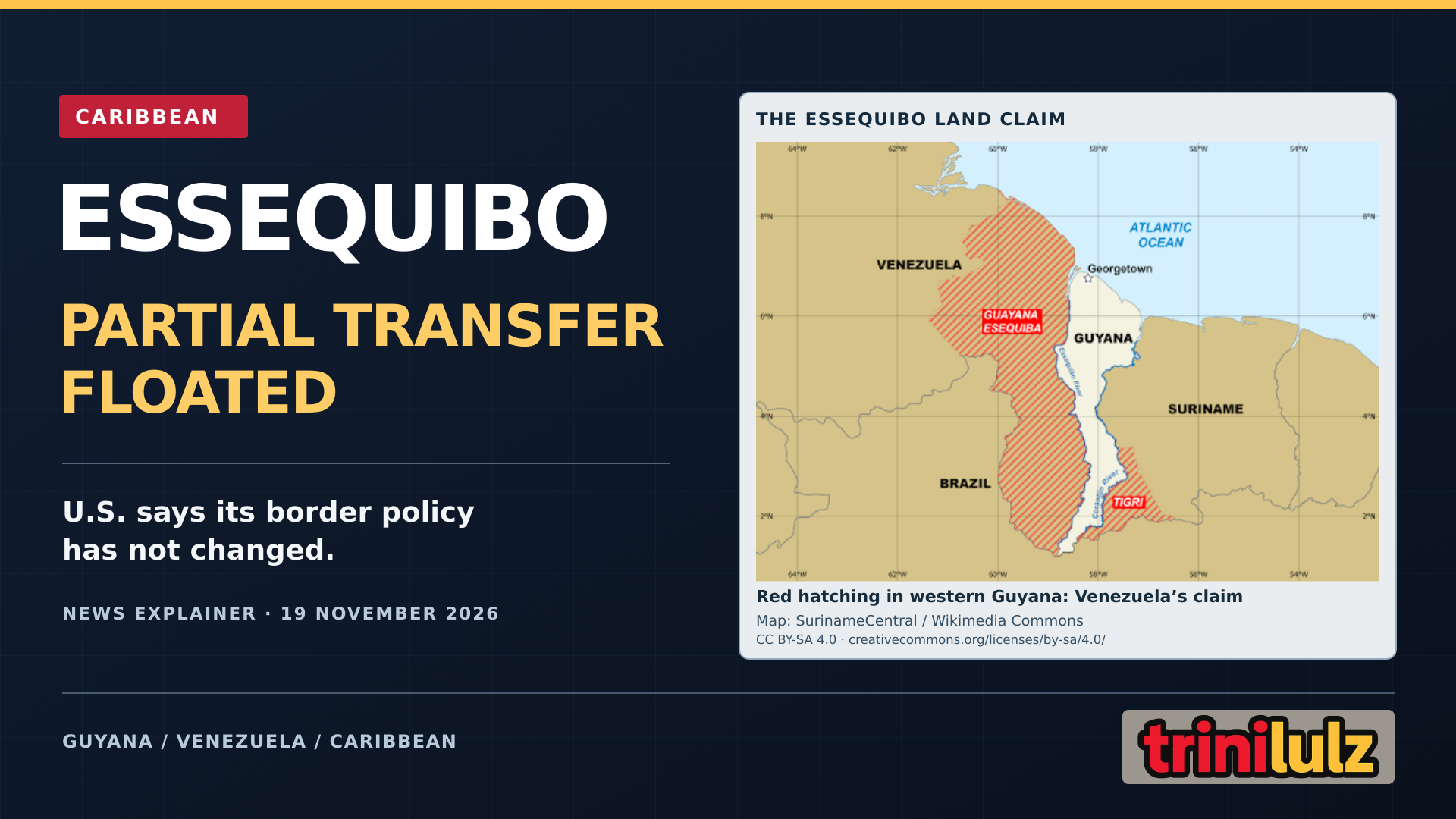
A senior Trump administration official floated the possibility of Venezuela taking control of part of the Essequibo, the region Guyana administers and Venezuela claims, Reuters reported on November 19. The official was Jeremy Lewin, then the U.S. State Department’s director of policy planning. The report brought the Essequibo dispute back into focus. As of November 19, no agreement or boundary change had been announced.
Guyana’s foreign ministry confirmed that officials discussed the border controversy with the State Department in September. It said the meeting focused on the pending International Court of Justice ruling and reaffirming U.S. support for that process. Georgetown says it received assurances that the U.S. position has not changed. Read Guyana’s official statement.
What was floated in Washington?
Reuters reported that Lewin offered to help arrange territorial talks at a September meeting with Guyanese Foreign Secretary Robert Persaud. Its sources differed on the exact wording. Lewin told Reuters the White House authorised preliminary conversations with both countries. The White House did not confirm that account. Lewin left the State Department in October.
News Source Guyana separately reported, citing Guyanese officials familiar with the meeting, that they objected to the suggestion. The ministry’s public statement did not recount that exchange. The U.S. State Department told EFE that Washington still backs the 1899 award that determined the land boundary. Neither government has released a map, a proposed dividing line or terms for a transfer.
Venezuela’s case for talks is on the public record. Acting President Delcy Rodríguez called for negotiations at the UN General Assembly in September. Guyana’s President Irfaan Ali used the same forum to call on Venezuela to abide by the forthcoming court ruling and said Guyana would do the same. They are still pursuing different routes to resolve the dispute.
Where is the Essequibo, and who administers it?
The Essequibo is a large region in western Guyana, mostly west of the Essequibo River. It makes up roughly two-thirds of the country’s land area. Guyana administers it. Venezuela calls it Guayana Esequiba and claims sovereignty over it. The hatching on the map shows the extent of that claim. Tigri, also labelled on the map, is a separate dispute involving Guyana and Suriname.
Behind the map are people who live and work there. Any proposal to change who administers part of the region would raise questions about local government, land rights and public services. No publicly disclosed proposal answers those questions or says which communities would be affected.
How the dispute got to The Hague
| Date | What happened |
|---|---|
| 1899 | An arbitral award set the boundary between Venezuela and British Guiana, placing the Essequibo on the British Guiana side. |
| 1966 | The Geneva Agreement set out a process to address the controversy after Venezuela challenged the award’s validity. |
| 2018 | Guyana took the case to the International Court of Justice after the UN Secretary-General chose the court as the means of settlement. |
| December 2023 | Venezuela held a referendum promoting its claim. Later that month both countries signed the Argyle Declaration pledging to avoid threats and force. |
| May 2025 | The court added a provisional order concerning Venezuelan elections in the territory Guyana administers. |
| May 2026 | Both sides argued the merits in The Hague. Hearings ended on May 11; the court had not announced its ruling as of November 19. |
The ICJ found in 2020 that it could hear the case on the validity of the 1899 award and the related question of the land boundary. It dismissed a further Venezuelan objection in 2023. The court’s December 2023 interim order told Venezuela not to change the situation in the territory Guyana administers and called on both sides to avoid aggravating the dispute. In May 2025 it also ordered Venezuela to refrain from conducting or preparing elections in that territory.
Both countries presented arguments on the merits in May 2026. The interim orders govern conduct while the case is pending; they did not decide the validity of the award. Guyana’s November 19 statement still described the judgment as pending. A U.S. official offering to broker talks does not alter the court process or transfer sovereignty.
The oil boom is offshore
The land claim predates Guyana’s oil boom by more than a century. The commercial stakes changed in 2015, when ExxonMobil announced a major discovery at Liza-1 in the offshore Stabroek Block. On November 16, the company said its fifth Stabroek development, Uaru, had started producing and brought installed capacity to about 1.1 million barrels a day. That is the capacity of the facilities, not the amount produced each day.
This is why the shorthand “oil-rich Essequibo” can be misleading. The striped area on the map is a land claim; it does not mark oilfields or establish a maritime boundary. A change to a land boundary could have consequences for arguments over adjacent waters, but no public terms identify any oil block or licence as part of what Lewin reportedly floated.
The separation matters in practice. In March 2025, CARICOM called for Venezuela to withdraw a vessel after Guyana reported an encounter with an offshore production platform. A border dispute can affect maritime safety and the people working offshore even when jurisdiction over land and rights at sea are separate legal questions.
Why it matters to Trinidad and Tobago
CARICOM reaffirmed its support for Guyana’s sovereignty and territorial integrity and for the ICJ process at its July 2026 summit. The region has helped keep lines of communication open, too. Trinidad and Tobago took part in the December 2023 Argyle meeting in St Vincent and the Grenadines, where Guyana and Venezuela agreed to refrain from threats or the use of force. They recorded their different positions on the court.
Port of Spain has relationships to protect on both sides. A 2025 T&T parliamentary report records agreements with Guyana on energy cooperation and food security. In October 2026, T&T hosted a business roundtable with a delegation from Venezuela’s Sucre State, with trade, investment and energy cooperation on the agenda. Those are reasons to keep talking to both neighbours. They also make it important to distinguish commercial cooperation from a position on Guyana’s border. Read our earlier look at Guyana–T&T economic ties.
For T&T, the practical interest is a peaceful resolution that both countries can live with. A diplomatic conversation that helps reduce tensions can serve that goal. An attempt to settle the ownership of territory through pressure would make it harder, especially for small states that rely on predictable rules when dealing with larger neighbours.
What to watch next
Watch for the ICJ judgment, any new statement by Georgetown or Washington setting out a different position, and whether Caracas says it will comply with the court’s decision. If mediation is announced, the key question will be what the parties agreed to discuss: keeping the peace, implementing a ruling, or reopening the boundary itself. Those are different conversations.
For now, a suggestion reported from private talks has put the Essequibo back in the headlines. Guyana continues to administer the region, the court’s ruling is pending, and the U.S. says its land-boundary policy has not changed.