Trump’s Midterm Defeat Is a Warning Kamla’s Government Cannot Afford to Ignore
Trump’s midterm defeat is a warning about affordability, political arrogance and personal loyalty. We argue that Kamla’s Government should listen—and explain T&T’s departures on Cuba and the ICC.
OPINION & ANALYSIS · November 4, 2026
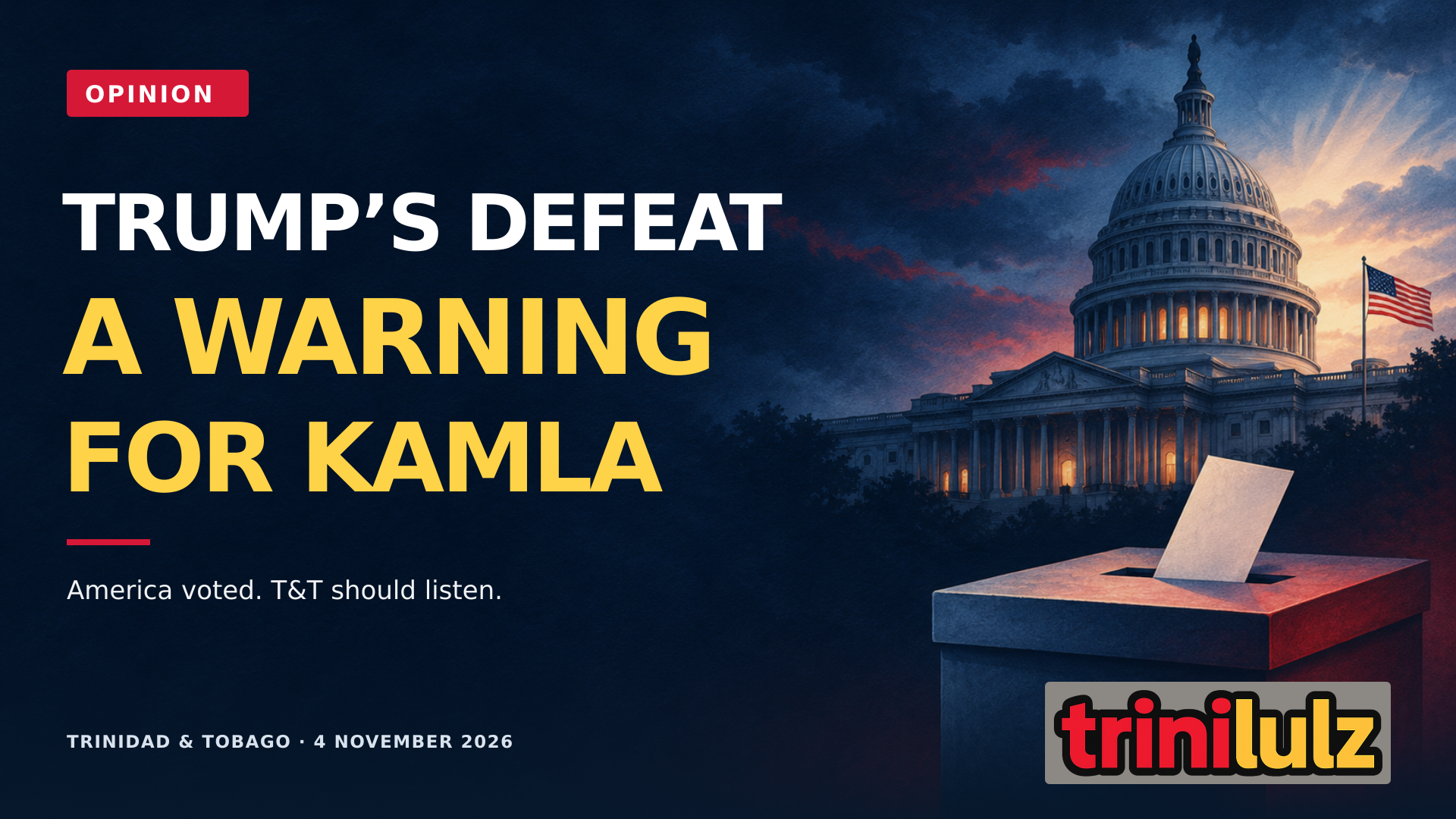
Donald Trump’s midterm defeat should set off an alarm in Port of Spain. American voters have delivered a sweeping congressional rebuke to a president whose promises of prosperity collided with expensive groceries, higher fuel costs, tariffs and the war in Iran. Prime Minister Kamla Persad-Bissessar’s Government should pay attention to both the economic warning and the danger of attaching this country’s diplomatic identity too closely to his.
The argument is straightforward: when households feel squeezed, political loyalty and declarations of strength eventually face the test of the ballot box. A government that dismisses discontent at home while moving closer to a foreign leader being punished by his own electorate risks misreading both countries at once.
T&T should maintain a productive relationship with the United States. But deference to Trump is a poor substitute for an independent foreign policy—especially after reversals on Cuba and a retreat from support for the International Criminal Court. The question is what Trinidad and Tobago gains, and whether those gains justify the principles being set aside.
What the midterm defeat actually tells us
The November 3 election delivered projected Democratic control of both the House and Senate. ABC News’ results displays, updated at 6:45 a.m. Eastern on November 4, showed 229 seats in its Democratic House column and 54 in its Democratic Senate column. Those were an incomplete results snapshot, not certified final totals.
The voter evidence strengthens the case that this was an indictment of Trump’s performance. Reuters’ account of the SSRS voter survey reported that nearly nine in ten voters regarded living costs as a major or crucial factor, while roughly two-thirds blamed Trump for high prices. Preliminary ABC News Voter Polls separately found about two-thirds of House voters thought his tariffs had harmed their national and local economies.
That supports the description of a serious economic and political rebuke. It does not turn a congressional election into a single-question referendum on every Trump policy, or establish how every American thinks. Candidates, turnout, local issues and concerns about democracy also mattered. The strength of the warning comes from the combination of the result and voter evidence. Read ABC News’ preliminary voter findings.
Even Trump acknowledged a role for Iran in the losses, according to Reuters’ reporting of his post-election interviews. He nevertheless defended the decision to attack. That leaves an uncomfortable contrast between a leader defending his course and voters signalling that its costs have become unacceptable.
Tariffs and war reached the household budget
There is more behind the affordability argument than campaign rhetoric. The US Bureau of Labor Statistics reported that consumer prices rose 3.7 per cent over the year to September 2026. Its gasoline index was up 34.2 per cent over the same period. Those figures describe the price pressure; they do not, by themselves, assign every increase to a particular presidential decision.
Research published by the Federal Reserve Bank of New York in August and revised in September examined the 2025 tariffs and found that costs reached consumer prices through several channels. Imported goods became dearer, American producers faced more expensive imported inputs, and competing domestic producers could increase markups. The authors’ estimates are a study of tariff effects, rather than an explanation of all inflation.
The political lesson is that the cost of an economic strategy cannot be wished away by calling it patriotic. A household pays the bill at the checkout. Higher energy and transport costs can also spread well beyond the petrol station. The Iran conflict and tariff policy gave voters concrete reasons to question whether the administration understood their financial circumstances.
T&T’s position is different from America’s. As an energy exporter, this country can receive a revenue benefit from higher international energy prices while households face imported price pressure. The IMF’s 2026 Article IV assessment identified precisely that combination. A better government revenue picture would not automatically mean an easier month for a family buying food and paying bills.
Kamla’s Government already has reasons to listen
The American result cannot predict a Trinidad and Tobago election. It can, however, expose a familiar governing mistake: treating a past mandate as proof that present complaints are unimportant. Voters judge the government they have by the circumstances they face, not only by the administration it replaced.
On October 30, leaders of at least twelve trade unions joined workers, politicians and other supporters in a protest against government policies, according to CMC reporting. That is documented opposition from organised sections of the country. It is not a national opinion poll, but it is a reason to examine the grievances rather than assume they disappear because a march can be mocked.
Persad-Bissessar has defended her record by pointing to backpay, updated salaries, proposed ten per cent increases and labour legislation. Those claims deserve to be assessed against delivery. She also dismissed the protest as a failure and accused its organisers of racial and political hostility, TTT reported. A government should be able to answer critics firmly while still explaining how its decisions improve their lives.
The Divali Nagar funding controversy has similarly required explanation and restraint. By October 29, Persad-Bissessar said the event would receive TT$500,000 from the Ministry of Culture and argued for transparency over requests to multiple state bodies. That means it would be misleading to describe the event as receiving no government funding. The dispute nevertheless shows how the handling of a policy can become a reputational problem of its own.
These disputes establish visible public resistance and controversy; they do not prove that a majority rejects every government policy. The warning is about responsiveness. Dismissing criticism as hostility can prevent a government from recognising dissatisfaction while there is still time to address it.
Cuba: a reversal that now needs a stronger explanation
On October 28, T&T voted with the United States against the UN call to end the US embargo on Cuba. That broke with the country’s established support for ending the embargo. It also reversed the yes vote cast in 2025 after Persad-Bissessar had returned to office, and the position she championed during her first premiership.
The Prime Minister’s explanation is that her Government supports democracy and political freedom for Cubans. She has explicitly endorsed Marco Rubio’s call for political reform. That is her stated rationale, and any fair analysis must include it. But supporting democratic rights does not resolve the separate question of whether an economic embargo is the right instrument.
Trump’s defeat makes the strategic question more pressing: why tie a departure from a longstanding national position so closely to the outlook of an administration whose domestic agenda has just suffered a major rejection? A persuasive answer would identify a benefit for T&T or a credible route to better outcomes for Cubans, rather than rely on the authority of Washington’s preference. Read our history of T&T’s Cuba embargo votes.
The ICC: T&T has a legacy worth defending
On November 2, T&T abstained on draft resolution A/81/L.11 concerning the ICC’s annual report. The United States voted against it. These were different votes: the abstention should not be reported as T&T joining the American no vote. Nor does an abstention itself withdraw a country from the Rome Statute, which has a separate formal withdrawal procedure.
| UN issue | T&T’s vote | US vote |
|---|---|---|
| October 28, 2026: call to end the US embargo on Cuba | No | No |
| November 2, 2026: resolution on the ICC’s annual report | Abstained | No |
The political significance remains considerable. T&T helped revive the international criminal court project in 1989 under ANR Robinson, a contribution recorded in the UN’s own history. The ICC’s Assembly of States Parties records this country’s ratification of the Rome Statute on April 6, 1999. Support for international criminal justice is part of a national diplomatic legacy built over decades. Read the UN account of T&T’s role in reviving the court project.
That legacy is particularly relevant while the court faces American sanctions. The ICC’s August 19 statement condemned US sanctions against its president and another official as an attack on judicial independence. T&T’s decision to withhold support in that environment invites scrutiny even though it was less confrontational than Washington’s vote.
Former foreign ministers have criticised the abstention. In its November 4 report, Guardian Media said it was awaiting a response from Foreign and CARICOM Affairs Minister Sean Sobers. A full government explanation should be added when available. Until then, the record supports criticism of the departure from established support; it does not establish an undisclosed instruction from Trump.
The argument for consistency is practical as well as historical. A small state benefits from institutions that constrain powerful actors and give legal principles weight beyond military or economic strength. That does not make every ICC decision immune from criticism. It means that weakening support for the institution should require a carefully stated national reason.
A lame duck still has power—and that requires careful diplomacy
Trump is serving his second elected term, and the Twenty-Second Amendment bars election to the presidency more than twice. The midterm defeat adds political weakness to that existing limit. It does not remove him from office or automatically undo his tariffs, sanctions or foreign policy.
The incoming Congress normally begins its term on January 3, 2027. Democratic control would give the opposition greater scope to scrutinise the administration and obstruct its legislative agenda; Senate control also matters for confirmations. Trump would still hold executive authority and a presidential veto. T&T has to deal with that reality over the remainder of his term.
Being subservient to a politically weakened president is therefore especially unwise, but treating him as powerless would also be a mistake. The sensible response is disciplined engagement with the American state: the administration, Congress, professional agencies and the people likely to shape relations after Trump. A durable partnership must be broader than affection for one leader.
What T&T should do with this warning
The Government should review its recent diplomatic departures against clear national objectives. On Cuba, explain why the earlier development and sovereignty arguments no longer determine the vote. On the ICC, explain the grounds for withholding support and how that position protects international justice and T&T’s interests. Publish the reasoning so citizens can assess it.
At home, make affordability and delivery the measure of success. Demonstrate what has reached workers’ pockets, what improves essential services and what new burdens households face. Respond to legitimate criticism with evidence and corrections where needed. A claim to care about ordinary people gains credibility through results they can see.
Abroad, build working relationships across American political institutions and maintain constructive Caribbean partnerships. Cooperation with Washington on trade, security and investment can be pursued alongside independent positions on sovereignty and international justice. A close relationship should leave room for disagreement.
The United States has just supplied a warning about the distance between a leader’s certainty and voters’ experience. Kamla’s Government should take it seriously. The task is to protect Trinidad and Tobago’s interests and earn the confidence of its own public—not to become more committed to Trump’s political project as Americans withdraw their confidence from it.
This story is part of our wider Caribbean Geopolitics & Global Affairs coverage. Explore the full hub for regional security updates, diplomacy, migration, energy politics, and deeper analysis of how global power plays shape Caribbean realities.