Phillip Edward Alexander: Has the UNC’s Loudest Voice Become Its Biggest Liability?
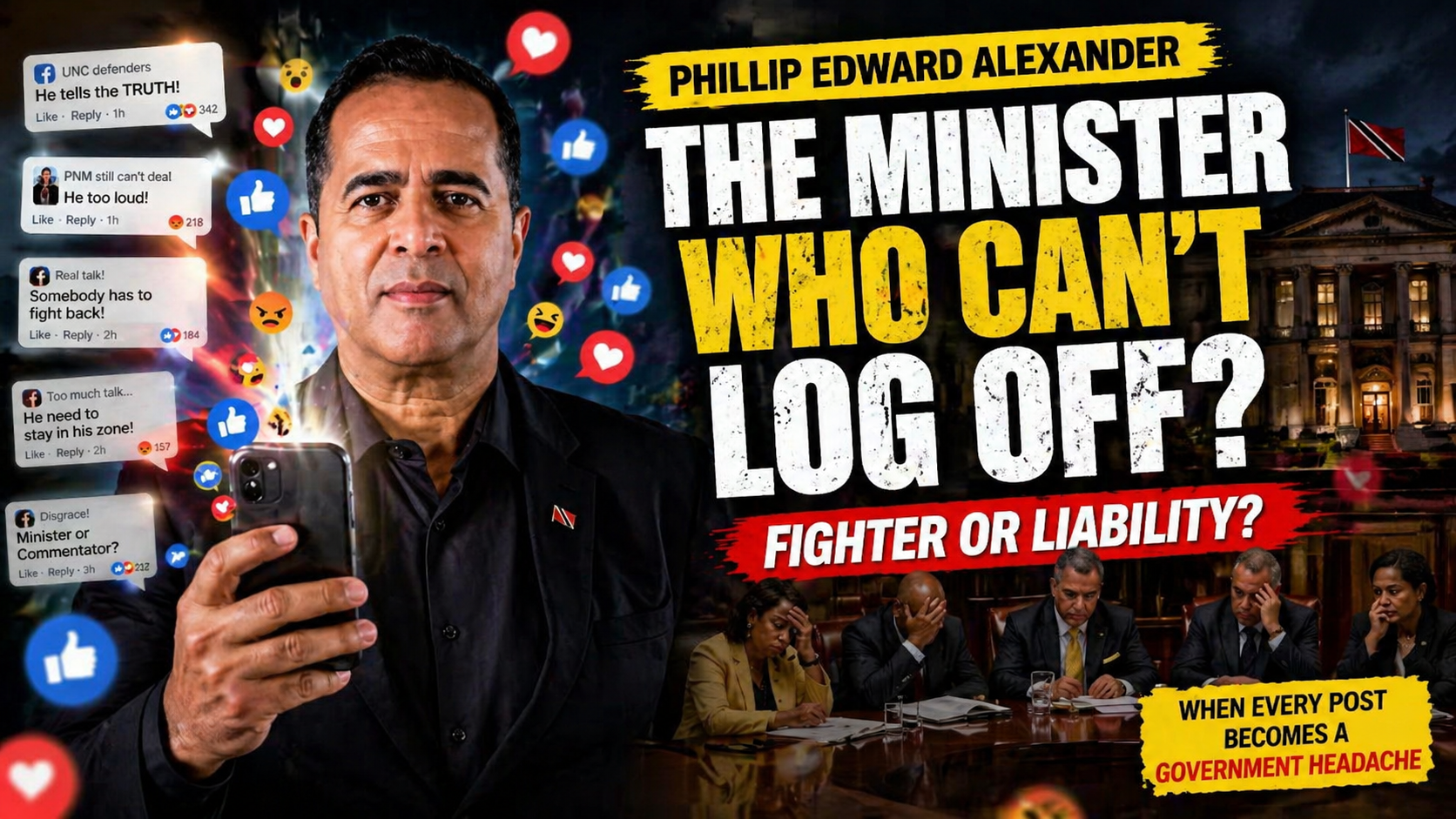
Phillip Edward Alexander and the Problem With Being Loud in Government
Phillip Edward Alexander did not enter politics quietly. He did not stroll into public life with a soft handshake, a beige tie, and a carefully polished press release. He came with volume, fire, Facebook posts, political jabs, hard opinions, and the kind of online following that could turn a dull Tuesday into national bacchanal before lunch.
That was part of the appeal.
For years, Phillip Edward Alexander built his brand as a man who would say what others were afraid to say. Supporters saw him as fearless. Critics saw him as reckless. Either way, people listened. And in modern politics, attention is currency.
But there is one small problem.
Opposition politics and Government politics are not the same sport.
In Opposition, noise can be strategy. In Government, noise can become policy confusion. In Opposition, a fiery post can energise the base. In Government, the same post can create a headache for the Prime Minister, the Cabinet, the Ministry, the diplomats, the lawyers, and the poor communications officer who thought the day would be normal.
Phillip Edward Alexander was appointed a Senator and Minister in the Ministry of Housing on May 7, 2025. His official Parliament profile describes him as a publicist, communications specialist, columnist, and social media blogger, which is almost the perfect résumé for understanding why he is both useful and risky to the UNC Government.
And that is the real question now.
Has the UNC’s loudest voice become its biggest liability?
The Fighter the UNC Base Loves
To understand Phillip’s political value, you have to understand why many people like him.
He does not sound like a traditional politician. He does not always speak in the careful, polished, “after consultation with stakeholders” language that makes people feel like they are listening to a washing machine manual. He speaks directly. He punches back. He gives supporters the feeling that somebody in Government is fighting with the same energy they use in the comment section.
For a political base that spent years in Opposition, that matters.
Many UNC supporters do not want soft talk. They want fighters. They want people who will defend Kamla Persad-Bissessar, attack the PNM, push back against critics, and treat politics like a full-contact sport. Phillip fits that role naturally.
Phillip’s supporters do not love him because he sounds like a Cabinet manual. They love him because he sounds like the man in the comment section who got promoted.
That is both his strength and his weakness.
Because once a man moves from commentator to Minister, the microphone changes. He is no longer just Phillip with an opinion. He is Senator Phillip Edward Alexander, Minister in the Ministry of Housing. His words carry official weight, even when he may be speaking personally.
That is where the trouble begins.
Phillip Edward Alexander, Social Media, and the Ministerial Line
The warning signs appeared almost immediately.
When Phillip received the Housing portfolio, Guardian reported that he admitted he would have to tone down his social media behaviour. That admission mattered because it showed even he understood the shift from outside commentator to inside Government figure.
But toning down is easier said than done when a political brand has been built on turning up.
Later in May 2025, he faced criticism after using his personal Facebook page to advertise construction jobs. He denied any wrongdoing and said the post was meant to help people in Port-of-Spain North/St Ann’s West find meaningful employment. Prime Minister Kamla Persad-Bissessar defended him at the time, saying what he does in his personal time is his business, as long as it is within the law.
On one level, that defence makes sense. Ministers are still citizens. They can still post. They can still speak. They can still help people.
But politics is not only about legality. It is also about perception.
And in Government, perception does not walk. It gallops.
A personal Facebook page can suddenly look like a ministerial notice board. A casual statement can sound like Government policy. A political jab can create a national headline. And when a Minister becomes the story too often, the Government’s message starts getting drowned out by the Minister’s personality.
That is the danger for the UNC.
Phillip may be useful online, but every viral moment comes with a cost.
When the Mouth Starts Writing Cheques the Government Must Cash
The most serious example came with his remarks involving India and Venezuela.
Newsday reported that Phillip Edward Alexander had said India would “nuke” Venezuela on behalf of Trinidad and Tobago. The remarks attracted backlash, including from Venezuela’s Vice President Delcy Rodríguez, and Prime Minister Kamla Persad-Bissessar later said he was “totally out of line.”
That is not small talk. That is not a bad joke in a rum shop. That is not two friends arguing over doubles and politics.
That is a sitting Government Senator and Minister making a statement that touched foreign relations, regional security, and Trinidad and Tobago’s relationship with a neighbouring country.
And that is exactly why Phillip’s style becomes complicated.
When a regular citizen says something dramatic online, people may quarrel, laugh, share, insult, and move on. When a Minister says it, the country has to wonder whether this is personal opinion, Government thinking, political theatre, or diplomatic confusion.
The issue is not that Phillip talks. Trinidad politicians talk for sport. The issue is that when Phillip talks, the Government sometimes has to reach for a mop, a lawyer, a diplomat, or all three.
That is not sustainable messaging. That is political fire drill management.
The Legal Shadow Hanging Over the Brand
There is also the defamation issue.
In February 2026, CNC3 reported that businessman Andrew Gabriel won an appeal before the Privy Council over the Court of Appeal’s decision to award only $10,000 in compensation for defamation by Phillip Alexander. The Privy Council ordered a new assessment of damages.
The official Privy Council judgment also discusses statements made by Alexander, including later Facebook posts after the claim was filed.
This does not mean every current criticism of Phillip is automatically fair. It does not mean every controversy is equal. It does not mean he has no right to defend himself.
But politically, it keeps one issue alive: words have consequences.
That is a serious problem for a Minister whose main political weapon has always been words.
The UNC cannot pretend this is just a personality matter. In Government, communications discipline is governance discipline. If Ministers keep becoming the headline for what they said, posted, implied, argued, or had to retract, eventually the public stops hearing the Government’s policy message and starts hearing only the noise.
Kamla’s Dilemma: Muzzle the Firebrand or Use the Flames?
This is where the politics gets interesting.
Kamla Persad-Bissessar has a choice, but it is not an easy one.
If she reins Phillip in too strongly, she risks annoying the section of the UNC base that likes his combative style. They may see discipline as betrayal. They may say the Government is letting critics bully one of its strongest defenders.
But if she lets him continue unchecked, she risks looking like she cannot control her own team.
That is the tightrope.
Phillip is not just a Minister. He is a political character. He gets attention. He drives engagement. He speaks the language of online war. In a country where Facebook sometimes feels like Parliament with worse spelling and more caps lock, that has value.
But a Government cannot run purely on reaction emojis.
Every Government wants a warrior. The danger begins when the warrior starts choosing his own battlefield.
Kamla may see Phillip as a useful defender, a loyal soldier, and a man who understands the social media battlefield better than many polished politicians. But she also has to ask whether his fire is warming the Government or burning holes in the curtains.
Because a Minister who dominates attention can quickly become a Minister who distracts from the agenda.
Is This a Phillip Problem or a Government Style Problem?
The bigger issue is not only Phillip Edward Alexander.
The bigger issue is whether this Government is drifting into a style where political performance online becomes more important than disciplined governing.
Social media is powerful. No serious political movement can ignore it. A Government must communicate quickly, directly, and clearly. People no longer wait for the 7 p.m. news to understand what is happening. They check Facebook, TikTok, WhatsApp, Instagram, live videos, screenshots, and voice notes before breakfast.
But there is a difference between using social media and being ruled by it.
A Minister can use social media to explain policy. That is useful. A Minister can use social media to update citizens. That is modern. A Minister can use social media to correct misinformation. That is necessary.
But when social media becomes a battlefield for personal outbursts, political score-settling, and loose statements, the Government starts looking less like an administration and more like a group chat with letterheads.
That is the danger.
A press conference has microphones, records, and consequences. A Facebook rant has hearts, shares, and somebody in Cabinet praying it does not become tomorrow’s headline.
Phillip may be the loudest example, but he is also a test case. If Kamla can manage him, she shows discipline. If she cannot, critics will argue that the Government is strong on slogans but weak on internal control.
The Real Question: Liability or Loyal Fighter?
So, has Phillip Edward Alexander become the UNC’s biggest liability?
The honest answer is: not yet, but the warning lights are flashing.
Crime, cost of living, jobs, housing, health care, public utilities, and national security remain far bigger issues for the country. No single Minister’s online behaviour is more important than whether people feel safe, employed, and able to afford groceries.
But politics is also about symbols.
And right now, Phillip Edward Alexander has become a symbol of the UNC’s governing tension: the desire to remain combative while also appearing disciplined; the desire to dominate social media while also looking serious; the desire to reward loyal fighters while also proving that Government is not just Opposition with access cards.
Supporters will say Phillip is being targeted because he is effective.
Critics will say he is being defended because he is useful.
Undecided voters may simply ask: why is a Housing Minister always in some new bacchanal?
That last question should worry the UNC.
Because once voters begin associating a Minister more with controversy than delivery, the portfolio becomes secondary. Housing policy disappears. The drama takes over.
Final Take: Phillip Can Still Help Kamla, But Only If He Learns the Difference Between Fire and Smoke
Phillip Edward Alexander may still be valuable to the UNC. He is energetic, loyal, media-savvy, combative, and capable of reaching people who do not care for traditional political language.
But Government is not Facebook Live.
The UNC does not need Phillip to become silent. It needs him to become strategic.
There is a difference between fighting for the Government and making the Government fight for every sentence you post. There is a difference between defending the Prime Minister and creating another issue the Prime Minister must explain. There is a difference between political fire and political smoke.
Fire can energise a movement.
Smoke can choke it.
So Kamla’s real problem is not whether Phillip Edward Alexander should speak. It is whether he can speak like a Minister and not like a man still campaigning from the outside.
Because in Opposition, loudness can build a brand.
In Government, loudness without discipline can become a liability.
And if Phillip is not careful, the man who once helped the UNC attack its enemies could become the Minister the UNC spends too much time defending.
Background reading: Parliament of Trinidad and Tobago profile for Phillip Edward Alexander.
This story is part of our wider Trinidad Politics Explained coverage. Explore the full hub for political analysis, key background, major controversies, and the latest updates.