Why Crime News Dominates Trinidad and Tobago — And What That Says About the Country
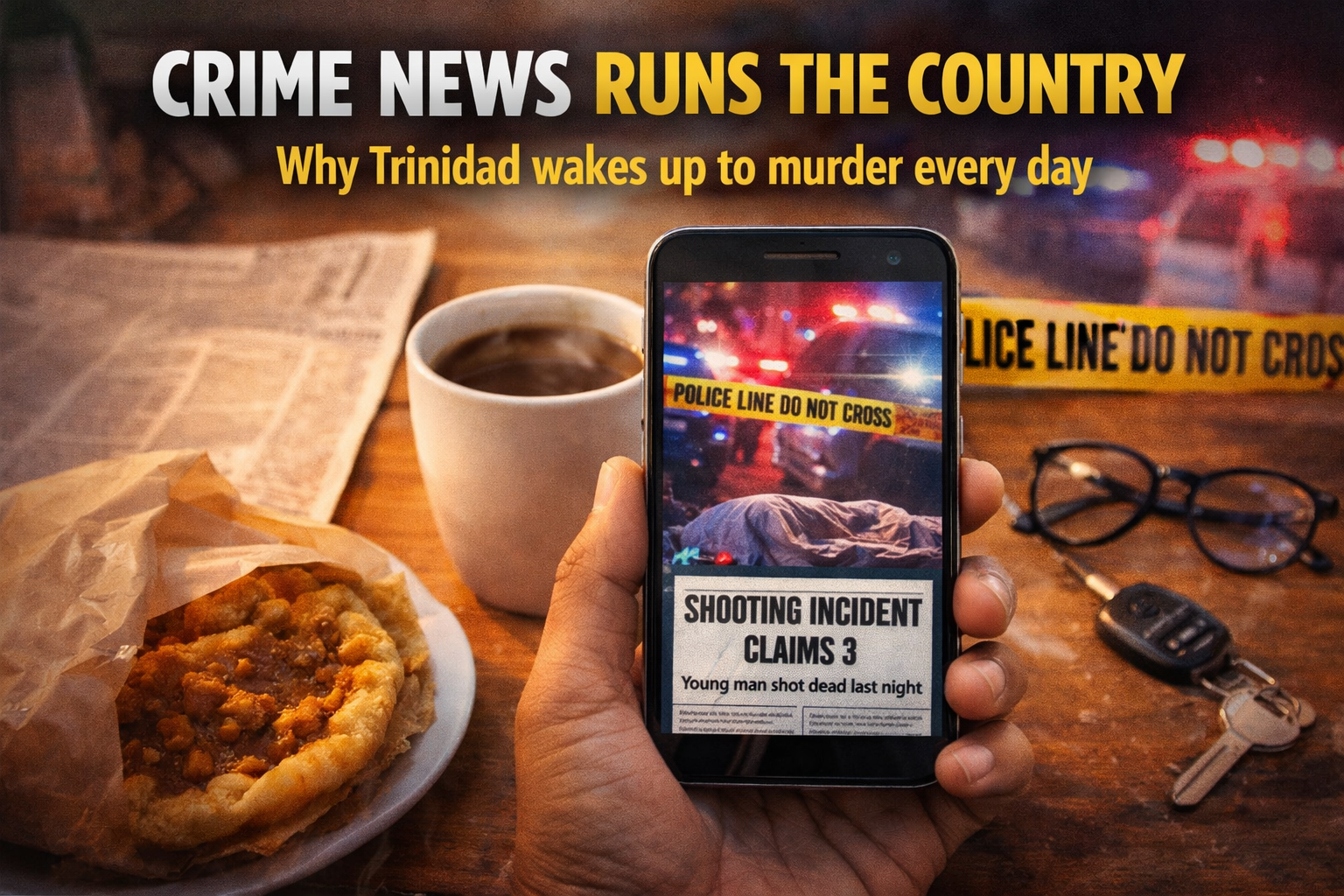
In Trinidad and Tobago, Crime News is not just a section of the paper anymore. It is the national weather report, the morning roll call, the background music to breakfast, and the dark little drumbeat behind almost every conversation. Before people even finish brushing their teeth, they checking who get kill, where it happen, whether it was gang-related, and if the video gone viral yet.
That is not normal. But in Trinidad, it has become normal enough to feel ordinary.
And that is the real story.
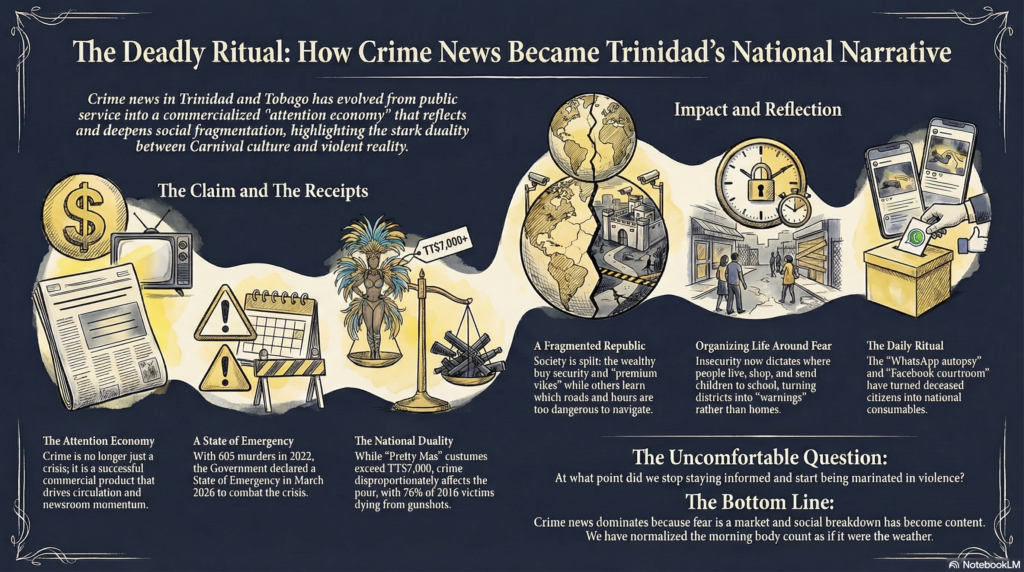
Crime news dominates Trinidad and Tobago partly because the violence is real. The country recorded a record 605 murders in 2022, and in March 2026 the Government again declared a State of Emergency over violent crime, later extending it for another three months. Even the US Embassy issued a security alert warning of increased police and military presence. In other words, the country is not imagining the crisis. The fear is being fed by real blood, real funerals, and a state now behaving like emergency rule is part of the annual calendar.
But crime news dominates for another reason too: it sells.
Crime News became one of the country’s most successful products
For years, murder in Trinidad and Tobago has not only been a tragedy. It has also been content.
Former Newsday editor-in-chief Suzanne Mills reflected publicly on the culture of crime coverage and recalled the chilling newsroom ritual where, around crunch time, editors would ask: “No murders yet?” Her point was not that journalists wanted death. Her point was that an entire publishing machine had become structurally dependent on it. Murder was not just being covered. It was helping to drive circulation, attention, and newsroom momentum.
That is how a society quietly slides into something dangerous.
At first, crime coverage feels necessary. Then it becomes commercially useful. Then it becomes culturally expected. And before long, a country ends up in a place where many citizens can no longer tell the difference between staying informed and being emotionally marinated in violence.
In Trinidad, crime is not only a public safety crisis. It has become a public attention economy.
This is why every murder now seems to arrive with its own media afterlife. There is the breaking alert. The photos. The shaky phone video. The neighbour quote. The police theory. The Facebook courtroom. The WhatsApp autopsy. By the end of the day, the dead person is no longer just a citizen. They are a national consumable.
That should trouble us deeply.
The country now lives between the “pretty” body and the broken body
One of the sharpest ways to understand modern Trinidad comes from sociologist Dylan Kerrigan, who describes the everyday coexistence of two dominant public images: the “pretty” body and the “grotesque” body. One is the polished, sexualised, commodified Carnival body of bikini-and-beads culture. The other is the dead, mutilated, and murdered body that fills crime reports and social media feeds.
That idea lands hard because it feels instantly familiar.
On one side, Trinidad sells itself as glow, waistline, rum, feathers, and premium vibes. On the other, it drowns in headlines about executions, reprisal shootings, home invasions, missing persons, and bodies found in bushes. One body is sponsored, staged, filtered and fenced off. The other is exposed, circulated, dissected and consumed.
That is not just a contrast. That is a national duality.
And the class angle makes it even sharper. Kerrigan noted that by 2016, participation in “pretty mas” could cost between TT$4,000 and TT$8,000, while major premium Carnival bands today still advertise costume packages costing several thousand Trinidad and Tobago dollars. Tribe’s 2026 costume listings, for example, include packages above TT$7,000. Carnival did not die, but for many ordinary people it has become increasingly gated, branded, and expensive.
So while one Trinidad is paying for all-inclusive joy behind ropes and wristbands, another Trinidad is learning to avoid certain roads, certain blocks, certain liming spots, and sometimes even certain hours of the day.
One Trinidad wines behind the truck. The other Trinidad checks if it safe to come out the house.
What Crime News says about the country is not flattering
It says we are frightened, yes. But it also says we are fragmented.
Crime news dominates Trinidad because the country no longer experiences itself as one shared social space. We increasingly live in bubbles of money, security, geography, and perceived risk. The rich buy walls, cameras, guards, generators, and access. The middle class buys avoidance, hypervigilance, and relocation plans. The poor often get left in the very communities most associated with both victimisation and suspicion.
That breakdown has been visible in the numbers for years. Research cited by Kerrigan found that from 2005 to 2010, 72.3% of murder victims were of African descent, even though Afro-Trinidadians made up 36.3% of the 2011 population census, while a 2016 murder profile found that 90% of victims were male, 62% were under 35, and 76% died from gunshot wounds. These are not random tragedies sprinkled evenly across the republic. They reflect a brutal concentration of risk.
And once violence becomes concentrated, media coverage can make the rest of the country consume those communities as danger zones rather than as fellow citizens in distress.
That is one of the ugliest things crime news does. It can turn suffering into geography. It can make whole districts feel like warnings instead of homes.
We are not only watching crime. We are organising national life around it
That is why the obsession with crime news says something bigger than “people like bacchanal.”
It says the republic has become psychologically structured by insecurity.
It shapes where people rent, where they fete, where they shop, where they send children to school, what route they drive, what time they leave work, and which parts of the country they only discuss like they are foreign territory. Even politics now performs itself through crime language. Governments promise crackdowns. Oppositions promise competence. States of Emergency return like sequels nobody asked for. Meanwhile the public keeps refreshing for the next body count.
And that is the deepest indictment of all.
Because when crime news dominates a country this thoroughly, it means violence has escaped the police blotter and entered the national imagination. It has become how the country narrates itself to itself.
Not through invention. Through repetition.
Not because every citizen is bloodthirsty. Because many now feel that crime is the only story powerful enough to explain why the place feels so tense, so divided, so exhausted, and so difficult to trust.
So yes, crime news dominates Trinidad and Tobago because crime is severe. But it also dominates because fear has become a market, spectacle has become a habit, and social breakdown has become content.
That is what it says about the country.
And until we confront that honestly, we will keep doing the same ritual every morning: open the phone, check the dead, shake we head, and keep moving like that is just life.
Maybe the most frightening thing is not that crime news rules the country.
Maybe it is how easily the country has learned to live with that fact.
Want the bigger picture? Explore our Trinidad Crime & Security hub for dashboards, explainers, updates, and deeper coverage of one of the country’s most urgent ongoing stories.