Trinidad STATE OF EMERGENCY: Now With Auto-Renew
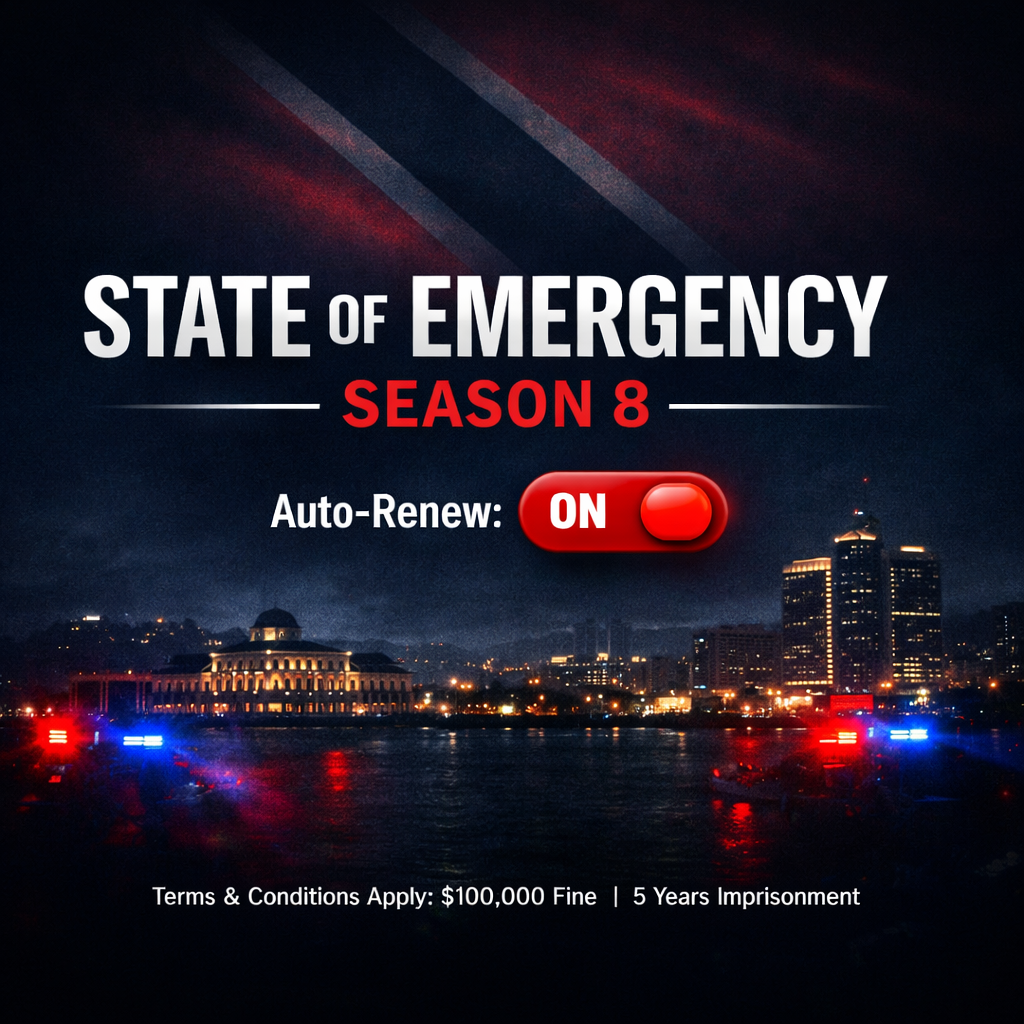
At 3:50 a.m. on March 3, 2026, Trinidad and Tobago woke up to another proclamation. The Trinidad State of Emergency was back. No countdown. No primetime address. Just a pre-dawn reset button pressed while most citizens were asleep.
A State of Emergency is supposed to be extraordinary. It exists for moments when the ordinary machinery of law cannot cope. Wars. Coups. Natural disasters. Clear and present threats. It is the constitutional equivalent of breaking glass and pulling the alarm.
But when the alarm keeps going off every few months, something changes. The extraordinary begins to feel… procedural.
And that is where this gets uncomfortable.
From Emergency to Policy?
The previous State of Emergency expired on January 31, 2026. Thirty-three days later, it was back. Official justification: escalating gang violence, 63 homicides early in the year, and “credible intelligence” targeting police and prison officers.
The formal mechanics are precise:
- Legal Notice No. 39: The Proclamation signed by President Christine Kangaloo declaring that a public emergency exists.
- Legal Notice No. 40: The Emergency Powers Regulations 2026, outlining expanded police authority.
- Penalties: $100,000 fine and five years’ imprisonment for violations.
- Initial constitutional lifespan: 14 days, subject to Parliamentary extension.
The distinction matters. The Proclamation opens the door. The Regulations rearrange the furniture inside the Constitution.
And the new layout gives law enforcement expanded powers of search, seizure, arrest, and detention, including the ability to hold individuals initially for 48 hours and extend that period through magistrate oversight.
This is not routine policing. This is emergency architecture.
“An emergency that keeps coming back isn’t an emergency. It’s a policy.”
The ZOSO Shadow
On January 27, 2026, the Government failed to secure the required three-fifths Senate majority for the Zones of Special Operations Bill which we covered here. Four days later, the previous SoE expired.
Then came a month of shootings.
Then came 3:50 a.m.
Critics argue the sequence is too neat to ignore. They frame this return to emergency powers as a workaround, a “Plan B” after legislative defeat. Government officials reject that characterization, insisting the intelligence threshold demanded action.
Here is the tension: if Parliament blocks a targeted security tool, and emergency rule replaces it, what exactly did the vote achieve?
Democracy is not just about outcomes. It is about process. When emergency regulations do the job that ordinary law failed to do, the line between crisis response and political convenience becomes blurry.
And blur is dangerous in constitutional governance.
What Changes for You
The Trinidad State of Emergency is not abstract. It alters the citizen-state relationship in measurable ways.
Expanded stop-and-search powers mean fewer procedural barriers.
Preventative detention mechanisms widen the net.
Restrictions tied to “protected places” allow control over movement.
Speech becomes more complicated. During emergencies, governments often argue that freedom of expression is not absolute. That is legally true. But the slope between restricting incitement and chilling criticism can be steep.
Recent high-profile detentions linked to social media posts have amplified fears that emergency regulations may extend beyond gang suppression and into opinion management.
That perception alone carries weight.
“Emergency powers don’t just catch criminals. They catch everybody’s rights.”
The Tobago Paradox
The Tobago House of Assembly reports only one homicide in 2026. Tobago officials insist serious crime remains low on the island.
Yet the emergency applies nationally.
This creates a visible contradiction. If the crisis is concentrated, why is the cure universal? Blanket measures are administratively simple, but constitutionally heavy.
Emergency powers are blunt instruments. They do not distinguish geography easily. But citizens do.
When people in one region feel safe while living under extraordinary restrictions, the question shifts from “Is there crime?” to “Is this proportional?”
Proportionality is the heartbeat of constitutional law. Remove it, and you remove public trust.
The Auto-Renew Problem
The Constitution allows a State of Emergency for 14 days unless Parliament extends it. That safeguard exists for a reason. Emergency powers bypass normal judicial rhythms and compress oversight.
But what happens when declarations recur in close succession?
At some point, the exceptional becomes the expected. Citizens begin to adjust. Police procedures normalize. Political rhetoric hardens.
Emergency governance has a psychological effect. It trains a population to accept expanded authority as background noise.
And that is the quiet risk.
Crime is real. Victims are real. The public demand for safety is legitimate. No serious person disputes that violent gang networks threaten national stability.
The debate is not whether crime exists. It is whether emergency rule is a long-term crime strategy.
Because once emergency becomes the strategy, ordinary law atrophies.
The Constitutional Trade-Off
The Trinidad State of Emergency sits at the intersection of two truths:
- The State has a duty to protect life.
- The State must not erode liberty in the process.
The Prime Minister has vowed to “terrorise criminals” using every legal mechanism available. Supporters applaud decisive leadership. Opponents warn of creeping authoritarianism.
Both reactions are predictable.
But history offers a sober lesson. Emergency powers are easiest to justify at the beginning. Hardest to withdraw at the end.
Trinidad and Tobago has declared multiple States of Emergency since 1970. Each one emerged from crisis. Each one left institutional fingerprints.
The question now is not whether this SoE is legal. It is.
The question is whether it is becoming normal.
“Auto-renew governance is efficient. Democracy is slower. Only one of them was designed to last.”
What Happens Next?
Parliament must debate and approve any extension beyond the initial period. That debate will be decisive.
If emergency rule continues for three months, the Government will argue that stability requires it. If crime declines, the SoE will be credited. If it does not, critics will say constitutional freedoms were traded for optics.
The real test will not be arrest numbers.
It will be whether the country exits emergency mode promptly once the threat stabilizes.
Because a State of Emergency is supposed to be the glass case on the wall. Break only in crisis.
When the glass is always cracked, citizens begin to wonder whether the alarm system has quietly become the building manager.
Want the bigger picture? Explore our Trinidad Crime & Security hub for dashboards, explainers, updates, and deeper coverage of one of the country’s most urgent ongoing stories.