DEMOCRACY ON LAYAWAY: How Stabroek News Got “Starved” in an Oil-Rich Guyana
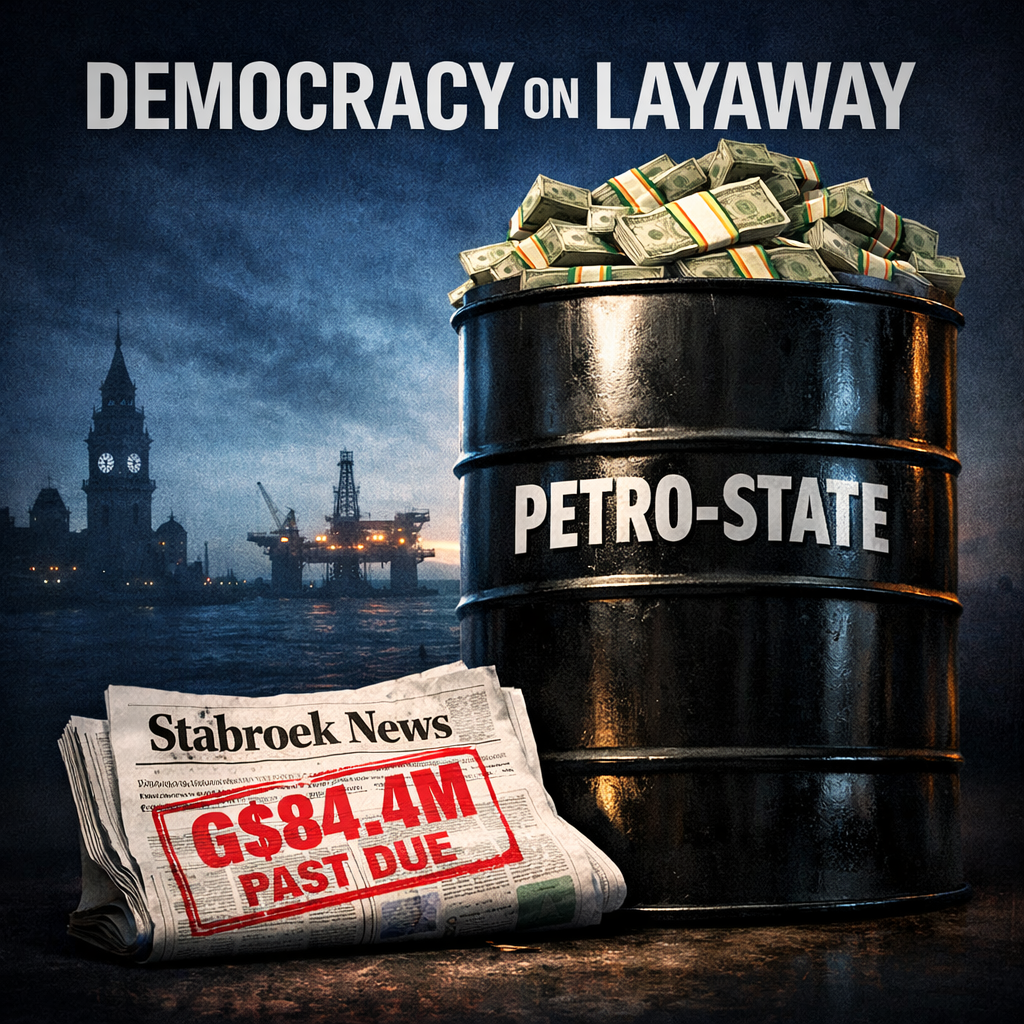
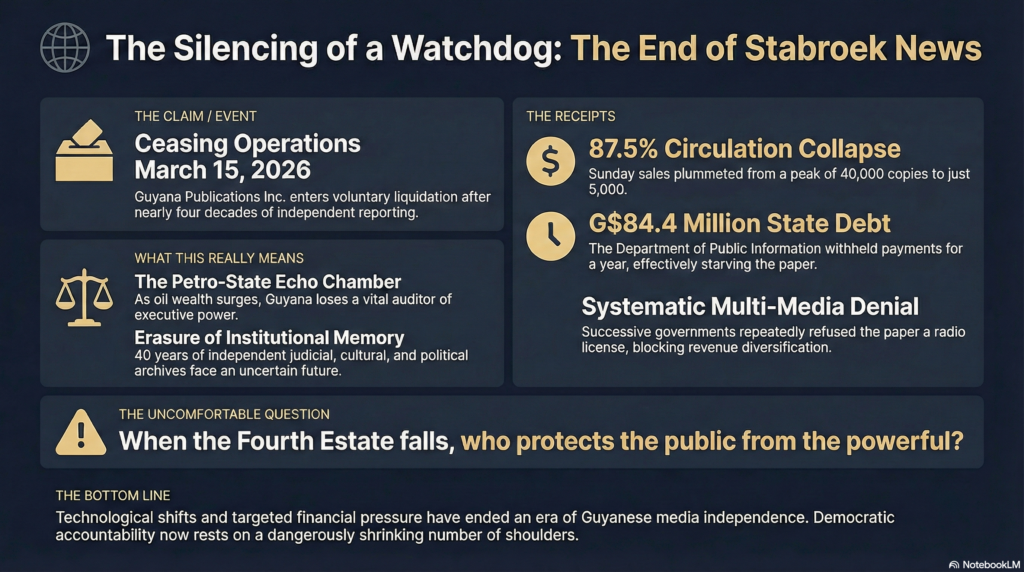
Guyana is a petro-state with a G$1.5 trillion budget. Yet Stabroek News — the country’s “newspaper of record” — is shutting down its print operations on March 15, 2026. The contradiction is so sharp it could cut glass.
This is not just the slow death of print. It is the collision of oil wealth, political power, and a media house that says it refused to kneel.
So here’s the uncomfortable framing: when a watchdog dies in an oil-rich democracy, is it market gravity or managed starvation?
Stabroek News: From Rebellion to Record
Founded in November 1986 by David de Caires and Miles Fitzpatrick, Stabroek News was born in an era when the state controlled the information tap. It emerged as what one stakeholder called a “rebellion against silence.”
In 1992, as Guyana navigated its first free elections in decades, the paper played a visible role in shaping civic discourse. By 1994, it had transitioned into a daily publication. It was not just a business. It was institutional memory.
Over time, it printed exam papers for students in remote communities. It challenged administrations across party lines. It survived open hostility, including a 17-month state advertising withdrawal between 2006 and 2008 under the Bharrat Jagdeo administration.
It endured because it diversified its readers and defended its independence.
Until the numbers began to suffocate it.
The Circulation Death Spiral
The hard data is brutal.
Sunday circulation fell from roughly 40,000 copies at peak to about 4,000–5,000 by 2026. That’s an 87.5 percent collapse. Daily sales fell from 18,000 to around 4,000. Digital migration is real. Corporate advertising budgets moved to social media. Digicel and Banks DIH shifted strategy.
Editor-in-Chief Anand Persaud was blunt: older subscribers are dying or migrating.
No conspiracy is required to explain part of this decline. Print media globally has been losing oxygen for years.
But this is where Guyana’s case stops looking purely structural and starts looking political.
The G$84.4 Million Question
As of January 2026, the state-run Department of Public Information owed Stabroek News G$84.4 million in advertising arrears. Some assessments place total outstanding liabilities, including older arrears, closer to G$100 million.
A partial payment of G$23.3 million was made in November 2025. No payments were recorded for December 2025 or January 2026.
The newspaper itself addressed the issue directly in an editorial examining the DPI debt and its implications for media sustainability. Read it here:
https://www.stabroeknews.com/2026/02/23/opinion/editorial/the-dpi-debt-to-stabroek-news/
Let’s put this in perspective. Guyana’s national budget sits at approximately G$1.5 trillion. (We broke that down in detail in our analysis of Guyana Budget 2026 Is a Trillion Dollars:
The arrears represent a fraction of one percent of state expenditure. In macro terms, it is dust.
In operational terms for a newspaper battling collapsing circulation, it is oxygen.
The company chose voluntary liquidation while still solvent, ensuring staff severance and pension obligations are met. Chairman Brendan de Caires called it a “dignified exit.”
That phrase matters.
“We want to leave on our feet rather than living on our knees.” — Anand Persaud
That is not the language of bankruptcy chaos. It is the language of independence under pressure.
The Clearinghouse Problem
Government advertising in Guyana flows through the DPI. That structure centralizes leverage.
When advertising revenue is withheld or delayed, the state is not just another client. It becomes a gatekeeper of survival.
Management has described the arrears as a tactic that “could equally be construed as an attempt to starve this company of its operating funds.”
Minister Kwame McCoy’s public response emphasizes the “porous global media landscape” and competitive market forces. That argument is not irrational. The market is indeed porous.
But when payments stall while the state is flush with oil revenue, skepticism becomes rational.
This is not proof of coordinated suppression. It is evidence of a power imbalance that democracies should treat carefully.
The Petro-State Paradox
Guyana is transforming at warp speed. Oil production offshore has made it one of the fastest-growing economies in the world.
In such moments, institutional oversight becomes more important, not less. Petro-states historically struggle with transparency. Revenue volatility, procurement opacity, and elite consolidation are not theoretical risks. They are well-documented patterns in political economy literature.
Remove a major independent media voice at precisely that inflection point, and the optics are disastrous.
“In a petro-state, silence doesn’t arrive with soldiers. It arrives with invoices.”
That line will travel because it captures the paradox. No tanks. No censorship decree. Just debt.
A Regional Warning
The timing is regional. In January 2026, Trinidad’s Newsday also ceased operations after 32 years, citing market pressures.
Small Caribbean markets face structural disadvantages: limited ad pools, population size constraints, and global digital giants siphoning revenue.
But when independent media collapses, the democratic cost is not regional. It is intimate. It is local.
Kaieteur News now stands more exposed as the remaining heavyweight. Whether one paper can sustain the Fourth Estate alone in a small petro-state is an open question.
What Dies When a Newspaper Dies?
When Stabroek News prints its final edition on March 15, 2026, the loss will not be measured in paper tonnage.
It will be measured in archives. In the loss of a platform that chronicled Guyana’s transition from state monopoly to electoral democracy. In the narrowing of voices.
Tacuma Ogunseye’s warning resonates:
“Without a meaningful democratic voice those in power begin to hear only itself.”
Echo chambers are comfortable. They are also dangerous.
The closure of Stabroek News may indeed reflect global print decline. It may also reflect how fragile independent institutions become when revenue streams are centralized under political authority.
Both can be true at the same time.
The real question for Guyana is not whether print is dying. Print has been dying for years.
The real question is this: in a nation swimming in oil wealth, what does it say about priorities when a G$84.4 million invoice becomes the quiet hinge on which a democratic institution swings shut?