Caribbean Carnival Is No Longer Just Culture — It’s a Full-Blown Regional Battle for Your Money, Your Waistline and Your Passport
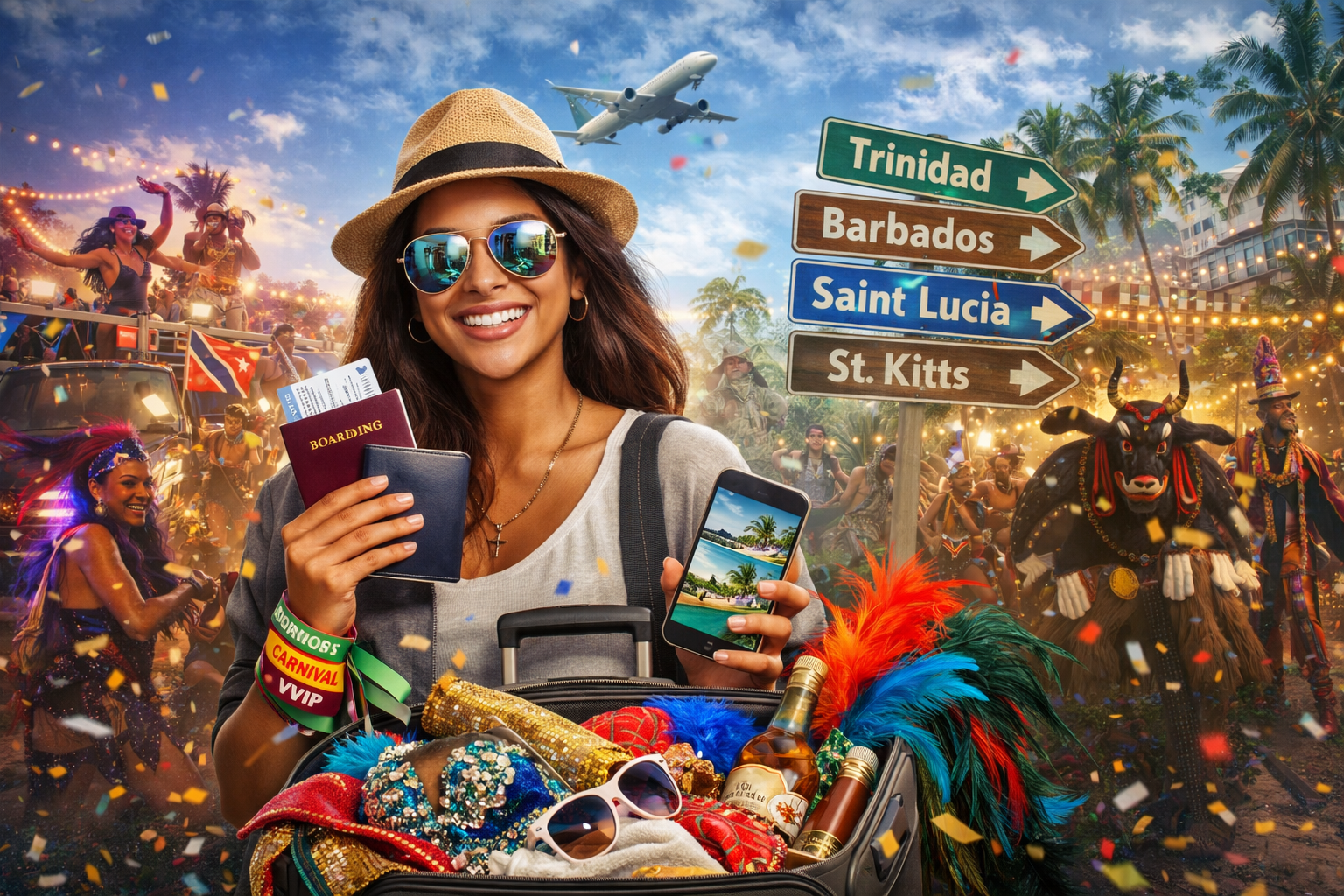
Caribbean Carnival used to be something people inherited. Now it is also something people budget for, train for, book flights for, and argue over like it is a football league table. Somewhere between Canboulay and card payments, the region’s greatest emancipatory celebration became a serious tourism battlefield. One island is selling prestige. Another is selling polish. Another is selling Christmas bacchanal. Another is selling pure summer heat.
And yet, beneath the feathers, foam coolers, premium wristbands and “all-inclusive” branding, Caribbean Carnival still carries the DNA of resistance. In Trinidad and Tobago, the festival’s roots are tied to the post-emancipation transformation of European masquerade into Afro-Creole expression, and institutions like NALIS still frame Carnival as a two-century evolution from elite festivity into a truly national cultural force.
From emancipation to export product
The uncomfortable truth is this: Caribbean Carnival is both a cultural archive and a commercial machine. That tension is the story.
The original energy of Carnival was not polished, curated, or sponsored by telecom logos. It was rougher than that. More defiant. In Trinidad, Canboulay emerged from the experience of emancipation and public reclamation, and colonial attempts to suppress African drumming and stick-fighting helped create new forms of expression that fed the later evolution of steelband culture and the wider festival. Saint Lucia’s official history traces its organized Carnival to 1947, when revellers beat rhythms on bottles and pieces of steel and paraded through Castries. Barbados’ Crop Over, meanwhile, reaches back to the sugar harvest traditions of the 18th century, rooted in plantation history and later revived as a modern national festival.
That is why Caribbean Carnival still matters. It is not just a party calendar. It is one of the region’s most visible proofs that African-descended Caribbean people took what was exclusionary, colonial and hierarchical, and remade it into something louder, freer and more ours.
Carnival did not begin as luxury. It began as reclamation.
Trinidad: the giant everybody still measures themselves against
Let us be honest. When people say “Caribbean Carnival” with chest, they are often still thinking about Trinidad first.
Trinidad remains the benchmark because it offers scale, history, music industry gravity and an unmatched ecosystem of mas bands, fetes, steelpan, calypso and J’Ouvert. Official tourism and NCC materials confirm Carnival Monday and Tuesday 2026 as February 16 and 17. Premium bands like TRIBE and BLISS have turned costume registration into something closer to a military operation: TRIBE says downpayments must be made within five days of registration and costumes paid in full by December 31, 2025, while both TRIBE and BLISS list Carnival Thursday, February 12, 2026 as the final collection date for costumes.
That tells you something important about modern Trinidad Carnival. Yes, it is still the Mother of All Carnivals. But it is also an industry. Miss your payment schedule and your “freedom” gets cancelled by email.
For the visitor, Trinidad is the right choice if you want the deepest cultural immersion, the broadest music experience, and the bragging rights of doing the biggest road in the region. It is less “soft life” and more full-contact bacchanal.
Barbados: Crop Over is sweeter, slicker and fiercely protective of its identity
Barbados does not merely host a carnival. Barbados insists that you call it Crop Over.
That is not a trivial branding quirk. It is cultural territory. Official Visit Barbados messaging literally warns visitors that “it’s not Barbados Carnival, it’s Crop Over,” and points revellers toward Grand Kadooment Day as the climax. Official listings show the 2026 season running from July 3 to August 4, and the National Cultural Foundation describes Crop Over as a three-month festival of Barbadian music, arts, food and culture ending in Grand Kadooment. Visit Barbados also recommends masqueraders register two to three months before the season begins to secure costumes.
Barbados is ideal for the traveller who wants Carnival with polish. The hotels are stronger at the upper end, the branding is cleaner, and the vibe often feels more curated than chaotic. Crop Over still has deep history, but it also knows exactly how to package that history for the camera, the luxury traveller and the return visitor who wants bacchanal without total disorder.
That makes Barbados a little dangerous in the regional rivalry. It is not trying to out-Trinidad Trinidad. It is selling a different proposition altogether.
Trinidad sells scale. Barbados sells polish. Both are selling belonging.
Saint Lucia and St Kitts: one brings summer fire, the other brings Christmas folklore
Saint Lucia and St Kitts may not have Trinidad’s scale, but both have found smart lanes in the regional race.
Saint Lucia has leaned into youthful energy and a sonic identity shaped by Dennery Segment. Its official Carnival platform says accommodations fill quickly and urges visitors to book early. For travellers, that matters, because Saint Lucia in carnival season is not a place to book late and then act shocked when the good options vanish. The island suits the person who wants beautiful scenery, hard partying, and a younger high-BPM atmosphere.
St Kitts, by contrast, owns a different calendar window. Sugar Mas 54 is positioned around Christmas and New Year, giving it strategic value in the regional circuit. Historic St Kitts sources highlight Christmas Sports traditions such as the Bull and Masquerade, reminding visitors that this festival still carries strong folklore components beneath the party marketing. That gives Sugar Mas a special texture. It feels festive, yes, but also deeply tied to older performance traditions that many visitors say they want but often ignore once the drinks start flowing.
How to choose your Caribbean Carnival wisely
Choose Trinidad if you want the biggest cultural statement, the strongest music ecosystem, and the road experience everybody compares everything else to. Choose Barbados if you want a more polished summer festival with strong hospitality and a clear climax in Grand Kadooment. Choose Saint Lucia if you want scenic beauty, younger energy and intense road vibes in July. Choose St Kitts if you want carnival folded into Christmas and New Year, with stronger visible links to Christmas Sports folklore.
Practical advice is simple. Register costumes early. In Barbados, official guidance says two to three months ahead. In Trinidad, the big bands work on strict payment deadlines and collection cutoffs. Book accommodation early, especially for Saint Lucia, where official carnival guidance says rooms fill quickly. Learn the soundtrack before you land too: soca and calypso remain central in Trinidad, Crop Over has its own Barbadian flavour, Saint Lucia pushes Dennery Segment energy, and St Kitts brings Sugar Mas character shaped by holiday-season traditions. For islands using the EC dollar, remember the XCD is pegged at EC$2.70 to US$1.00, which helps with planning in St Kitts and Saint Lucia.
The deeper point, though, is this: Caribbean Carnival has become a global phenomenon precisely because it never stopped being local first. The powder, paint, feathers and flags may now attract influencers, package tourists and carnival chasers with expense spreadsheets. But the soul of the thing still comes from somewhere older than the marketing copy. It comes from resistance. Reinvention. Release.
And that is why people keep coming back.
Because in the Caribbean, Carnival is not just an event. It is history in motion with better music and less sleep.
For more destination guides, travel warnings, tourism updates, and plain-English Caribbean travel coverage, visit our Caribbean Travel hub.