Is Trinidad Carnival Still for the People — Or Just for People With Money?
Trinidad Carnival has always sold a dream: freedom, rhythm, colour, bacchanal, and that magical annual feeling that for two days the whole country belongs to the street. But in 2026, plenty people are asking a harder question. Is Trinidad Carnival still a people’s festival, or has it slowly become a premium lifestyle product with feathers, fences, and a frightening price tag?
That question is not anti-Carnival. It is pro-truth. Because the truth is that Trinidad Carnival was not born as a luxury brand. It was born out of resistance, improvisation, and people making culture under pressure. Over two centuries, it evolved from elite European masquerade into a distinctly local, rebellious celebration shaped by emancipation, Canboulay, stickfighting, drumming, satire, and the raw energy of ordinary people taking over public space. Even NALIS notes that Carnival in Trinidad and Tobago evolved from an “elegant, exclusive affair” and that the modern festival did not begin as an inclusive national celebration.
“Carnival did not start as a premium package. It started as people refusing to disappear.”
From French masquerade to Canboulay rebellion
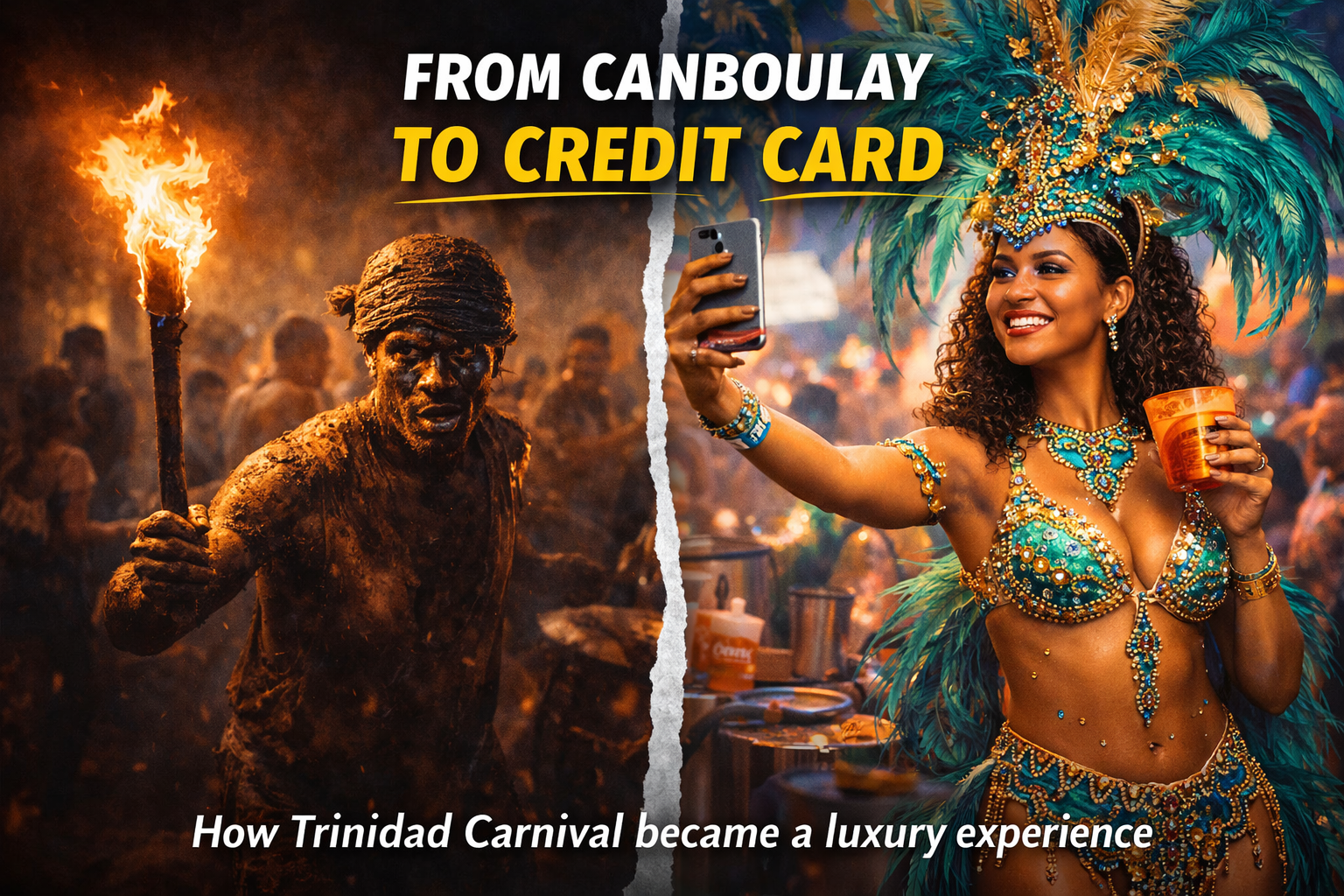
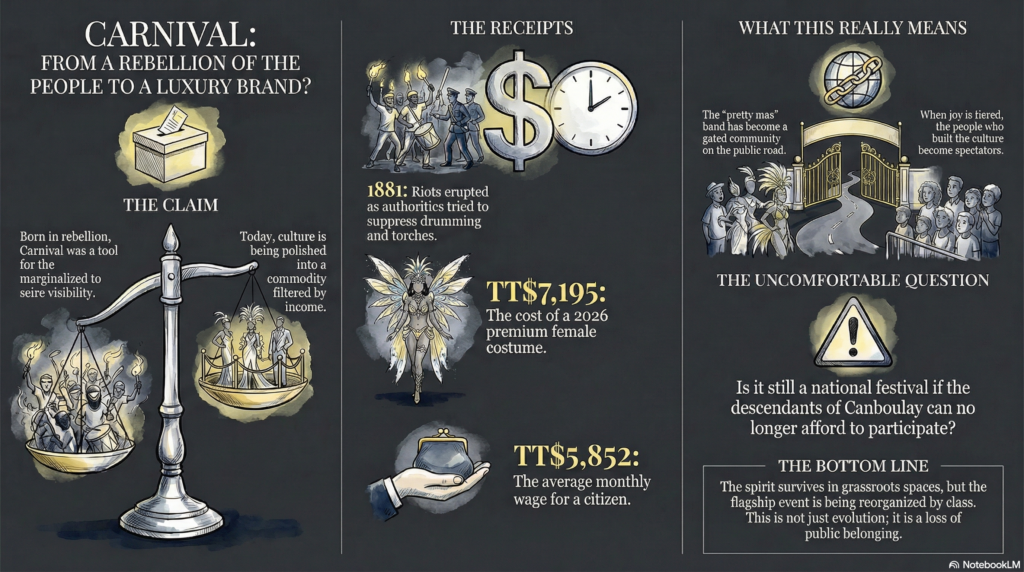
To understand what Trinidad Carnival has become, you first have to understand what it was. The roots of Carnival in Trinidad go back to the late 18th century, when French planters brought pre-Lenten masquerade customs to the island. After emancipation in 1834, formerly enslaved Africans transformed the festival into something far more powerful and far more dangerous to the colonial order: Canboulay, a night-time street celebration filled with drums, chant, torches, stickfighting, mockery, and memory. Colonial authorities did not merely dislike it. They feared it. NALIS records that state repression of Canboulay helped produce the 1881 and 1884 riots, and the authorities moved to suppress drumming, torch processions, and other practices, pushing Carnival toward the regulated form people later recognized as J’Ouvert and daylight mas.
That history matters because it destroys the lazy idea that Carnival was ever just “fun.” From the start, it was also about power. Who controls the street? Who gets seen? Who gets to perform nationhood? Trinidad Carnival became one of the few places where the people from below could seize visibility, style, and symbolism for themselves.
And that is why the modern shift feels so politically loaded. When people complain that Carnival feels less accessible now, they are not just grumbling about prices. They are reacting to the possibility that a festival created through struggle is being polished into something that looks inclusive but is increasingly filtered by income.
How Trinidad Carnival became more expensive, polished, and exclusive
A lot changed in the late 20th century. Scholar Dylan Kerrigan argues that the rise of “pretty mas” and the all-inclusive band model transformed Carnival from a broader “theatre of the streets” into a more commodified and status-driven experience. He notes that by 2016, participation in major pretty mas bands ranged from roughly TT$4,000 to TT$8,000, while the average monthly wage was TT$5,852. In plain language, a person could spend an entire month’s pay, or more, just to get on the road in one of the headline bands.
That logic has not gone away. It appears to have hardened. TRIBE’s current costume listings show female options at TT$6,995 to TT$7,195 and male options around TT$5,795 to TT$5,995. Guardian reporting from Carnival 2026 also noted that some premium all-inclusive events were charging more than TT$4,000 per ticket. So when ordinary Trinidadians say Carnival feel like it have a cover charge on culture, they are not imagining things.
The result is that modern Carnival often looks like two festivals happening at once. One is the glossy export version: curated bodies, premium sections, branded experiences, private security, imported aesthetics, and carefully managed access. The other is the older, rougher, more democratic spirit still living in J’Ouvert, pan yards, traditional mas, community bands, and roadside lime.
“When a people’s festival starts costing a month’s salary, the question is no longer about vibes. It is about ownership.”
Trinidad Carnival and the class question nobody can dodge
This is where the argument gets uncomfortable. Trinidad likes to tell itself that Carnival belongs to everybody. Spiritually, yes. Symbolically, yes. Economically, not so simple.
Kerrigan’s work goes even further, describing the all-inclusive mas band as a kind of “gated community” on the road, where participation becomes a public display of wealth and belonging. He argues that this shift mirrors a wider class divide in Trinidad, where the people who historically made the culture can end up working around it rather than fully inhabiting it. That is the sting in the modern Carnival debate. The working class may still be central to Carnival’s labour, sound, and energy, but not always to its most glamorous spaces.
And the broader economy is not making that easier. The Central Statistical Office reports Trinidad and Tobago’s unemployment rate at 4.8% in September 2025, up from the prior quarter. In a country where many households already feel squeezed, Carnival pricing does not land as harmless luxury. It lands as a reminder that even joy is being tiered.
That does not mean every band is predatory or every masquerader is elite. It means the centre of gravity has shifted. Too much of Trinidad Carnival now revolves around who can afford the polished version, rather than how many people can meaningfully participate in the cultural whole.
The good news: the people’s Carnival is not dead
But here is the part that stops this from becoming a funeral. The people’s Carnival is still alive. It is just under pressure.
Guardian reporting this year highlighted Berkeley Carnival Revolution’s “pay what you can” approach, built around accessibility, protest mas, repurposed materials, and the belief that “everybody should enjoy the culture.” The same coverage of Carnival 2026 also pointed to spaces like Flava Village that kept a grassroots, more accessible pulse alive even as premiumisation accelerated.
That matters. It means the story is not simply “Carnival sell out.” The real story is a tug of war. On one side is Carnival as commodity, tourism engine, and aspirational package. On the other is Carnival as memory, protest, improvisation, and public belonging. Even official and academic discussions reflect that tension. Shari Bissoondatt’s research argues that Trinidad and Tobago’s 2020 cultural policy can centralize Carnival in ways that flatten the country’s wider cultural complexity and reinforce exclusionary frameworks rather than truly inclusive ones.
So, is Trinidad Carnival still for the people?
Yes, but less evenly than we like to admit. Yes, in spirit. Yes, in history. Yes, in the smaller spaces where culture still breathes without asking for a wristband. But if the flagship experience increasingly belongs to those with disposable income, then the country has to stop pretending that this is just normal evolution. It is a political and cultural shift.
Because once the descendants of Canboulay start feeling like spectators outside the rope, Trinidad has bigger problems than costume prices. It means one of the nation’s greatest acts of collective self-expression is slowly being reorganized by class.
And for a festival born in rebellion, that should trouble all of we.
“Carnival is still for the people in theory. The problem is that the premium version keeps looking less and less like the people who built it.”
For more destination guides, travel warnings, tourism updates, and plain-English Caribbean travel coverage, visit our Caribbean Travel hub.