
GUYANA BUDGET 2026 IS A TRILLION-DOLLARS: IS THIS A NORWAY SPEEDRUN OR A CARIBBEAN CHAOS PATCH?
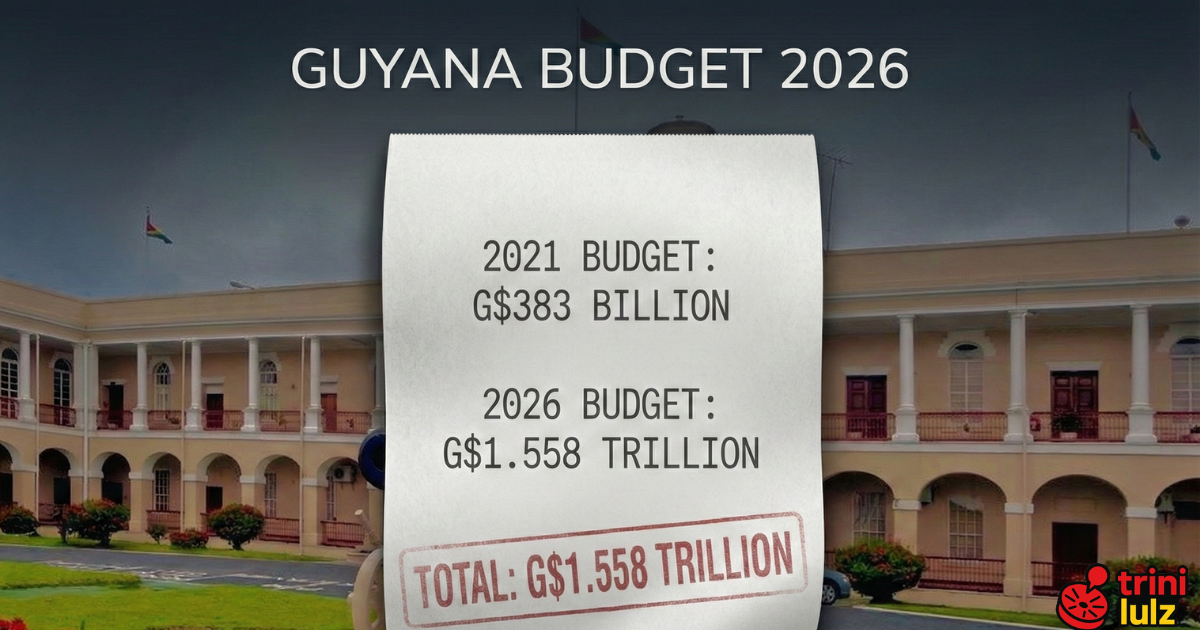
Five years ago, Guyana was operating on a national budget of roughly G$383 billion. That was 2021, not ancient history, not some pre-independence footnote. Fast-forward to today and the Guyana Budget 2026 has landed at a staggering G$1.558 trillion.
Let that sit for a second.
This is not a “slightly bigger budget.” This is a country that has watched its spending envelope more than quadruple in half a decade. Same population. Same geography. Entirely different money.
And it is being unveiled with confidence, not apology. The government’s case is simple: the economy can handle it.
That confidence is rooted in oil production that has already reshaped the country’s balance sheet, with Guyana now producing close to a million barrels a day and redefining its place in the regional energy hierarchy, as we examined in Guyana hits 900,000 barrels a day: the Caribbean’s new energy superpower.
In 2025, Guyana’s economy expanded by 19.3 percent overall, while the non-oil economy grew by 14.3 percent, suggesting growth is no longer confined to offshore wells alone. The pitch is clear. This is not just oil money sloshing around. This is broad-based momentum.
Which brings us to the uncomfortable Caribbean question.
Is the Guyana Budget 2026 the opening act of a Norway-style transformation? Or is this what happens when a small state suddenly has access to very big money and has to learn how to spend it at speed?
From G$383B to G$1.558T: the budget that ate its vegetables and lifted weights
Governments usually grow budgets cautiously. Incremental increases. Careful language. Guyana did none of that.
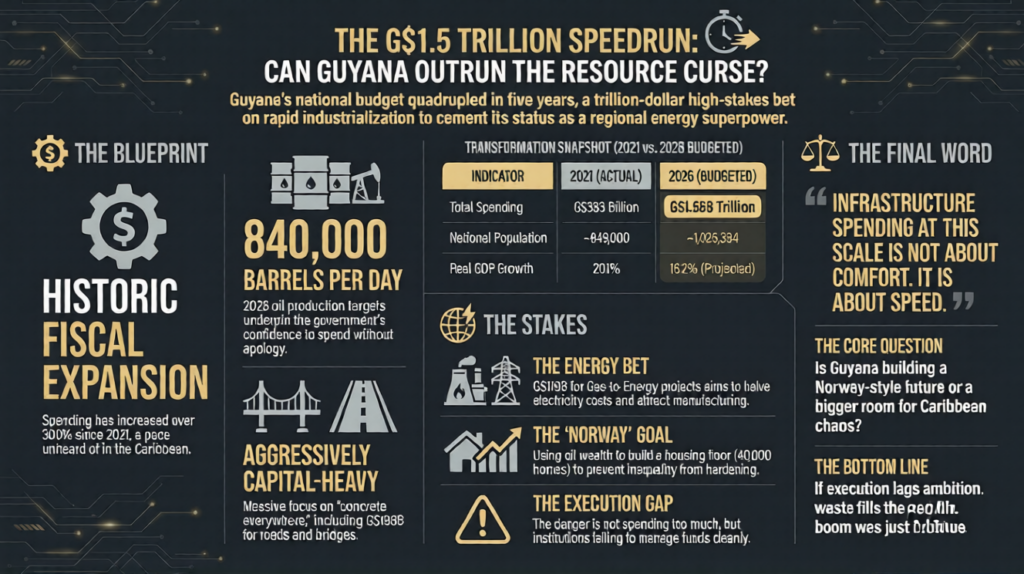
According to the official Budget 2026 Speech laid in Parliament by the Ministry of Finance, total government spending now stands at G$1.558 trillion, representing an increase of more than 300 percent since 2021. That pace alone makes this budget historic. In Caribbean terms, it is almost unheard of.
What matters more is where the money is going. This is not a budget built around handouts and vibes. It is aggressively capital-heavy.
Roads, bridges, and concrete everywhere
Infrastructure is the backbone of the Guyana Budget 2026, and the numbers are not subtle.
Nearly G$196 billion is earmarked for roads and bridges. Community roads and drainage alone account for over G$40 billion, while major bridge projects command another G$12 billion.
This is the logic of acceleration. You cannot industrialise, decentralise housing, or move labour efficiently without first fixing how people and goods move. Guyana is attempting to do decades of catch-up in one sprint.
Call-out:
“Infrastructure spending at this scale is not about comfort. It is about speed.”
Energy: the bet that changes everything
Energy spending under the Guyana Budget 2026 sits at roughly G$119 billion, and this is where the long game becomes obvious.
Gas-to-energy remains the flagship project, positioned as the lever that cuts electricity costs, attracts manufacturing, and reshapes competitiveness. Renewables also make an appearance, with G$6 billion allocated to clean energy initiatives.
This is not climate virtue signalling. It is industrial math. Cheap, reliable power is how countries move from exporting raw resources to exporting value.
Whether execution keeps pace with ambition is the question that will define the decade.
Education and health: holding the social floor steady
One of the more interesting signals in the Guyana Budget 2026 is restraint.
Education spending sits at roughly G$183.6 billion, almost unchanged from the previous year. Health rises to about G$161.1 billion, up from 2025, with increased allocations for drugs, medical supplies, and electronic health records.
This suggests a government confident enough not to overreact. Instead of ballooning social spending to chase applause, the strategy appears to be consolidation and system-building.
Call-out:
“The quiet budgets are sometimes the most confident ones.”
Housing: building a country people can actually live in
Housing receives roughly G$159 billion in the Guyana Budget 2026, tied to an explicit medium-term goal of 40,000 new homes over five years.
This matters more than glossy GDP charts. Rapid growth without housing supply is how inequality hardens. It is how young workers get priced out of the very boom they helped create.
Guyana seems keenly aware of that trap.
The risk nobody can budget away
Here is the part no spreadsheet can solve.
Spending money is easy. Spending it well, quickly, and cleanly is not.
A budget that expands this fast puts enormous strain on institutions. Procurement systems. Project management. Oversight. Labour capacity. Even simple things like auditing timelines get stretched.
The danger is not that Guyana is spending too much. The danger is that execution lags ambition, and waste fills the gap.
This is where the Caribbean will be watching closely.
Why the region is watching Guyana like a reality show
The Guyana Budget 2026 is no longer just Guyana’s business.
It affects migration, labour markets, housing prices, and investment flows across the region. Every island now has someone eyeing Georgetown as the place where the future seems to be happening faster.
For countries still juggling debt ceilings and refinancing bills, the contrast is uncomfortable. For others, it is aspirational.
Norway speedrun or Caribbean chaos patch?
That is the real question sitting inside this trillion-dollar moment.
If Guyana executes well, this budget becomes a case study in how a small resource-rich state builds infrastructure first, institutions second, and prosperity last.
If it stumbles, the same numbers will be cited for years as proof that money alone does not equal development.
Either way, the Guyana Budget 2026 has changed the regional conversation. Quietly, decisively, and at a scale the Caribbean is not used to seeing.
The oil boom was the prologue.
This budget is where the story actually begins.