Why Trinidad Traffic Keeps Getting Worse — And Why Nobody Ever Seems to Fix It
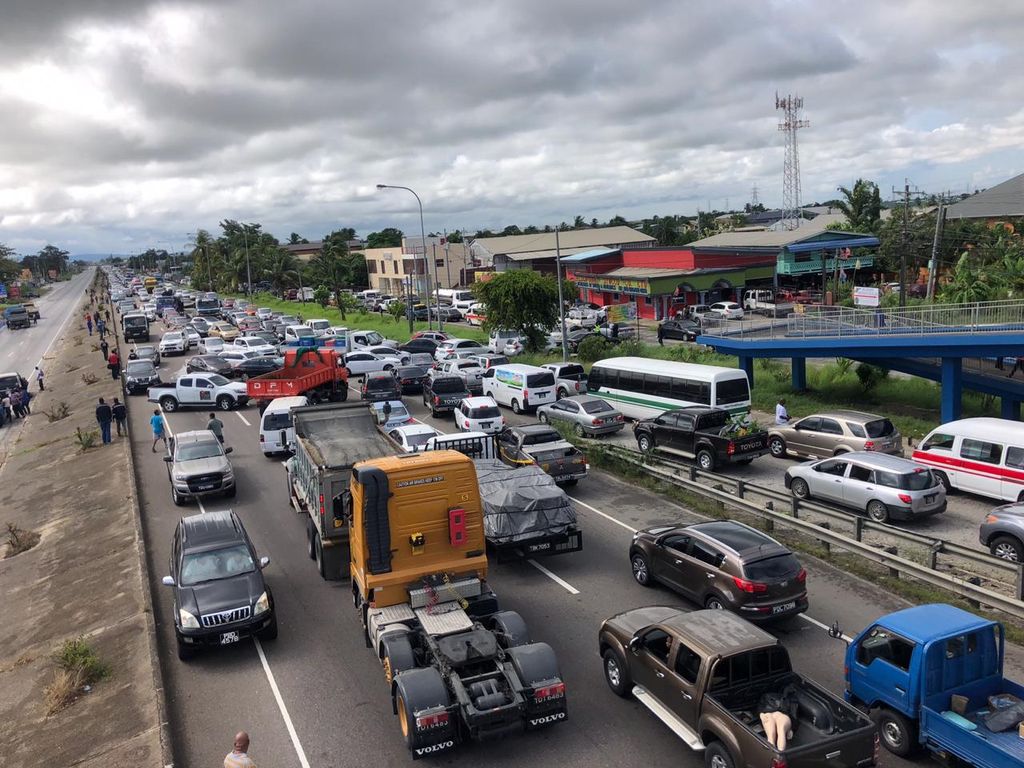
Trinidad Traffic is no longer just a daily annoyance. It is a national punishment ritual. Every morning, thousands of people leave home with hope, only to end up trapped in a long metallic prayer circle of brake lights, potholes, missed turns, maxi smoke, and existential regret. The cruel part is that everybody knows traffic bad. Everybody cusses it. Every government promises relief. And yet somehow, year after year, the jam gets worse.
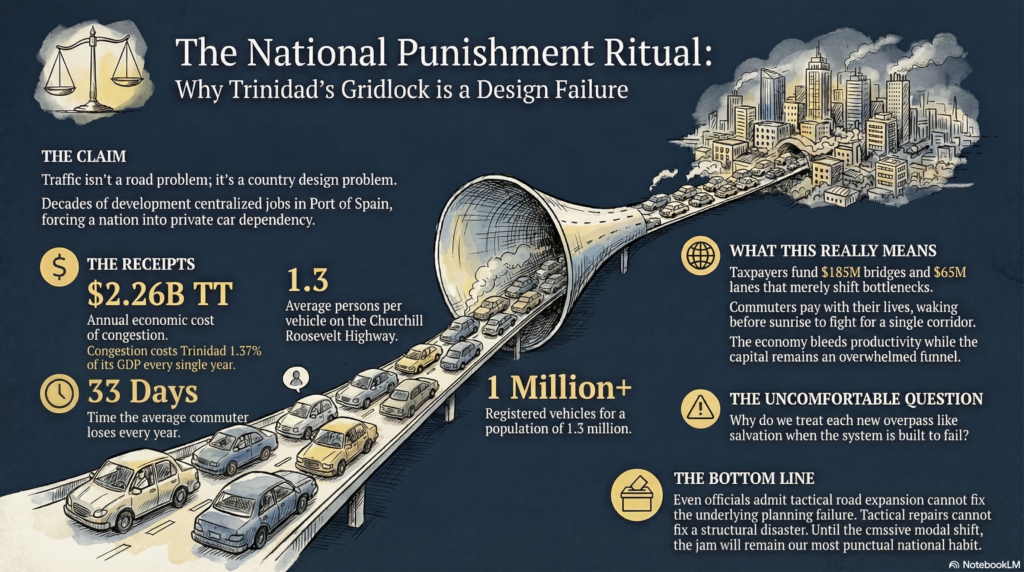
That is because Trinidad’s traffic problem is not simply a road problem. It is a country design problem. The gridlock choking the Churchill Roosevelt Highway, the Solomon Hochoy, the Uriah Butler, and every major feeder road is the result of decades of development that packed too many jobs, schools, services, and opportunities into a handful of urban corridors, while pushing more and more people into private cars to survive the daily commute. ECLAC estimates that congestion costs Trinidad and Tobago about TT$2.26 billion a year, or 1.37 percent of GDP, and that the average commuter loses about 33 days a year in traffic delays.
Trinidad did not just build traffic. Trinidad built a system that forces people into traffic.
Too Many Cars, Too Few Real Alternatives
One of the hardest truths in this whole mess is that Trinidad simply has an extraordinary number of vehicles for a small country. By 2019, the total number of vehicles had already passed one million, in a country with a population of roughly 1.3 million. At that time, annual new registrations were running above 25,000. Central Bank data also shows 25,091 registrations in 2019, 22,992 in 2024, and 14,221 in 2025. Even when annual registrations fluctuate, the long-term pattern remains clear: the national transport model keeps feeding private vehicle dependence.
And here is where the bacchanal becomes technical. More cars do not automatically mean better mobility. In fact, they can mean the exact opposite. Research cited in public discussion around Trinidad’s road use found the average vehicle occupancy on the Churchill Roosevelt Highway at about 1.3 persons per vehicle. In other words, whole lanes of precious road space are being consumed by mostly one person per car.
Why do people keep driving anyway? Because public transport in Trinidad is too fragmented, too unreliable, and too exhausting for many commuters to trust with their workday. The Inter-American Development Bank has noted that congestion is fueled by long-distance commuting patterns and the demand to move people across major corridors like San Fernando to Port of Spain. Research highlighted by UWI-linked work has also stressed that Trinidad’s public transport system is heavily dependent on paratransit modes, which grew partly because the state-owned bus service was inadequate.
Port of Spain Still Pulling Half the Country
This is the next ugly truth. Trinidad traffic is terrible because too much of the country still has to pass through too few places. The capital remains the single most important destination for work, administration, and commerce. IDB-backed analysis using a 2023 survey found that the destination most traversed by commuters in Trinidad is Port of Spain, with journeys originating from as far south as Siparia, Princes Town, and Penal, and as far east as Sangre Grande.
That means traffic is not just a highway issue. It is a land-use issue. It is a jobs issue. It is a planning issue. It is a “why half the island have to wake up before sunrise to go fight for one corridor” issue. Port of Spain simply was never designed for the modern daily weight placed on it. So what happens? Every morning the road network becomes a giant funnel, and every afternoon it becomes revenge.
To make matters worse, Trinidad is also dealing with physical limits. Land acquisition is expensive. Urban expansion is constrained. Existing corridors are already heavily built up. Even previous Works and Transport Minister Rohan Sinanan has admitted the obvious: “We cannot build ourselves out of a traffic jam.” He also pointed to the cost and land constraints involved in endlessly expanding the road network.
The jam does not start on the highway. The jam starts in the way Trinidad was planned.
Why Fixing Trinidad Traffic Is So Difficult
This is where people get frustrated, because on paper the solutions sound simple. Add a lane. Build an overpass. Synchronize some lights. Patch a road. Move an office. Ban a turn. Put on wardens. But traffic in Trinidad is difficult to solve because it is made up of several interlocking problems all happening at once.
First, the roads are under pressure from sheer volume. Second, public transport is not attractive enough to pull large numbers of people out of private vehicles. Third, commercial and government activity is still too concentrated in key urban nodes. Fourth, road quality itself is undermined by drainage failures, utility cuts, and maintenance battles between agencies. Fifth, political cycles encourage ribbon-cutting projects more than long-range structural reform.
So yes, projects do help, but only in pieces. The Curepe Interchange was partially opened in April 2020 to improve movement at one of the East-West Corridor’s notorious choke points. The Diego Martin Vehicular and Pedestrian Bridge Overpass, opened to traffic in December 2023, cost TT$185 million and was presented as a connectivity boost between the Diego Martin valley and the western peninsula. Meanwhile, government also moved to add a third lane along part of the Sir Solomon Hochoy Highway between Chaguanas and Chase Village, with a reported cost of about TT$65 million for two packages of works. Traffic signal modernization has also been pushed as part of a smarter-management approach.
Those projects are not useless. They matter. But they mostly attack bottlenecks one at a time. They do not change the deeper structure of how Trinidad moves people.
The Ghost of Patrick Manning’s Rapid Rail
And this is where former Prime Minister Patrick Manning enters the story like a political ghost haunting rush hour.
For all the criticism, Manning at least understood one brutal truth: a country drowning in cars eventually has to give people another serious way to move. In 2008, the TriniTrain consortium was selected for the proposed rapid rail system, with plans for two express lines totaling about 105 kilometres and around 10 stations. The project was sold as a transformational answer to road congestion. But it was also dogged by criticism over transparency, cost, feasibility, and public consultation. By 2010, the rapid rail project was scrapped by the incoming PP/UNC administration.
Would rapid rail have solved everything? No. Not even close. But it represented the kind of large-scale modal shift Trinidad keeps refusing to commit to. Since then, the country has mostly doubled down on roads, interchanges, and private vehicle dependence, then acted surprised when the nation’s arteries keep clogging again.
That is the real tragedy of Trinidad traffic. The problem is so big that small fixes feel temporary. But the big fixes are so politically expensive, financially heavy, and institutionally difficult that governments keep retreating into smaller fixes.
So here we are. One million-plus vehicles. Billions in economic waste. A public transport system many people do not trust. A capital that still swallows commuters from all directions. And a national habit of treating each new overpass like salvation until the next line of red tail lights reminds everybody otherwise.
Trinidad traffic keeps getting worse because the country keeps trying to solve a structural problem with tactical repairs. Until that changes, the jam will remain the most punctual thing in the republic.