Trinidad Drinking Age: Why Higher Age Limits and Huge Penalties Go Too Far
T&T’s proposed age increases deserve scrutiny beyond the health argument. This opinion examines adult autonomy, TT$50,000 consumer fines, rehabilitation and supplier penalties that rival or exceed ceilings for violent offences.
Opinion | Trinidad and Tobago | 30 September 2026
A shop knowingly sells alcohol to a 20-year-old. A robber threatens someone with a weapon and takes their property. Should the law put the first offence within the same prison range as the second?
That is the uncomfortable question behind the proposed Trinidad drinking age increase. The liquor-sale proposal carries prison exposure of 15 years for a first conviction, rising to 30 years for repeated convictions. Aggravated robbery, under section 24(1)(a) of the Larceny Act, has a 15-year ceiling on indictment.
These are different offences, and a legal ceiling is not an automatic sentence. But the comparison deserves more attention than a debate confined to whether an 18-year-old should have a beer.
My view is that this package goes too far. Raising the ages restricts more adults, while the proposed punishments stretch well beyond what a sensible prevention policy should require. Protecting young people is a legitimate goal. Parliament still owes the country an explanation of why these particular restrictions, fines and prison terms are proportionate.
What the proposed age changes actually mean
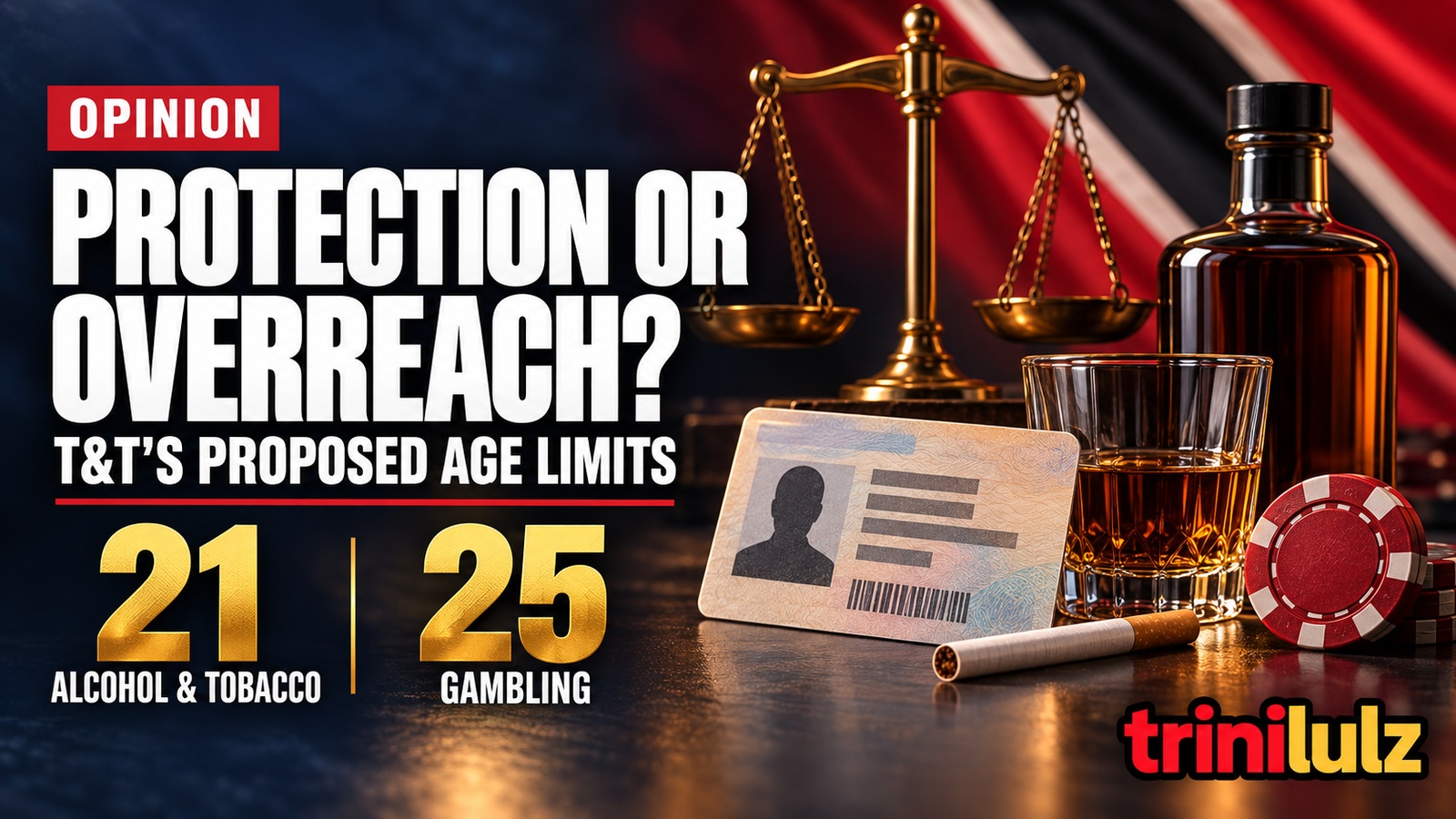
The Bill introduced on September 30 proposes the following thresholds:
| Activity | Proposed age |
|---|---|
| Alcohol | 21, up from 18 |
| Tobacco | 21, up from 18 |
| Gambling | 25, up from 18 |
Cannabis at 25 is also part of the wider package. This article concentrates on drinking, smoking and gambling. The proposed law requires Presidential proclamation to commence; an announcement or parliamentary introduction does not itself activate the new ages. Readers seeking the details can consult Parliament’s overview of the proposed changes.
The advantages are real—and deserve an honest hearing
The Government’s stated purpose is to protect young people from addiction and harmful behaviour. There is a serious public-health argument for delaying access, and an opinion against this Bill should acknowledge it.
The US Centers for Disease Control and Prevention links a minimum drinking age of 21 with reduced drinking and motor-vehicle crashes. Its explanation of the evidence for drinking-age restrictions provides useful context. International findings are relevant, although they are not a prediction of what this particular Trinidad and Tobago package would achieve.
Tobacco research also gives supporters a substantial argument: starting regular smoking at 18–20 has been associated with greater nicotine dependence and poorer quitting outcomes. Delaying initiation can matter. Gambling harm, meanwhile, can involve financial distress, damaged relationships and mental-health problems; PAHO treats it as a public-health concern.
A well-enforced age restriction may reduce access and help delay a harmful habit. That is an advantage worth weighing against adult autonomy, enforcement costs and unintended effects. It does not establish that every proposed age is the right one—or that huge fines and decades of prison exposure are necessary to secure the benefit.
Why I oppose the higher limits
An adult should not have to pretend alcohol, tobacco or gambling is harmless to object to the State taking away a choice. The argument is about how far government should go, and what it should have to demonstrate before going there.
An 18-year-old can vote and hold a full-time job. A 24-year-old may be supporting a household and raising children. Those responsibilities do not make anyone immune to addiction. They do make blanket restrictions over this adult population a serious policy decision, rather than an obvious extension of protecting children.
Different activities can reasonably have different age rules. Voting is not drinking, and a legal age of adulthood does not settle every health-policy question. Even so, adults deserve more than the assumption that another birthday will make them sufficiently responsible.
The Government should explain why 21 is the appropriate threshold for alcohol and tobacco, why gambling requires 25, and why less restrictive measures would not adequately address the local problem. The justification should be specific to each activity.
I favour retaining the existing adult thresholds while strengthening safeguards against harmful conduct and unlawful sales to children. The strongest challenge to that position is the evidence supporting delayed access, particularly for tobacco. It deserves a substantive answer through local evaluation and public consultation. It should not be brushed aside—and it should not be treated as approval for the entire punitive package.
The proposed penalties demand their own debate
The consumer and supplier provisions must be kept separate. Covered under-21 alcohol and tobacco offences carry a proposed TT$50,000 court fine; specified under-25 gambling and gambling-premises offences also carry TT$50,000. These provisions include fixed-penalty and rehabilitation routes.
The much longer prison exposures concern suppliers and other offences. Guardian Media’s September 30 reporting, corroborated by Parliament’s briefing, sets out these proposed penalties:
| Proposed offence | Fine | Prison exposure |
|---|---|---|
| Knowingly selling or allowing alcohol sales to someone under 21: first conviction | TT$50,000 | Up to 15 years |
| Same liquor-sale offence: second conviction | TT$150,000 | Up to 20 years |
| Same liquor-sale offence: third or subsequent conviction | TT$300,000 | Up to 30 years |
| Using or hiring a child to sell, buy or deliver liquor | TT$300,000 | Up to 30 years |
| Specified tobacco supply offences: first summary conviction | TT$300,000 | Up to 10 years |
| Same tobacco offences: subsequent summary conviction | TT$600,000 | Up to 20 years |
For the child-related liquor offence, the reported existing penalty is TT$6,000 and three years. The proposal multiplies the fine by 50 and the prison exposure by ten.
The word “knowingly” matters in the alcohol-sale offence. This is not a claim that every honest age-checking mistake automatically creates liability. Nor should anyone read the table as a prediction of what a court would impose in every case.
Those qualifications make the criticism more precise. They do not answer why Parliament needs penalties of this scale. A statutory ceiling expresses the seriousness assigned to an offence and defines the punishment a court may consider. It cannot be dismissed as irrelevant merely because a lower sentence might eventually be imposed.
How those punishments compare with violent offences
The following are statutory prison ceilings for specified existing offences, rather than selected examples of unusually lenient sentences:
| Existing violent offence | Legal provision | Prison ceiling |
|---|---|---|
| Unlawful and malicious wounding or inflicting grievous bodily harm | Offences Against the Person Act, section 14 | 5 years |
| Assault occasioning actual bodily harm, on indictment | Offences Against the Person Act, section 30 | 5 years |
| Wounding or shooting with intent to cause grievous bodily harm | Offences Against the Person Act, section 12 | 15 years |
| Robbery with aggravation, on indictment | Larceny Act, section 24(1)(a) | 15 years |
The comparison identifies particular charges and conviction routes. It does not mean every violent attack is capped at five or fifteen years: different facts can support more serious charges, and multiple offences can produce additional sentences. The proposed liquor penalties and existing indictment penalties are also not identical procedural routes.
Even with those distinctions, the disparity is striking. A first knowing sale to an under-21 adult would sit alongside the prison ceiling for aggravated robbery. Repeated liquor-sale convictions could carry twice that ceiling. The proposed first tobacco-supply exposure is higher than the ceiling for unlawful wounding.
Supplying children with harmful products warrants serious enforcement. Repeatedly flouting licensing rules can warrant suspension, revocation and substantial punishment. But a deliberate attack on another person involves an immediate violation of that person’s safety and bodily integrity. In my view, the proposed hierarchy of punishments gives regulatory breaches an excessive place beside such violence.
The answer is not simply to make every other offence harsher. Parliament should explain the scale of harm, culpability and deterrence it used to choose these numbers.
TT$50,000 has a different meaning when you are starting out
Consider a hypothetical young worker earning TT$5,000 a month. A TT$50,000 fine would equal ten months of gross pay, before food, rent, transport or family commitments. That is an illustration of the maximum financial burden, not a claim that everyone receives that fine or earns that salary.
A wealthier household may be able to absorb a penalty that a poorer household cannot. The same number on the statute book can therefore produce very different practical consequences.
Court proceedings and a conviction may also create difficulties extending beyond the payment itself. A prevention policy should weigh those consequences against the behaviour it is trying to change. It should distinguish dependency requiring treatment, reckless conduct endangering others, and a breach of an age restriction.
For a country that needs young people working, studying and building stable lives, that distinction is essential. A punishment should not be so severe that the response becomes a fresh obstacle to the future it claims to protect.
The rehabilitation option deserves credit—and proper preparation
The Bill’s diversion provisions matter. A fixed-penalty amount is prescribed separately from the TT$50,000 court fine. Completing the prescribed payment or rehabilitation route can avoid conviction. For specified notices, programmes must generally begin within 28 days and be completed within three months, subject to the relevant rules. Community work or counselling can form part of the programme.
That is a meaningful safeguard. The policy should be assessed with it included, rather than portrayed as an automatic march from a drink to a criminal conviction.
But the country needs to know how it will work. Will suitable programmes be available in Tobago and outside major towns? Can a participant fit attendance around work or study? Who pays for access and transport? What happens when a place is unavailable? Will qualified, accessible counselling be offered to people who need it?
A rehabilitation route should be ready before enforcement begins. It should help someone change behaviour, not become another obligation that people with fewer resources are most likely to struggle to complete.
Enforcement could determine who carries the burden
BOATT’s president supports raising the alcohol age to 21, while warning about enforcement and possible displacement toward illicit sellers. He also says the association was not consulted before the announcement. Those concerns deserve examination; displacement is a risk to assess, not an outcome already proved.
A licensed operator can be inspected, trained and held accountable. If a restriction shifts some activity beyond regulated premises, the State needs a practical plan for that activity too. Changing an age on a sign does not explain how police and regulators will identify breaches, gather evidence or maintain consistent enforcement.
There is also an opportunity cost. Time spent processing an age offence is time officials cannot spend on something else. That does not mean prevention enforcement has no value. It means expanding it should come with staffing, priorities and an assessment of what the public receives for the effort.
The Government should publish measures of success: fewer harmful incidents, less unlawful access by children, effective treatment and consistent retailer compliance. Counting tickets or arrests alone would not show that young people are healthier or safer.
A better policy should target harm and preserve proportion
I would prefer a package built around these measures:
- Enforce the existing restrictions: fund consistent retailer checks, clear identification procedures and action against unlawful sales to children.
- Match sanctions to culpability: distinguish deliberate repeat breaches from less serious failures, with fines and licence restrictions proportionate to the conduct.
- Invest in prevention and treatment: provide accessible tobacco cessation, alcohol services and qualified counselling before a crisis develops.
- Address dangerous conduct directly: prioritise impaired driving, irresponsible supply and behaviour that puts other people at risk.
- Reduce gambling harm: examine self-exclusion, spending controls, marketing restrictions and access to treatment, with measures covering relevant digital channels.
- Require public evaluation: publish local evidence, delivery costs and results, and review whether interventions justify their restrictions.
These are proposals for debate, not a promise that one measure will solve addiction. They offer a way to pursue protection while keeping adult autonomy, access to help and proportionate punishment in view.
Protection should not come at any price
The Trinidad drinking age debate should ask more than whether alcohol is bad for young people. It should ask whether this package uses the right tools, whether the age restrictions are justified locally, and whether the punishments fit the offences.
My answer is that the higher limits are the wrong approach in this package, and the penalties are excessive. The Government should rethink both. A credible public-health policy can be firm with deliberate harmful conduct while treating young adults as people capable of making choices and benefiting from support.
Before approving punishment measured in tens of thousands of dollars and decades of prison exposure, Parliament should answer a simple question: Are we protecting young people’s future—or making one bad decision costly enough to damage it?
Reporting note: This opinion examines the proposal introduced on September 30, 2026, using Parliament’s published briefing, legislation, court rulings, research and contemporary reporting. Prison figures are statutory exposure, not automatic sentences. Parliamentary amendments and commencement should be checked again before publication.
This story is part of our wider Trinidad Politics Explained coverage. Explore the full hub for political analysis, key background, major controversies, and the latest updates.