THE NIGHT THEY MUTED KAISO: Dimanche Gras 2026, Helon Francis, and the State-TV “Audio Cut” Nobody Believes
In Trinidad and Tobago, censorship does not always arrive wearing boots.
Sometimes it arrives wearing a headset.
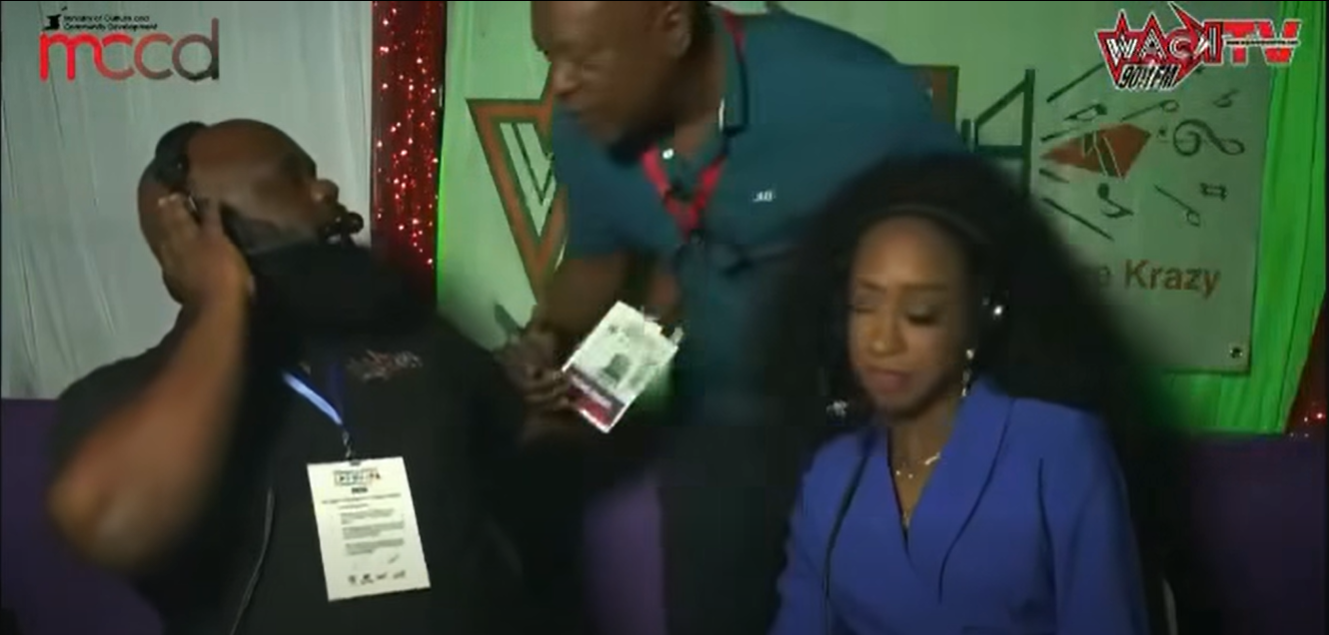
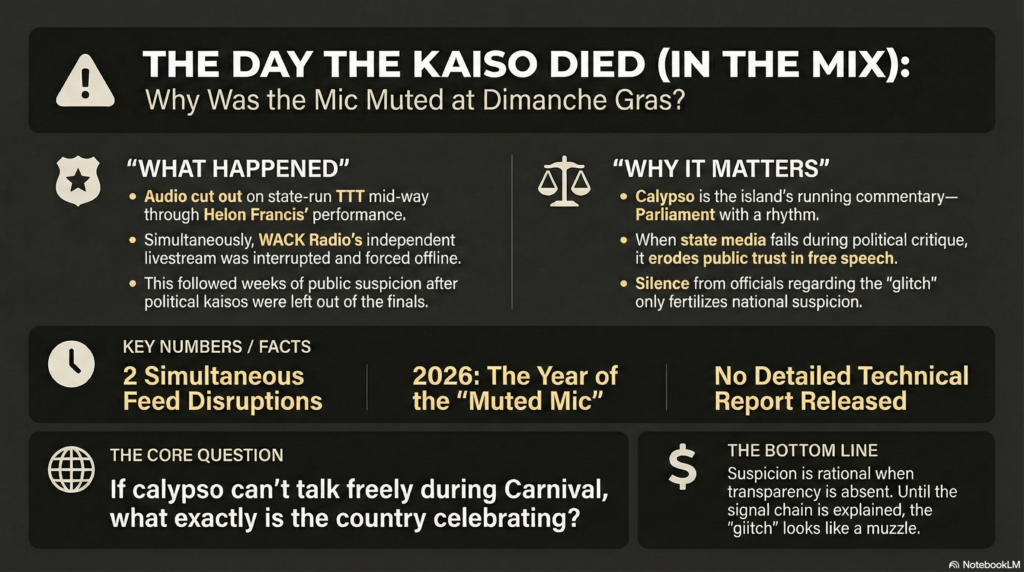
Dimanche Gras 2026 was supposed to be the triumphant climax of Carnival. Sequins. Spotlights. The Savannah pulsing. Instead, it delivered something colder: a sudden loss of audio during Helon Francis’ performance on state-run TTT, followed by apologies, confusion, and then an even stranger twist — the interruption of WACK Radio’s livestream.
And just like that, what should have been a musical contest turned into a national conversation about free speech.
This is not just bacchanal. This is about the role of calypso itself.
First, the Finalists Raised Eyebrows
The controversy did not begin on Dimanche Gras night.
After Calypso Fiesta, public criticism erupted over which songs advanced to the finals. Several strong political and social commentary calypsos were left out. On social media and call-in programs, accusations surfaced that political content was being sidelined.
Guardian Media reported on the backlash, with critics questioning whether politically charged calypsos were being sidelined. (Read the full report here.)
The government response came swiftly. Culture Minister Michelle Benjamin publicly denied interference, stating that calypso belongs to the country and that claims of government manipulation were politically motivated.
On paper, that should have settled it.
But calypso has never been just “music.” It is the island’s running commentary. It is satire with steelpan backing. It is Parliament with rhythm.
When political kaiso appears filtered out of a major competition, people notice.
And when people already suspect filtering, they do not interpret “technical difficulties” generously.
Then, Live on Stage, the Audio Disappeared
Helon Francis stepped up to perform.
Mid-delivery, the audio feed on TTT cut.
Dead air.
TTT later apologised, describing it as an audio interruption. Technical glitches happen. Carnival production is complicated. Broadcast chains are delicate ecosystems of mixers, routers, uplinks and human hands.
But here’s the thing about timing: when suspicion is already in the air, coincidence becomes combustible.
It wasn’t just that the audio dipped.
It was that it dipped during politically charged performance energy, at a moment when the country was already primed to see patterns.
Then came the second shock.
The WACK Livestream Twist
Viewers migrated online.
WACK Radio’s livestream reportedly confirmed attempts were being made to stop their feed. Shortly after, their YouTube stream went down.
Now pause.
One technical error? Plausible.
Two simultaneous broadcast disruptions, during the same performance, in a year already clouded by allegations of political filtering?
That moves from “glitch” to “story.”
And once something becomes a story in Trinidad, it grows legs.
“In Trinidad, the fastest way to create a conspiracy… is to cut a man mic mid-verse.”
Is Calypso “Too Political”?
No verified on-record statement from the Prime Minister explicitly declares calypso “too political.” That matters. Accuracy matters.
However, critics argue that the administration’s posture toward sharp political kaiso has felt uncomfortable at best. When strong political calypsos fail to reach finals, and then a live performance experiences a mysterious mute, the perception becomes its own force.
Perception in politics is not a side effect. It is oxygen.
Historically, calypso has functioned as the Caribbean’s democratic safety valve. From colonial governors to modern cabinets, no leader has escaped lyrical scrutiny. That is the point.
Calypso without political bite is just melody.
And Trinidadians understand that instinctively.
Why This Moment Feels Bigger Than a Glitch
Let’s strip away emotion and think scientifically for a second.
Hypothesis A: It was a routine technical malfunction.
Hypothesis B: It was deliberate suppression.
Hypothesis C: It was a chaotic mix of human error amplified by political tension.
We do not yet have evidence proving B.
But we also do not have a fully transparent technical explanation detailing:
- What failed?
- Where in the signal chain it failed?
- Why it coincided with that specific performance?
- Why an independent livestream also went down?
Until those questions are answered clearly, suspicion remains rational.
And when state media is involved, the burden of clarity is higher.
“If calypso can’t talk freely in Carnival, what exactly is Carnival celebrating?”
Dimanche Gras 2026: A Cultural Inflection Point?
Dimanche Gras has survived political eras, economic crashes, and culture wars. It is supposed to be the night where the artform flexes without fear.
Instead, Dimanche Gras 2026 may be remembered less for who won and more for who got muted.
The irony is almost poetic.
Attempts to suppress speech, if that is what occurred, often amplify it. The Streisand Effect is undefeated: hide something, and it multiplies.
Now Helon Francis’ performance is not just a song. It is a symbol.
And symbols are louder than microphones.
What Happens Next?
If the government truly did not interfere, transparency is their ally.
Publish detailed judging breakdowns.
Release a technical broadcast report.
Clarify what happened with the WACK stream interruption.
Sunlight neutralizes suspicion.
Silence fertilizes it.
Carnival markets itself as freedom.
Kaiso markets itself as truth.
When the two collide with dead air, the country listens harder.
And sometimes, the quietest moment on television becomes the loudest moment in history.
This story is part of our wider Trinidad Politics Explained coverage. Explore the full hub for political analysis, key background, major controversies, and the latest updates: