Rooted in Resilience: How Carnival’s Past Still Wine in the Present

🎭 Carnival Was Never Just a Party
Carnival wasn’t dreamed up in a marketing meeting or polished in a costume launch with LED bras and Bluetooth speakers. It came from fire, sweat, and stubborn joy — a rebellion dressed in colour.
When most people say “Carnival,” they think of pretty mas, feathers, and drinks in hand. But underneath the glitter is a heartbeat that started long before Tribe, before Kes, before stage trucks and cooler fetes. The roots go back to a time when celebration was resistance and music was weaponry.
🔥 The Fire That Started It: The Canboulay Riots
Let’s rewind to the late 1800s. Enslavement had been abolished, but freedom was still rationed. The newly freed Africans wanted to celebrate emancipation in their own way — with drums, dance, and defiant joy.
That celebration became Canboulay, from the French cannes brulées — “burnt cane” — a reference to the harvest festivals of the enslaved who had to extinguish cane fires in the plantations.
The colonial elite saw those processions as disorderly, dangerous, and too…African. When authorities tried to stamp them out in 1881, the people pushed back. Sticks met batons. Rhythm met repression. The Canboulay Riots were born — and with them, a culture that refused to bow.
That confrontation didn’t just defend a festival; it defended the right to joy, to gather, to express, to exist loudly in a world that preferred silence.

🥁 When They Took the Drums, We Built the Pan
After the riots, the colonial powers banned drums — too much bass, too much spirit, too much freedom.
So Trinis did what Trinis do best: we invented our way around it.
First came tamboo bamboo — rhythmic ensembles built from cut bamboo sticks, thumping the heartbeat of the people. But colonial bans followed those too.
So we turned to metal. Biscuit tins, brake drums, oil drums — we beat until we made melody.
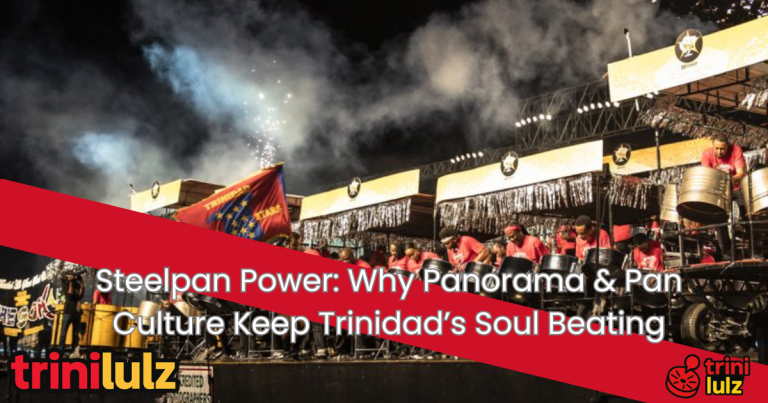
Out of that came the steelpan, born in Laventille’s hills, the only acoustic instrument invented in the 20th century. From rebellion to renaissance, the pan became a sound of survival — a reminder that when you take away a Trini’s instrument, they’ll just make a new one and still outplay you.

🌅 J’ouvert: Mud, Paint, and Memory
Fast-forward to today, and every J’ouvert morning is a reenactment of that history. It’s not just random mud and cocoa powder — it’s ritual.
The paint, the oil, the powder — all that chaos is coded memory. It’s the people reclaiming the streets before dawn, before the costumes and commercialization take over.
J’ouvert means “opening of the day,” but it also feels like reopening the past — a moment where the descendants of those who fought for freedom can finally play, scream, wine, and release.
When you see people dancing barefoot, faces smeared in blue and black, they’re not just liming — they’re carrying on a centuries-old act of rebellion disguised as revelry.
💃 Pretty Mas Meets Dirty Mas: Two Sides of the Same Freedom
Modern Carnival has evolved — glitz, sponsors, camera crews, and influencers in glitter. But underneath it all, the same pulse beats.
The feathers and body paint might seem far removed from Canboulay’s torches and tamboo bamboo, yet the spirit hasn’t changed: self-expression, ownership of space, defiance through beauty.
Every woman dancing freely down Ariapita Avenue, every man wukking up like rent due, is performing a kind of social statement — that freedom of body and spirit is something generations fought for.
The pretty mas might be polished, but the soul remains wild.

🥇 Steelpan and Soca: The Soundtrack of Defiance
Pan gave us melody. Soca gave us movement. Both were born from that same lineage of invention.
When you hear a steelband rehearsing in the panyard, it’s more than music — it’s collective discipline, community, and creativity welded into one.
Soca, meanwhile, evolved from calypso — the voice of the people, the gossip paper of the streets. Lord Kitchener, Sparrow, Chalkdust — they sang politics, pain, and pleasure, all in one breath.
And today’s soca stars still carry that same mission, even when the lyrics shift from protest to pure vibes. Joy itself, in a world that keeps testing us, is still a form of defiance.
⚖️ The Commercial vs The Cultural
Every few years, the same argument comes up: “Carnival too commercial now.”
Yes — the sponsorships, the brand bands, the ticketed fetes — they’ve changed the texture. But they haven’t erased the root.
The same way tamboo bamboo evolved into pan, Carnival evolves too. Culture doesn’t fossilize; it remixes.
If you dig deep enough beneath the LED wings and glitter bras, you’ll still find Canboulay’s spirit wukking hard — adaptation as survival.
❤️ Why Remembering Matters
When you wine down the road, covered in sunblock and vibes, you’re part of something ancient.
Each chip, each bassline, each pelting of powder carries the memory of struggle wrapped in rhythm.
To forget that would be to make Carnival just another festival.
To remember it is to honour the people who fought to dance in the streets, and to understand that our greatest export — joy — was once an act of rebellion.
Carnival isn’t just a show. It’s a story.
A love letter written in mud and melody.
A reminder that even when they tried to silence the drums, we still found a way to make the world listen.
For more destination guides, travel warnings, tourism updates, and plain-English Caribbean travel coverage, visit our Caribbean Travel hub.