The Real Cost of Crime in Trinidad and Tobago: The Fear Tax Every Family Is Paying
The Real Cost of Crime in Trinidad and Tobago Is Not Just the Murder Count
The cost of crime in Trinidad and Tobago is not only measured in police reports, murder statistics, court files, or press conferences. It is measured in the mother waiting by the phone until her child reaches home. It is measured in the doubles vendor who packs up early because “after dark, things change.” It is measured in the small business owner who spends money on cameras, burglar-proofing, security lights, and still sleeps with one eye open.
This is the part of crime that never appears neatly on a dashboard.
Because in Trinidad and Tobago, crime has become more than a public safety issue. It has become a national tax.
Not a tax passed in Parliament. Not a tax printed on a receipt. Not a tax deducted by the Board of Inland Revenue.
A fear tax.
Every family pays it. Every school feels it. Every business calculates it. Every community lives under it.
And the cruelest thing about this tax is that even people who are never directly attacked still pay the price. They pay in cancelled plans, shorter work hours, nervous children, empty streets, higher costs, and a country slowly learning to live smaller than it should.
The murder count tells us who died. It does not tell us how many people stopped living freely.
Crime has become a second cost of living crisis in Trinidad and Tobago.
The Cost of Crime Is Also the Cost of Fear
When people talk about crime in Trinidad and Tobago, the conversation usually begins with murders. That is understandable. Homicide is the most extreme and painful symbol of a country in crisis.
But the real national damage goes much wider.
According to the Inter-American Development Bank, the direct cost of crime and violence across Latin America and the Caribbean was estimated at 3.44% of GDP in 2022, with the Caribbean average even higher at 3.83% of GDP. These costs include lost human capital, public spending on policing and justice, prisons, and business spending on security.
In plain Trini English, crime is eating money that could be going into schools, jobs, roads, health care, youth programmes, small businesses, tourism, and community development.
But even that does not fully capture the emotional bill.
How do you price a parent’s panic when a child is late?
How do you price the stress of driving through certain areas with the windows up and heart racing?
How do you price a family deciding not to go to the beach, not to attend an event, not to visit relatives, not because they cannot afford it, but because they no longer feel safe?
That is the real cost of crime.
It changes the way people move. It changes the way they spend. It changes the way they raise children. It changes the way they see strangers. It changes the way a nation breathes.
The Family Budget Now Has a Crime Line
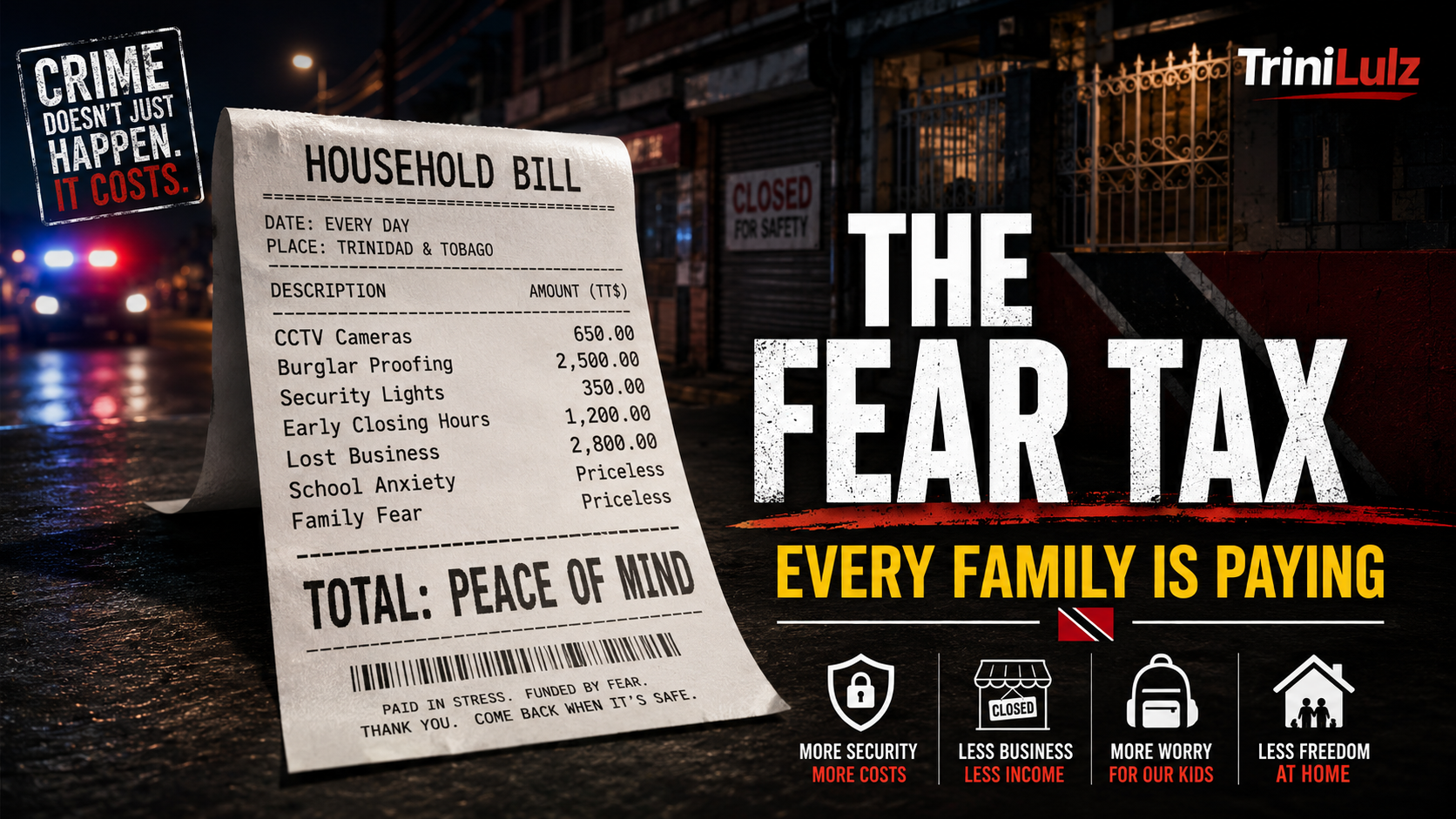
Once upon a time, the household budget had the usual suspects: groceries, rent or mortgage, light bill, water rate, school books, transport, internet, maybe a little something for Sunday lunch.
Now add the modern crime package.
CCTV cameras.
Burglar-proofing.
Security lights.
Higher taxi fares.
Extra data so children can message when they reach.
Delivery fees because some people no longer want to go out at night.
Private transport because waiting on the roadside feels unsafe.
Dogs, alarms, padlocks, reinforced gates, and sometimes a constant sense of dread.
Nobody calls it a tax, but that is exactly what it is.
A family in a safer society might spend that money on tutoring, savings, home improvement, a weekend trip, a small business idea, or simply a little breathing room. In Trinidad and Tobago, too many families are spending money just to feel slightly less exposed.
And even after paying, peace of mind is not guaranteed.
Because the fear tax is not only financial. It is emotional.
It is the grandmother who calls five times because she saw something on the news. It is the father who sits up until the car pulls into the yard. It is the teenager who knows which streets to avoid before they even understand why.
That is not normal childhood. That is national trauma wearing school shoes.
Every camera, gate, alarm, security guard and early closing hour is part of the fear tax.
Small Businesses Are Paying Twice
For business owners, the cost of crime is brutal because they pay twice.
First, they pay to protect themselves.
Then they lose money because customers are afraid.
A restaurant that closes earlier loses sales.
A parlour that installs cameras loses profit.
A taxi driver who avoids certain routes loses income.
A shop owner who hires security raises prices or cuts somewhere else.
A young entrepreneur who refuses to open in a “hot” area leaves that community with fewer jobs and fewer services.
This is how crime quietly drains the economy.
It does not only rob businesses at gunpoint. It robs them through fear, reduced hours, higher insurance, lower foot traffic, nervous staff, and customers who decide, “Nah, I staying home tonight.”
The IDB has repeatedly identified business spending on security as a major component of the region’s crime costs. In other words, the private sector is not just operating in the economy. It is also spending heavily to defend itself from the economy’s failure to provide safety.
And when business suffers, workers suffer.
Less revenue means fewer jobs. Fewer jobs mean more pressure on families. Less community investment means more idle spaces. More idle spaces create more opportunities for trouble.
So the cycle spins again.
Crime weakens business. Weak business weakens communities. Weak communities become easier hunting grounds for criminal networks.
And then politicians hold another press conference acting shocked, as if the country did not watch the warning signs flashing for years like a maxi taxi hazard light.
Schools Are Now Part of the Crime Conversation
There was a time when school was treated as the safe place. The place children went to learn, lime, play football, quarrel over snacks, complain about homework, and grow into themselves.
Now schools are increasingly pulled into the national crime conversation.
Parents worry about bullying, violence, weapons, gangs, online threats, community feuds spilling into school life, and children being exposed to a culture where badness is sometimes marketed as status.
This does not mean every school is unsafe. It does not mean every child is in danger. But it does mean the national mood has changed.
When parents begin to ask whether their child is safe at school, the country has crossed a serious line.
And when children grow up seeing violence treated as normal, hearing adults speak about murders like weather updates, and watching communities mourn again and again, something happens to the national imagination.
A child should not have to become streetwise before becoming literate.
A teenager should not have to know which area is “hot” before knowing what career they want.
A school should not have to operate like a soft security zone because the adult world failed to control the streets outside.
This is why crime cannot be treated only as a police issue. It is also an education issue, a parenting issue, a community issue, a mental health issue, and an economic issue.
The World Bank and UNODC have long warned that crime and violence in the Caribbean are development issues, undermining growth, threatening human welfare, and damaging social development.
In other words, crime is not just what happens after school. It affects what kind of future children believe is possible.
A child should not have to become streetwise before becoming literate.
Crime Shrinks Family Life
One of the saddest things about crime in Trinidad and Tobago is how quietly it changes ordinary family life.
People still laugh. People still fete. People still go beach. People still line up for doubles, argue politics, play all fours, and say “we outside” when the spirit takes them.
But under the surface, everybody is calculating risk.
Which road are we taking?
What time are we leaving?
Where are we parking?
Who is coming with us?
Is that area safe?
Did you reach home?
Message me when you get inside.
This is the language of a society trying to have a normal life in abnormal conditions.
And bit by bit, the country gets smaller.
People stop visiting certain relatives.
Families stop going out late.
Children lose freedom.
Elderly people become more isolated.
Community events become harder to organize.
Neighbourhood trust breaks down.
The first thing crime steals is life. The second thing it steals is freedom.
That is the part we do not discuss enough.
Because even when a person is alive, working, paying bills, and doing their best, they may still be living behind invisible bars. Not prison bars. Fear bars.
And fear bars can reshape an entire nation.
Even When Crime Falls, Fear Does Not Disappear Overnight
To be fair, recent official figures have shown improvement in some major crime categories.
Newsday reported that Trinidad and Tobago recorded 369 murders in 2025, a 42% decline compared with 2024, when the toll was reported at 626. The report also quoted officials crediting police work rather than the state of emergency alone.
That matters.
A reduction in murders is not something to dismiss. Every life saved matters. Every family spared grief matters. Every community that avoids another tragedy matters.
But here is the hard truth: you can lower the murder count faster than you can rebuild public confidence.
Fear has memory.
People remember the videos.
They remember the headlines.
They remember the robberies.
They remember the neighbour who was attacked.
They remember the child who never came home.
They remember the business that closed.
They remember the road they now avoid.
So when officials say crime is down, many citizens do not automatically feel safe. That does not always mean the statistics are fake. It means lived experience has its own data set.
The government may count reported crimes. Families count close calls.
Police may track detection rates. Parents track the time their children reach home.
Economists may calculate GDP losses. Small businesses calculate how much money they lose after sunset.
Both realities can exist at the same time.
Crime can be statistically down and fear can still be socially high.
That is why any serious crime strategy must focus not only on reducing incidents, but on rebuilding public trust.
You can reduce murders on paper and still have a country afraid to breathe after dark.
State of Emergency Politics Cannot Be the Whole Plan
Trinidad and Tobago has leaned heavily on emergency powers in recent years. The Associated Press reported in March 2026 that the country had spent roughly 10 of the previous 14 months under emergency conditions, with repeated emergency measures also affecting tourism.
That fact alone should make the country pause.
A state of emergency may be presented as a tool. But if emergency becomes routine, then the real question is uncomfortable:
What does “normal” even mean anymore?
No serious person should pretend violent crime does not require strong action. But emergency powers cannot become a substitute for long-term crime strategy, functioning institutions, faster justice, better intelligence, youth intervention, prison reform, community rebuilding, and economic opportunity.
Because if the only plan is emergency after emergency, then the country is not curing the disease. It is treating the fever while the infection spreads.
This is where Trinidad and Tobago has to be honest with itself.
Crime is not hard to fix because one government is unlucky and another has all the answers hiding in a drawer. Crime is hard to fix because it is tied to gangs, illegal guns, weak detection, slow justice, corruption, community silence, family breakdown, economic pressure, school failure, and political short-termism.
That is why this article should be read alongside our previous piece: Why Is Trinidad and Tobago Crime So Hard to Fix? The Brutal Truth Nobody Wants to Say.
Because the fear tax did not appear overnight. It was built over years of denial, excuses, failed systems, and communities being left to manage danger on their own.
The Real Solution Must Be Bigger Than Police
Police matter. Enforcement matters. Arrests matter. Patrols matter. Intelligence matters.
But the country cannot arrest its way out of every social collapse.
A real crime strategy for Trinidad and Tobago must be wider than flashing lights and press conferences.
It must include focused violence reduction, aimed at the small groups most likely to drive serious violence. It must include faster court processes, because justice delayed becomes national cynicism. It must include serious protection for witnesses and communities. It must include school-based intervention before gangs become more attractive than classrooms.
It must include support for victims and families, not just attention when a story goes viral.
It must include business support in high-risk communities, because economic abandonment creates space for criminal power.
It must include reliable public data, because citizens cannot trust what they cannot see.
And yes, it must include political maturity. That may be the rarest thing of all.
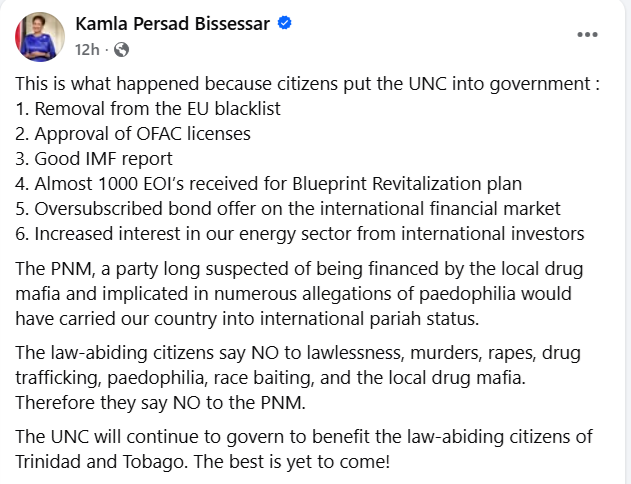
Because every time crime becomes only a UNC versus PNM shouting match, the criminals get the best seat in the house. They watch the country argue while they organize.
The Fear Tax Is a National Emergency
The real cost of crime in Trinidad and Tobago is not only the number of people killed.
It is the number of people who no longer feel free.
It is the business that closes before it should.
The school that worries about what children are bringing through the gate.
The parent who cannot relax until everyone reaches home.
The community that stops gathering.
The child who learns fear before confidence.
The family that spends money on protection instead of progress.
That is the fear tax.
And every day it goes unpaid by the people responsible, ordinary citizens are forced to cover the bill.
Trinidad and Tobago does not only need fewer murders. It needs more freedom. More trust. More safe streets. More functioning schools. More businesses willing to open late without feeling foolish. More children who can grow up without being trained to scan every corner like security guards in school uniforms.
The murder count tells one part of the story.
The fear tax tells the rest.
And until this country starts measuring both, we will keep pretending crime is only about the people who died, while ignoring the millions of small ways it is changing how the living survive.
The first thing crime steals is life. The second thing it steals is freedom.
Want the bigger picture? Explore our Trinidad Crime & Security hub for dashboards, explainers, updates, and deeper coverage of one of the country’s most urgent ongoing stories.