Baltimore Crime Plan Cut Murders by Nearly 60% Can Trinidad Utilise This Model
The Baltimore crime plan did something Trinidad and Tobago should be studying very carefully.
Not because Baltimore is perfect. Not because America has suddenly solved crime. And definitely not because Trinidad can simply copy and paste a foreign policy and expect Laventille, Belmont, Morvant, Enterprise, Sea Lots, Maloney, Carapo, La Horquetta, Beetham and Diego Martin to magically behave like a case study.
But because Baltimore asked one question Trinidad keeps dodging:
What if murder is not random? What if it can be mapped, interrupted, reduced, and prevented before another family ends up planning a funeral?
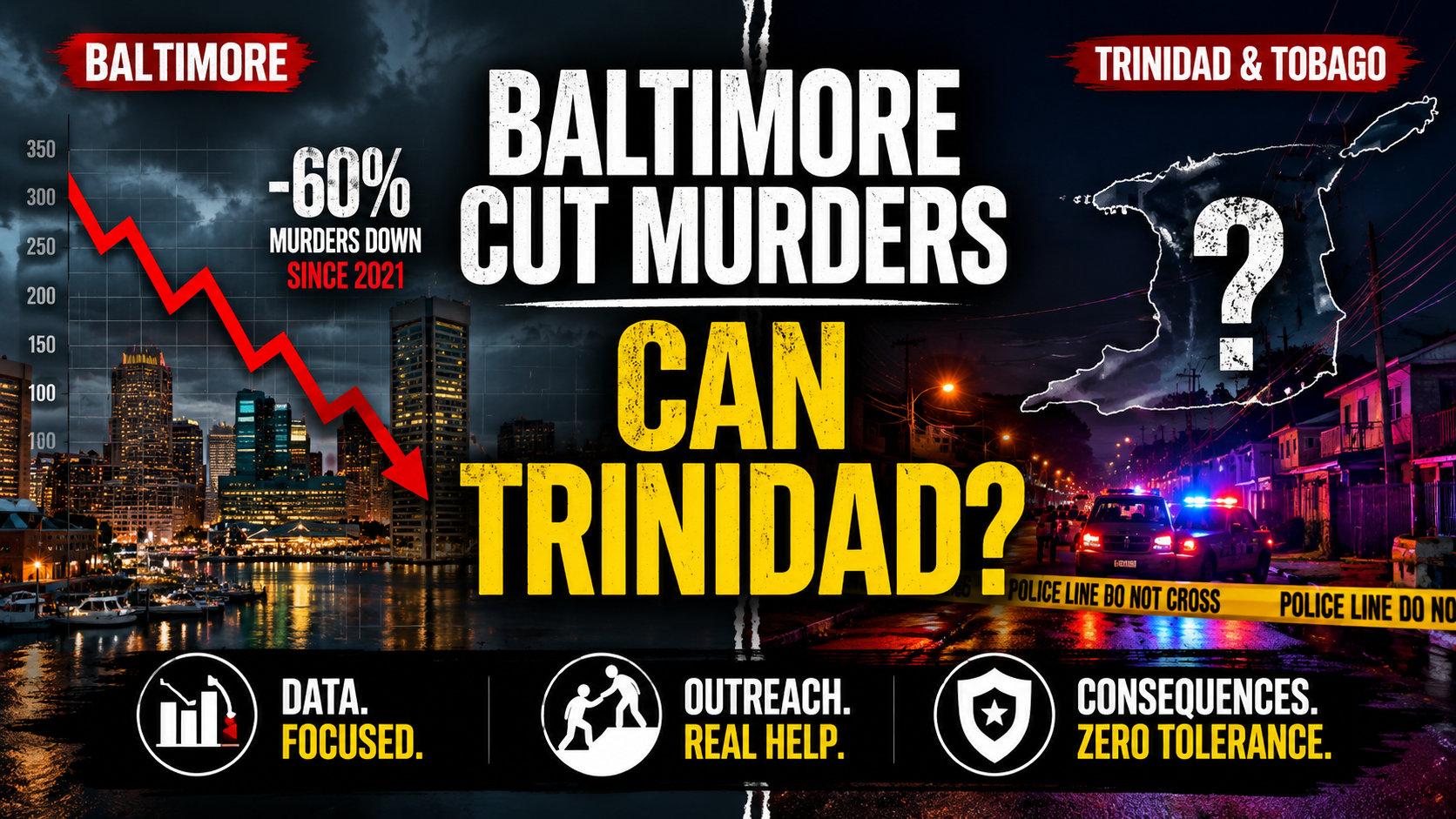
Baltimore recorded 133 homicides in 2025, its lowest count in nearly 50 years, according to the city’s mayor’s office. That represented a major fall from the 300-plus annual homicide years Baltimore experienced between 2015 and 2021.
And one major part of that turnaround was not another dramatic press conference.
It was not a politician pounding a podium.
It was not a State of Emergency catching plenty small fish while the big networks continue swimming.
It was a focused, data-driven public safety model called the Group Violence Reduction Strategy, or GVRS. The idea was simple but serious: identify the small group of people most likely to shoot or be shot, offer them real help, send a direct warning, and bring focused consequences if the violence continues.
“Baltimore’s lesson is not that letters stop bullets. The lesson is that seriousness stops cycles.”
What The Baltimore Crime Plan Actually Did
The Baltimore crime plan did not try to stop every argument, every bad mind, every gang lime, every corner dispute, every school dropout, every rum-shop threat and every gunman in the city at the same time.
It narrowed the lens.
Who is most likely to pull the trigger?
Who is most likely to be the next person shot?
Which groups are involved in the retaliation cycle?
Which people need help now?
And which people need to be removed from the streets if they continue creating danger?
That is the part Trinidad needs to understand.
Baltimore’s model focused on the people and groups most directly connected to violence. In the Western District, where the strategy was first implemented, University of Pennsylvania researchers said less than 6% of the city’s population accounted for 16.2% of citywide homicides and non-fatal shootings between 2015 and 2021. The same evaluation estimated that GVRS reduced homicides and shootings in that district by roughly a quarter, with no evidence that the violence simply moved somewhere else.
That is the difference between a crime plan and crime theatre.
Crime theatre looks busy.
A crime plan knows who, where, why, and what happens next.
The Letter That Should Make Trinidad Uncomfortable
One of the most viral details from the Baltimore model is also one of the simplest.
The city reportedly sent direct messages to people identified as being at high risk of involvement in serious violence.
The message was not vague.
It was not “we are monitoring the situation.”
It was not “the police are working assiduously.”
It was basically three things:
- The violence must stop.
- Help is available if you want it.
- If the violence continues, there will be consequences.
But the messenger mattered.
The message was not only coming through police. It came through community workers, violence interrupters, trusted messengers, and people with credibility in the neighbourhood.
That is a crucial point for Trinidad.
Because in many communities, the State does not arrive with trust. It arrives with sirens, raids, cameras, handcuffs, speeches, and sometimes promises that disappear after the funeral.
Baltimore tried to put the intervention before the body count.
Therapy. Job support. Housing help. Relocation where needed. Mentorship. Community pressure. Focused policing.
Not softness.
Not foolishness.
A way out for those who wanted it, and a clear consequence for those who refused it.
“The offer was real. The warning was real. The consequences were real. That is the part Trinidad keeps turning into a slogan.”
Why Trinidad Should Be Studying This Right Now
Trinidad and Tobago does not have a mystery crime problem.
We have a repeat-offender problem.
A gang-retaliation problem.
An illegal-gun problem.
A community-silence problem.
A witness-fear problem.
A youth-recruitment problem.
A prison-to-street-to-prison cycle.
And, most painfully, a political unseriousness problem.
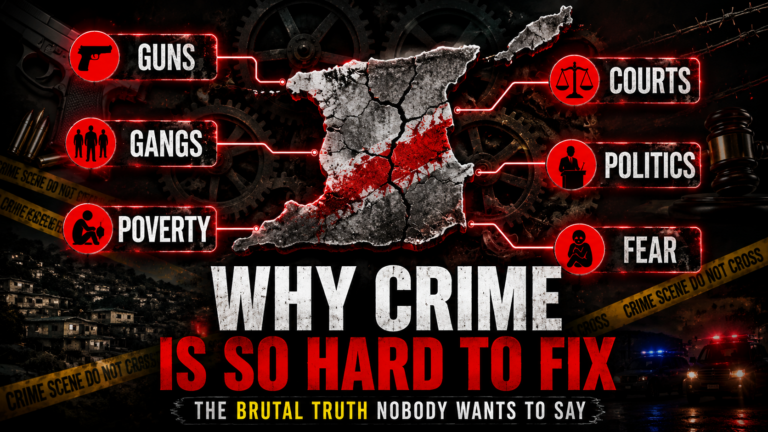
This is where readers should revisit our previous piece, “Why Is Trinidad and Tobago Crime So Hard to Fix? The Brutal Truth Nobody Wants to Say”, because the Baltimore example helps prove the same point: crime is not fixed by one speech, one raid, one minister, one commissioner, one law, or one State of Emergency.
It requires a whole operating system.
Trinidad already knows certain communities are trapped in cycles of reprisal violence. The country already knows certain young men are at higher risk of becoming either perpetrators or victims. The country already knows that some people are arrested again and again, only to return to the street like the justice system has a revolving door with WD-40.
So the question is not whether Trinidad has data.
The question is whether Trinidad is willing to use it seriously.
Can the TTPS, intelligence units, social services, community leaders, probation services, schools, churches, NGOs, courts, prison authorities and local government sit around one table and agree on the same target list?
Not a political target list.
Not a “who voted for who” list.
A violence-risk list.
A list based on evidence, behaviour, incidents, retaliation patterns, group conflicts and public safety risk.
That is where the real bacchanal starts.
Could Trinidad Execute It Without Spoiling It?
This is the part where plenty people will say, “Nice idea, but this is Trinidad.”
And honestly, they have a point.
A Baltimore-style model in Trinidad would face serious problems.
Could the police identify the right people without political interference?
Could social services respond fast enough?
Could the courts deal with repeat violent offenders quickly and fairly?
Could community workers be protected?
Could the State offer real alternatives beyond a hamper, a photo op and a certificate?
Could politicians resist turning the programme into campaign content?
Could citizens trust that the strategy is not just another excuse to harass poor communities while white-collar facilitators, gun suppliers, corrupt officials and financiers remain untouched?
That is the real test.
Because if Trinidad imports the Baltimore model but leaves out the discipline, data integrity, community trust and accountability, then it will become just another policy costume.
A press release wearing foreign clothes.
Not Another State Of Emergency
Trinidad loves emergency measures because emergency measures look like action.
Roadblocks look like action.
Big raids look like action.
Soldiers on the road look like action.
Midnight speeches look like action.
But the question is always the same: what happens after?
If a State of Emergency reduces murders for a few months but does not break the networks, disrupt the retaliation cycles, rehabilitate at-risk youth, protect witnesses, remove chronic violent offenders and rebuild community trust, then the country is not solving crime.
It is pressing pause.
Baltimore’s model was different because it tried to identify the people driving the violence and intervene directly.
That is why the concept matters.
Not because Baltimore has all the answers.
But because Baltimore stopped pretending all violence is equally random.
The Trinidad Version Would Need Five Things
A real Trinidad version of the Baltimore crime plan would need five serious pillars.
First, a violence intelligence map.
Not just murder statistics after the fact. A living map of conflicts, retaliation risks, group activity, repeat offenders, vulnerable youth and communities most likely to experience the next shooting.
Second, trusted community messengers.
Not political activists in matching jerseys. People with real credibility. Former offenders who changed. Clergy. Coaches. Social workers. Community elders. People the streets know are not just collecting a cheque.
Third, real services.
Counselling, job placement, relocation support, training, family intervention, substance-abuse support, conflict mediation and emergency help for people trying to leave violence behind.
Fourth, focused enforcement.
The small group driving serious violence must know that continued violence brings fast, lawful and targeted consequences. Not random harassment. Not broad punishment. Focused enforcement.
Fifth, public accountability.
Monthly reporting. Independent evaluation. Clear targets. Clear outcomes. No hiding numbers. No political spin. No “trust us, it working” without evidence.
“Trinidad does not need another crime slogan. Trinidad needs a crime operating system.”
The Children, The Communities And The Cost Of Doing Nothing
This is not an abstract policy debate.
Every time Trinidad delays serious reform, another family pays.
Another child grows up hearing gunshots as background noise.
Another mother has to identify a body.
Another school mourns.
Another community goes quiet because everybody knows who did what, but nobody believes the system can protect them.
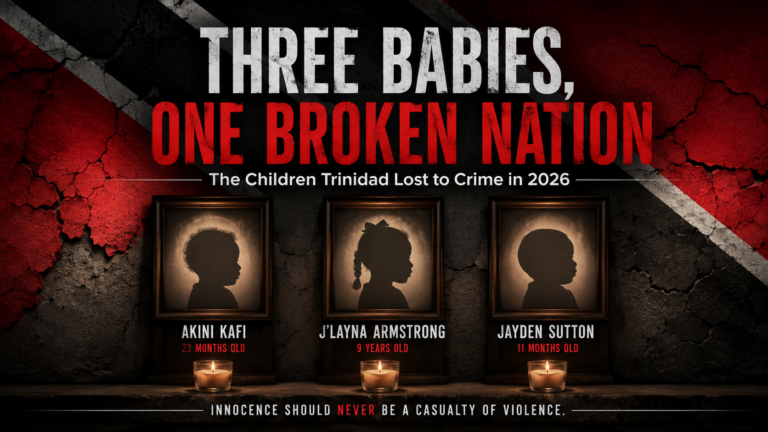
This is also why readers should revisit “Three Babies, One Broken Nation: The Children Trinidad Lost to Crime in 2026”. That story shows the human cost of a country that keeps reacting after the worst has already happened.
Baltimore’s lesson is not that a letter can save everyone.
The lesson is that a country must stop waiting until after the shooting to prove it cares.
So, Can Trinidad Utilise This Model?
Yes.
But not casually.
Not cosmetically.
Not as another imported buzzword.
Trinidad can utilise a Baltimore-style targeted violence reduction model only if it is willing to be honest about what serious crime reduction requires.
That means admitting that violence is concentrated.
It means admitting that some people need help before they become killers or victims.
It means admitting that some repeat violent offenders need swift consequences.
It means admitting that communities cannot be treated only as crime scenes.
It means admitting that policing alone cannot fix what family breakdown, school failure, gang recruitment, illegal firearms, weak prosecution, prison culture, unemployment, corruption and political cowardice keep feeding.
Baltimore did not cut murders by magic.
It used data.
It used outreach.
It used community credibility.
It used focused enforcement.
It used coordination.
Most importantly, it used seriousness.
And maybe that is the uncomfortable part for Trinidad.
Because the question is no longer whether a better model exists.
The question is whether Trinidad and Tobago is brave enough, disciplined enough, and honest enough to try it properly.
Not for a headline.
Not for a minister’s TikTok.
Not for a campaign speech.
For the families who are tired of burying people.
For the communities tired of living under siege.
For the children who deserve to grow up in a country where murder is not treated like weather.
Baltimore has shown that violent crime can fall when a city stops performing concern and starts building a system.
Now Trinidad has to answer one question:
Are we serious, or are we just waiting for the next funeral to act serious again?
Want the bigger picture? Explore our Trinidad Crime & Security hub for dashboards, explainers, updates, and deeper coverage of one of the country’s most urgent ongoing stories.