Tobago’s $400 Ticket Is a Fantasy: CAL Is Bleeding Millions to Keep the Tobago Airbridge Subsidy
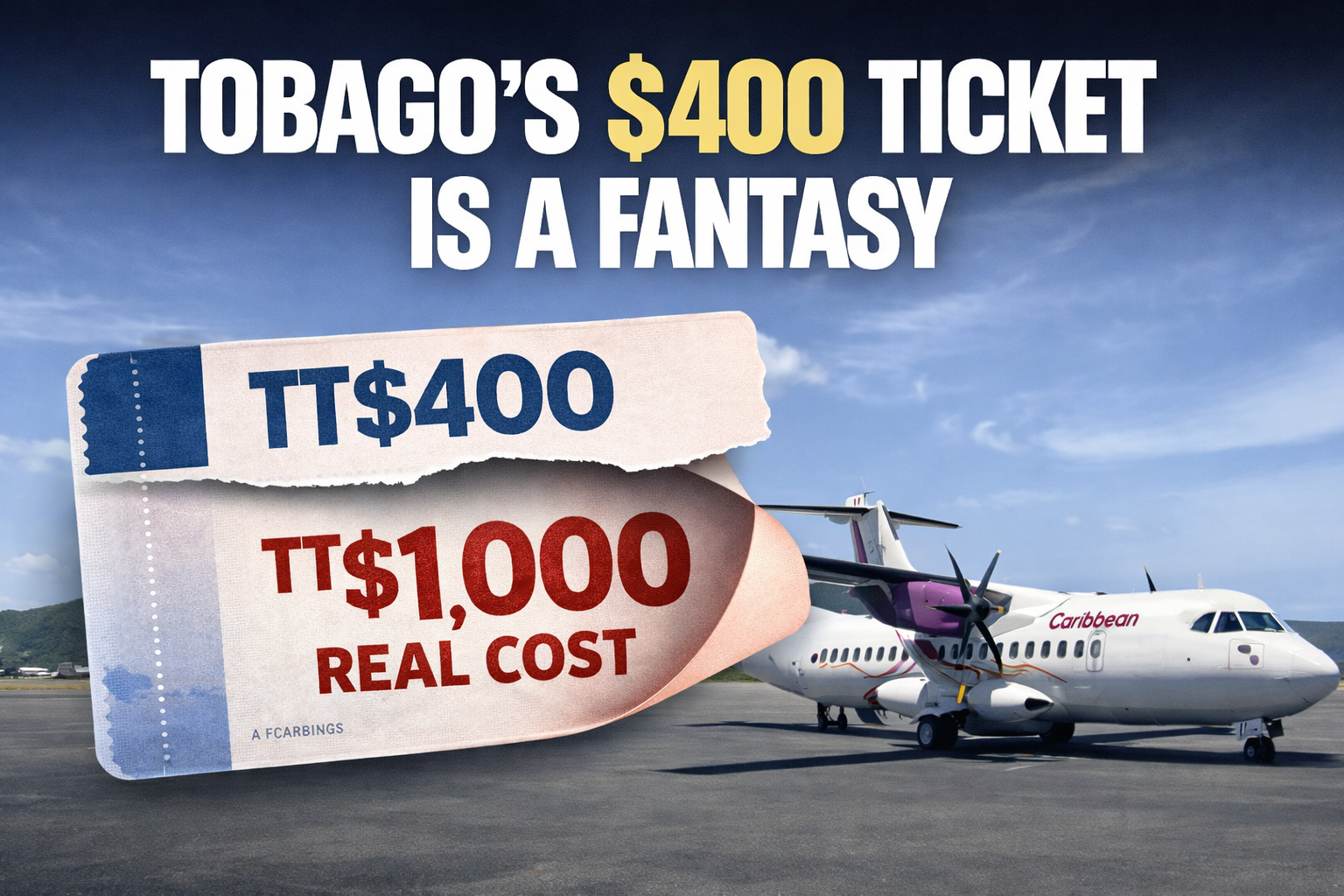
The Tobago Airbridge Subsidy is one of those things most people in Trinidad and Tobago know exists, but very few stop to really price out. On paper, a return ticket between Trinidad and Tobago now costs TT$400 after the January 2023 increase from TT$300. In reality, multiple estimates and recent public comments suggest the true economic cost of that same return seat is closer to TT$1,000. That means every “cheap” ticket comes with a hidden bill, and Caribbean Airlines is the one being forced to carry much of the burden while already drowning in debt, fuel pressure, and years of missing audited accounts. The result is a national transportation policy built on political convenience, emotional attachment, and a financial model that looks shakier by the month.
That is why this debate is no longer just about flights. It is about whether Tobago’s lifeline is being protected sensibly, or whether CAL is being used as a state-owned shock absorber for a subsidy structure that no longer matches economic reality. The airbridge is a public utility more than a normal airline route, with CAL caught between public service duty and commercial collapse. The trouble is that a public utility still has to be funded honestly. Right now, the country appears to want first-class convenience at a politically tolerable fare, while pretending the gap will somehow vanish in the cockpit.
The Tobago Airbridge Subsidy Is Hiding the Real Price of Flying
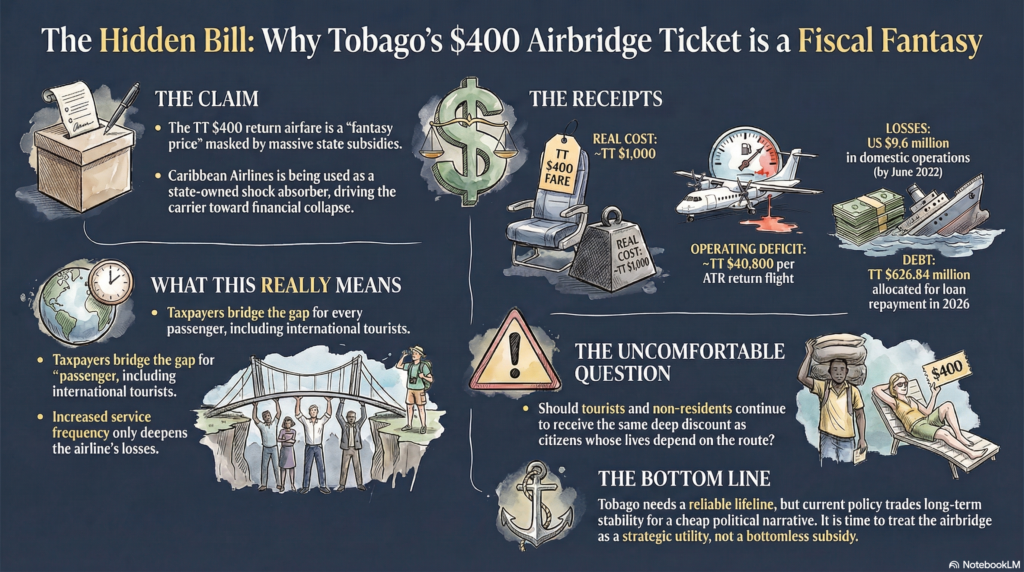
Let us call the thing by its real name. Tobago is not getting a TT$400 air ticket. Tobago is getting a heavily discounted ticket whose true cost is being masked by subsidy and by CAL’s balance sheet. The economic cost of production is estimated at about TT$1,000 per return seat, while the airline’s operating deficit can reach roughly TT$40,800 per ATR return flight. In addition domestic operations recorded losses of US$9.6 million by June 2022, with total domestic operating costs of US$18.78 million. Those are not the numbers of a route merely having a rough patch. Those are the numbers of a route that bleeds when it flies.
Worse still, increased flight frequency can actually deepen the problem. That is the political trap no one wants to say too loudly. Tobago leaders understandably want more flights because Tobago’s tourism sector and broader economy depend on reliable access. But when each additional seat is sold below real cost, “more service” can quickly translate into “more losses.” What Tobago sees as growth stimulus, CAL experiences as subsidised strain.
Tobago’s TT$400 ticket is not cheap. The real fare is simply being split between taxpayers, subsidies, and a struggling airline.
CAL’s Bigger Problem Is Not Tobago Alone. It Is a Business Model Under Siege
To be fair, Tobago did not create all of CAL’s problems. The airline’s crisis is bigger than the airbridge. Recent reporting says CAL has asked Government for fresh support as fuel costs rise, and the options reportedly put to the Ministry of Finance included a fuel surcharge, higher ticket prices, cuts to low-revenue routes, possible removal of the inter-island subsidy, and even a billion-dollar debt write-off. The 2026 Estimates reportedly allocate TT$626.84 million for principal repayment on CAL’s local loans, triple the revised TT$200.8 million in fiscal 2025. Guardian also reported that the airline has not published audited financial statements for more than eight years, even though work on them is now said to be underway.
That last point matters. A state enterprise can ask the public for patience, but it cannot ask for blind faith forever. When an airline is simultaneously seeking rescue, carrying old debt, blaming fuel prices, and operating without up-to-date audited accounts in public view, every subsidy attached to it becomes politically explosive. People stop asking, “How do we help Tobago?” and start asking, “How much more money are we pouring into a black hole?”
That is where the Tobago Airbridge Subsidy becomes dangerous for CAL as a whole. It is not just a line item. It becomes the symbol of a wider crisis: a state airline expected to act like a development agency, a social service, a tourism engine, and a commercially disciplined carrier all at once. That kind of arrangement may win applause in Cabinet notes and election speeches. It rarely wins in the accounts.
Tobago Needs Connectivity, But Does It Need This Version of It?
None of this means Tobago should be left stranded. Farley Augustine has been consistent that CAL’s first duty should be to the citizens of Trinidad and Tobago, and he has pushed back against any reported move to remove the subsidy entirely. He has also pointed to past suggestions that residents could keep the subsidised fare while non-residents or international passengers pay something closer to the true market rate. That idea keeps returning because, frankly, it makes more sense than pretending every passenger should be treated the same on a route with such obvious public-policy importance for Tobago residents.
But here is the question: if there is already a sea bridge, should CAL continue carrying such a heavy subsidy burden in its current form?
That question is uncomfortable because it sounds almost anti-Tobago on first hearing. It is not. It is a question about transport design. Official ferry fare listings remain far below the cost of flying, with TTIT ferry pages showing adult economy fares at TT$75 one way and TT$150 return. The sea bridge is slower, yes. Less convenient, yes. But it exists precisely because Tobago’s mobility cannot depend on air alone. If a cheaper public transport alternative is available, then the national conversation has to move beyond emotion and into priorities: who should get the flight subsidy, how much of it should remain, and whether tourists and non-residents should still enjoy the same discount as citizens whose lives and livelihoods genuinely depend on the route.
A Fantasy Fare Cannot Be National Policy Forever
The hardest truth in this story is also the simplest. A TT$400 return fare that may really cost closer to TT$1,000 is not an affordable transport miracle. It is a fantasy price sustained by subsidy, political fear, and CAL’s weakening finances. And fantasies are fine for campaign speeches, but they are terrible for state-enterprise management.
Tobago deserves reliable access. Tobago deserves an airbridge that supports business, family life, healthcare access, and tourism. But CAL also deserves a structure that does not force it to lose money every time it tries to keep the country connected. That may mean a resident-first subsidy. It may mean tourists and non-residents paying a more realistic fare. It may mean treating the sea bridge as the true mass-market option and the airbridge as a more targeted, strategic service. What it cannot mean is continuing to act as though the hidden bill does not exist.
Because in the end, somebody always pays. Right now, it is CAL, the Treasury, and by extension the taxpayer. The only thing “cheap” about Tobago’s TT$400 ticket is the political story wrapped around it.
This story is part of our wider Trinidad Politics Explained coverage. Explore the full hub for political analysis, key background, major controversies, and the latest updates.