The Great Work Wipeout: How a New Government Turned ‘Make-Work’ Into No Work
On April 28, 2025, voters handed power to the United National Congress and sent the People’s National Movement into opposition. Elections are about change. But few expected the kind of economic shock therapy that followed.
Within weeks, thousands of workers employed under state-sponsored programmes found themselves on the outside looking in. The justification was reform. The result was unemployment.
This is the story of how Trinidad job losses 2025 became not just a statistic, but a political choice.
From Employer of Last Resort to “Figure It Out”
For decades, programmes like the Community-Based Environmental Protection and Enhancement Programme (CEPEP), the Unemployment Relief Programme (URP), and the National Reforestation and Watershed Rehabilitation Programme acted as economic shock absorbers.
Were they perfect? No. Critics called them bloated, inefficient, and politically weaponised. Supporters called them survival.
But in May and June 2025, survival got terminated.
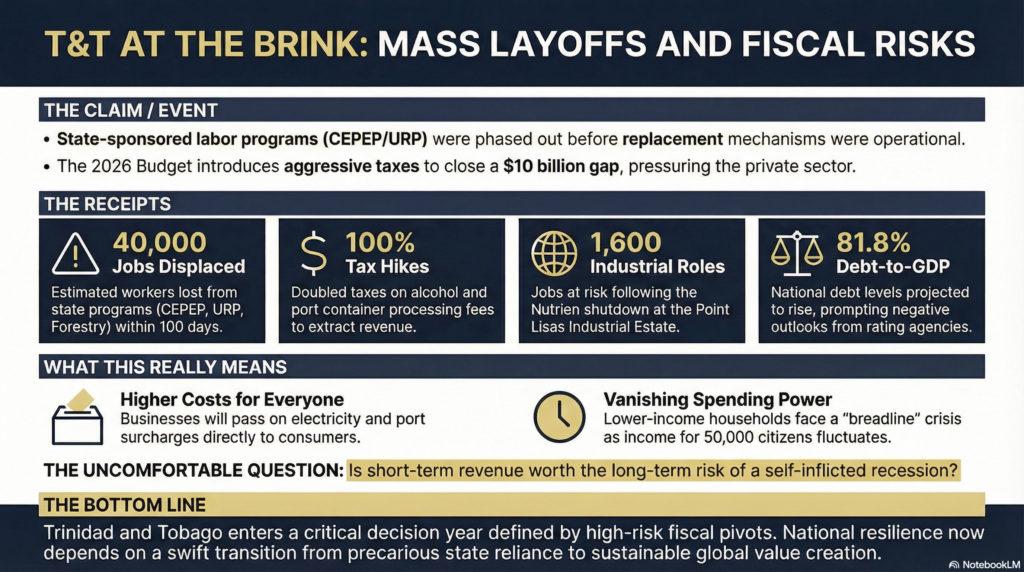
CEPEP contracts were ended in a sweeping move that reportedly affected over 10,000 workers and hundreds of contractors. URP cuts followed. Forestry workers were sent home. The numbers vary depending on the source, but analyst estimates put total displacements between 30,000 and 40,000 when you combine CEPEP, URP, forestry, and related state-linked contracts.
That is not trimming fat. That is removing an economic organ.
“Policy has consequences. In this case, the consequence was paycheques disappearing overnight.”
The government argued it was dismantling dependency and eliminating “make-work.” The problem is that when you remove make-work without replacing it, you get no work.
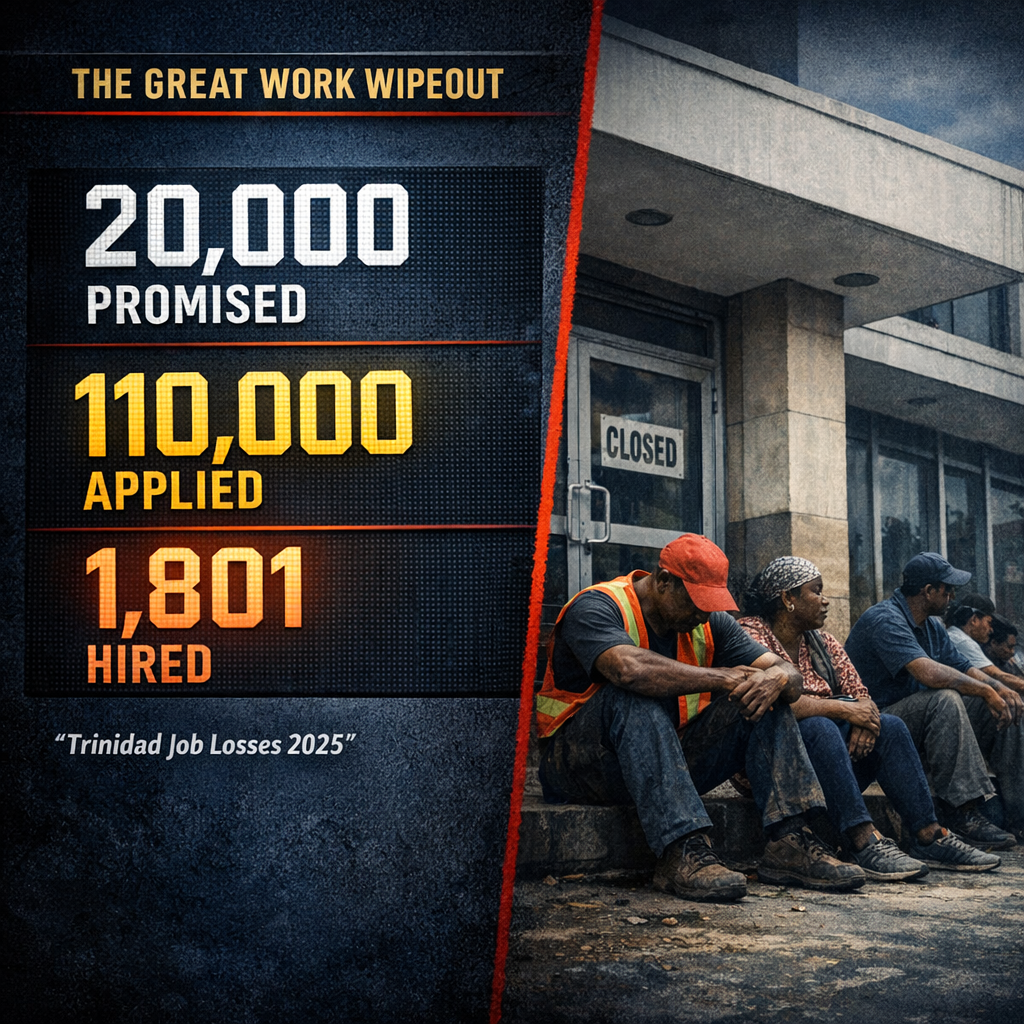
The 20,000 Job Promise That Became 1,801
In October 2025, the administration launched a National Recruitment Drive through the EmployTT platform. The promise was bold: 20,000 jobs.
The public response was overwhelming. Over 110,000 applications flooded the system.
By February 28, 2026, official confirmations showed only 1,801 hires had materialised.
Read that again.
20,000 promised.
110,000 applied.
1,801 hired.
This is not a rounding error. It is a credibility gap.
The “vacancy” narrative suggested thousands of open roles existed in the public service. But the operational reality revealed a slow, bureaucratic trickle. While government spokespeople pointed to screening processes and audits, displaced workers were pointing to rent due and groceries rising.
“You cannot eat a recruitment portal.”
The hiring lag transformed what was framed as reform into something that felt punitive. When thousands lose income first and opportunities arrive later, resentment grows faster than GDP.
A Fiscal Squeeze Meets a Labour Shock
The timing made everything worse.
Budget 2026 projected revenues of roughly $55.3 billion against expenditures of $59.2 billion. Debt-to-GDP projections hovered above 80 percent. New measures rolled out on January 1, 2026: a 0.25 percent asset levy on banks and insurance companies, electricity surcharges for commercial users, administrative fee hikes, and increased NIS contributions.
At the same time, unemployment ticked upward to 4.8 percent by Q3 2025.
A country already facing energy-sector volatility and foreign exchange constraints decided to cut tens of thousands from state payroll ecosystems.
This is the paradox: the government says it needed fiscal discipline. Yet eliminating CEPEP, URP and forestry did not just cut costs. It removed spending power from entire communities.
When 30,000 households reduce consumption simultaneously, small businesses feel it. When small businesses feel it, private retrenchments quietly follow.
Official retrenchment data shows only a few hundred formal layoffs in early 2025. But contract non-renewals rarely show up neatly in Ministry of Labour tallies.
The labour market can shrink quietly.
Reform or Retribution?
Prime Minister Kamla Persad-Bissessar defended the elimination of contract employment as a step toward permanent, pensionable positions. Supporters argue this creates dignity and financial leverage for workers.
But critics frame the mass closures differently.
They see vindictiveness. They see an administration dismantling programmes closely associated with the previous government. They see speed without cushioning.
When CEPEP and URP were shut down before the replacement system proved functional, it looked less like gradual reform and more like political demolition.
Intent is always debated. Impact is measurable.
The impact was tens of thousands displaced within months of the election.
The Decision Year
Newsday described 2026 as a “decision year.” That label fits.
Will the $475 million Employment Fund scale quickly enough to absorb displaced workers?
Will the public service truly convert precarious labour into secure tenure?
Or will Trinidad job losses 2025 become the turning point where the state finally admitted it could no longer act as employer of last resort?
Economic transitions are messy. But transitions without bridges feel like cliffs.
The Great Work Wipeout may yet be remembered as tough medicine that led to a leaner, more productive economy.
Or it may be remembered as the moment reform became rupture.
Right now, for thousands of households, it simply feels like no work replaced make-work.
This story is part of our wider Trinidad Politics Explained coverage. Explore the full hub for political analysis, key background, major controversies, and the latest updates.