NGC, Moody’s and the Missing Report Card: Why Trinidad Should Be Asking Hard Questions
NGC Did Not Fail The Exam. The Report Card Disappeared.
There are some stories that sound boring until you translate them into normal people language.
Moody’s did not come out and say NGC collapsed. Moody’s did not announce a fresh downgrade. Moody’s did not run through Wrightson Road waving a red flag and shouting “all yuh run for cover.”
What happened is more subtle, and maybe more uncomfortable.
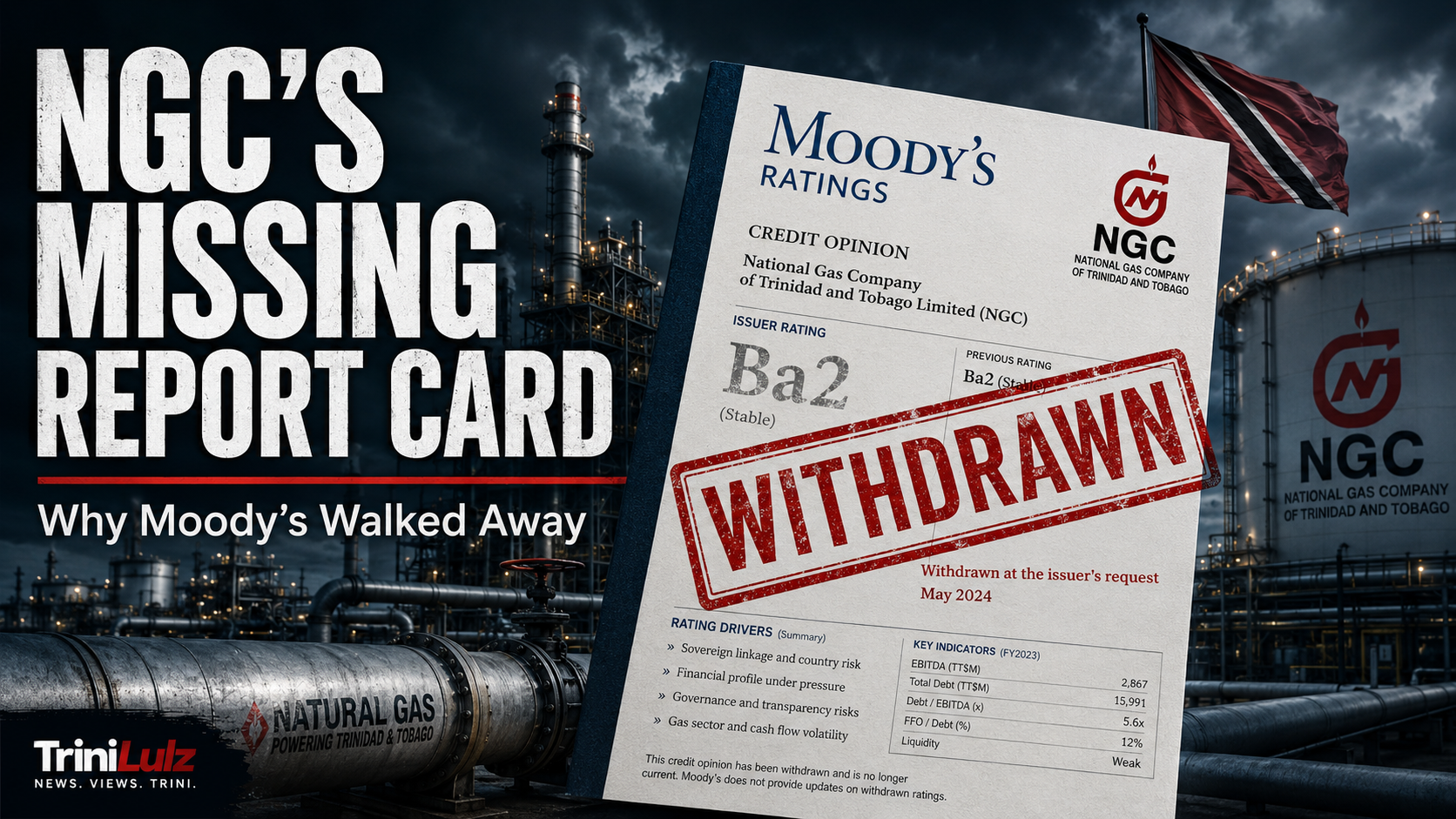
Moody’s Ratings has withdrawn all ratings assigned to the state-owned National Gas Company of Trinidad and Tobago after NGC decided to stop participating in the ratings process. According to CNC3, Moody’s cited “inadequate information to monitor the ratings” because of the company’s decision to cease participation. The withdrawn ratings included NGC’s Ba2 corporate family rating, ba2 baseline credit assessment and Ba2 senior unsecured notes rating. The outlook before the withdrawal was negative.
In school terms, NGC did not necessarily fail the exam.
The teacher simply said: “I no longer have enough information to mark the paper.”
And when the “student” is one of the most important State-owned companies in Trinidad and Tobago, that missing report card becomes everybody’s business.
NGC did not get a fresh downgrade. Moody’s simply said it no longer had enough information to keep rating the company. That may be the more uncomfortable story.
Why This NGC Story Matters To Ordinary Trinidadians
Some people may hear “credit rating” and immediately tune out.
But this is not some abstract Wall Street bacchanal. This is NGC.
NGC is wholly owned by the Government of Trinidad and Tobago. CNC3 reported that the company is the country’s sole purchaser, transporter and distributor of natural gas to the domestic energy sector. It also has stakes in major energy operations, including Phoenix Park Gas Processors Ltd and Atlantic LNG.
In other words, NGC is not a little corner-shop company selling doubles by the roundabout.
It sits in the middle of the national gas economy. Gas feeds petrochemicals. Petrochemicals feed exports. Exports help bring in foreign exchange. Foreign exchange affects businesses, imports, prices, confidence and the Government’s room to breathe.
So when an international ratings agency walks away because it says it does not have enough information, citizens have a right to ask questions.
Not panic.
Not spread rumours.
Ask questions.
Because Trinidad and Tobago has seen this movie before. State companies are often called “strategic” right up until the public finds out the strategy was written in invisible ink.
The Part That Makes People Nervous
The timing is what makes this story politically hot.
CNC3 reported that Moody’s withdrawal came five months after the agency affirmed NGC’s Ba2 ratings but changed the outlook from stable to negative. That previous outlook change followed a similar revision for Trinidad and Tobago, with Moody’s pointing to heightened government liquidity risks, declining foreign exchange reserves and persistent foreign exchange shortages.
That is not a small context.
When a rating agency says the country’s outlook is negative, and then later withdraws the rating of a major State-owned energy company because there is inadequate information, people are going to connect dots.
Some of those dots may be fair.
Some may be political mischief.
Some may be genuine concern.
But NGC and the Government cannot simply expect citizens to hear “inadequate information” and calmly return to watching TikTok recipes and pothole videos.
This is a company tied to the national purse, the energy sector, and the wider economic confidence of Trinidad and Tobago.
A little explanation would not hurt anybody.
Actually, it would probably help.
To Be Fair, NGC Is Not A Basket Case
This article is not saying NGC is collapsing.
That would be lazy.
NGC’s own published summary financial statements show that for the financial year ended December 31, 2024, the NGC Group recorded profit after tax of TT$1.6 billion. That was a major improvement from the TT$1.3 billion loss reported for 2023, which NGC said was mainly due to impairment charges of TT$1.8 billion.
TTT News also reported in April 2026 that NGC recorded a profit after tax of TT$3.285 billion for 2025, described by Prime Minister Kamla Persad-Bissessar as its highest in 11 years and double the previous year’s profit.
So yes, there is a positive side.
NGC has shown financial recovery. It has major assets. It remains strategically important. It is not some empty shell.
But that is exactly why the Moody’s withdrawal matters.
When a company is doing well, transparency should be easier, not harder.
If the numbers are strong, show the strength.
If the decision to stop participating in Moody’s process was a normal business decision, explain it.
If another rating agency is being prioritised, say so.
If Moody’s fees, methodology or requirements no longer made sense, say so.
But silence creates room for suspicion. And in Trinidad, suspicion does not walk. Suspicion takes a maxi, picks up five passengers and reaches Facebook before breakfast.
When a State company as important as NGC pulls back from outside scrutiny, the public has every right to ask: why now?
The CariCRIS Picture: Strong But Not Risk-Free
CariCRIS has also looked at NGC and painted a mixed but useful picture.
The agency describes NGC as strategically important to the domestic energy sector and the Government of Trinidad and Tobago. It also points to supporting factors such as improvement in gas supply and continued low gearing.
But CariCRIS also lists real risks. It says NGC is highly vulnerable to a changing energy landscape marked by volatile energy prices. It also notes reduced earnings and profitability due to lower energy commodity prices and gas production.
That is the honest picture.
NGC is important.
NGC is valuable.
NGC is not immune.
And when a company is that important but also exposed to energy prices, gas supply pressures, State finances and foreign exchange realities, citizens should want more information, not less.
The Real Issue Is Transparency
This is where the story moves beyond finance and into national culture.
Trinidad and Tobago has a transparency problem.
Too many major decisions involving State assets are explained after the fact, if they are explained at all. Too often, citizens are treated like shareholders when the company wants national pride, but like strangers when hard questions start.
NGC belongs to the State.
The State belongs to the people.
Therefore, the people are not being “fass” when they ask why Moody’s no longer has enough information to rate a company so central to the economy.
They are doing exactly what citizens in a democracy are supposed to do.
Ask.
Probe.
Demand clarity.
Because today it is a withdrawn credit rating.
Tomorrow it could be a debt issue, a dividend decision, a gas contract, a plant closure, a foreign exchange squeeze or another mysterious “strategic decision” that the public only understands when the bill lands.
Just as crime creates a fear tax on families and businesses, weak transparency creates a trust tax on the country. People begin pricing in suspicion. Investors get cautious. Citizens get cynical. Every official statement gets translated into “what they really mean is…”
That is not healthy for a country trying to rebuild confidence.
The Question NGC Must Answer
Nobody should pretend that every credit-rating process is sacred.
Companies can choose which agencies they work with. They may stop participating for cost reasons, strategic reasons, administrative reasons or because they disagree with the process.
Fine.
But NGC is not just any company.
It is a State-owned energy giant.
And when Moody’s says it is withdrawing ratings because of inadequate information after NGC stopped participating, the country deserves a plain-English explanation.
Not a lecture.
Not a cloud of corporate jargon.
Not “stakeholder alignment in the context of evolving strategic priorities.”
Just answer the question:
Why did NGC stop participating in the Moody’s rating process, and what will replace that layer of external scrutiny?
Because in a country where citizens are constantly told to trust the process, the process must be visible enough to trust.
This is not just about Moody’s. This is about whether Trinidad and Tobago’s energy crown jewels are being managed in sunlight or behind curtains.
The Missing Report Card Should Not Stay Missing
The most dangerous part of this story is not necessarily the withdrawal itself.
It is the information vacuum.
Nature hates a vacuum. Trinidad hates it even more. Leave a gap and the country will fill it with speculation, voice notes, political spin, WhatsApp University economics and one uncle who suddenly becomes a sovereign debt analyst because he watched three YouTube videos.
NGC can avoid that.
The Government can avoid that.
A clear public explanation would go a long way.
Tell the country whether this was a routine corporate decision. Tell the country whether another rating framework is being used. Tell the country whether investors, bondholders and citizens will still have enough independent information to assess the company’s position.
Because this is not just about Moody’s.
This is about trust.
And trust, like foreign exchange, gets scarce when people feel they cannot see what is really going on.
Final Word
NGC may still be profitable. NGC may still be strong. NGC may still be one of the country’s most important national assets.
But that is exactly why this story matters.
When a company that important loses an international rating not because of a fresh downgrade, but because the rating agency says it no longer has enough information, Trinidad and Tobago should not shrug.
We should ask hard questions.
Because a missing report card does not always mean the student failed.
But it does mean the parents deserve to know why nobody can see the grades.
This story is part of our wider Trinidad Politics Explained coverage. Explore the full hub for political analysis, key background, major controversies, and the latest updates.