Special Operations Bill: Everything You Need to Know About Your Rights and the 16–15 Vote
Could you need a permit to leave your own community? We explain the Special Operations Bill’s proposed powers, constitutional concerns, safeguards and the 16–15 Senate vote.

Could you need a permit to leave your own community? The Special Operations Bill makes that a practical question for Trinidad and Tobago. Imagine heading to work, taking a child to school or trying to reach an elderly parent, only to discover that the route crosses a newly declared closed area.
The Government presents the legislation as a way to reclaim communities from gangs. Its critics question how far the State can restrict ordinary residents’ lives, how those powers would be supervised and whether Parliament used the correct constitutional route.
Then came the vote: a divided Senate, a deciding intervention by President Wade Mark and a fresh argument about the independence of the Chair.
Here is what the bill provides, what remains unannounced and why the dispute reaches beyond the Red House.
Status checked: 26 September 2026. Parliament records passage by both Houses. Presidential assent and commencement by proclamation had not been verified for this explainer.
What has passed, and is it already operating?
The House of Representatives completed passage on September 19, following debate that began the previous day. The Senate passed the bill early on September 24. Parliament records that both Houses approved the text without amendments.
That does not automatically activate its powers. A bill must receive presidential assent to become an Act. Clause 2 then requires a proclamation fixing its commencement date. Orders and operational arrangements are also needed to apply particular restrictions.
The distinction matters: an announcement, parliamentary passage and a checkpoint legally operating under this framework are different things. The official parliamentary bill page provides the text and legislative history for readers who want to follow its progress.
Clause 26 gives the proposed Act a two-year lifespan from commencement. It is separate from the Constitution’s state-of-emergency machinery; references to emergency-style powers do not make it a declaration of a national emergency.
How would the Special Operations Bill be implemented?
The framework divides the country into seven policing districts. These are administrative areas, not seven automatically closed zones.
| District | Areas covered |
|---|---|
| 1 | Port of Spain, Diego Martin and San Juan/Laventille |
| 2 | Arima and Tunapuna/Piarco |
| 3 | Sangre Grande and Mayaro/Rio Claro |
| 4 | Chaguanas and Couva/Tabaquite/Talparo |
| 5 | San Fernando and Princes Town |
| 6 | Point Fortin, Siparia and Penal/Debe |
| 7 | Tobago |
The Commissioner of Police would designate a Head of Special Operations, at least a Superintendent, for each district. The Chief of Defence Staff would designate a military-assistance head, at least a Major. Military assistance depends on the Commissioner’s assessment and request.
Both designation processes require consultation with the Prime Minister. She can object after the consultations specified in the bill. That creates a point of executive influence over who leads operations, even though police and military authorities make the designations.
Assigned personnel must have training in human rights, use of force, community engagement and de-escalation. Police and Defence Force leaders must establish joint protocols and operating procedures, including a method of identifying officers. Implementation therefore requires trained personnel, clear command arrangements and workable procedures.
The public should be able to understand the rules affecting residents without being told confidential raid plans. Publishing a permit process is different from revealing where officers intend to search.
Who can declare your neighbourhood a closed area?
Under clause 11, the President may declare an area closed where there are reasonable grounds concerning specified threats, including escalating violent crime, illegal weapons or gang control and intimidation. Ordinary law-enforcement measures must also be insufficient to maintain or restore safety and peace.
The President generally acts on Cabinet advice under section 80 of the Constitution, unless a different arrangement is prescribed. This should not be presented as an independent judicial decision by the Head of State.
Specific grounds must be delivered to the Speaker within seven days for presentation to the House. The order is subject to negative resolution: it can take effect without an advance affirmative vote, while the House can annul it. The President can also revoke it.
The bill restricts how frequently annulment motions may be brought: they cannot be brought within three months of each other. It does not put a separate fixed expiry period on each closed-area order. The two-year lifespan of the Act is therefore not the same safeguard as regular, automatic reconsideration of each neighbourhood’s restrictions.
Independent Senator Anthony Vieira argued that a written recommendation from the Commissioner should be required before declaration. His concern goes to who establishes operational necessity before executive power is used.
Would you need permission to enter or leave?
Generally, yes, if the relevant closed-area provisions were activated. Clause 12 requires a permit to enter or leave a closed area. Clause 13 provides for cordons, with notices identifying boundaries and requirements. Clause 14 separately permits curfews requiring people to remain on their premises during specified hours.
These are distinct controls. Permission to cross a boundary should not be assumed to authorise movement during curfew hours; residents would need to check the applicable orders and permits.
The Commissioner can issue permissions for classes of people through Gazette notices. Specified police and military authorities can issue individual permits with conditions. The bill also allows suspension or cancellation and requires arrangements for applications manually and electronically.
Exemptions include specified public officeholders, judges and security officials, with duty-related exemptions for police and Defence Force members. Ordinary residents do not receive an automatic blanket exemption merely because their home is inside the area.
In Guardian reporting published on September 26, Prime Minister Kamla Persad-Bissessar promised minimal inconvenience and said assent would come soon. Activation timing and practical permit arrangements remained unannounced.
A shift worker needs to know how quickly approval arrives. A parent needs to know how school transport crosses a cordon. A family facing a medical emergency needs an immediate route to help. The absence of published answers is an implementation gap, not evidence that those journeys have already been prohibited.
Can police search your home or take your property?
Clause 15 authorises searches of places, vehicles and people inside a closed area without a warrant, upon reasonable suspicion that an offence is being committed, has been committed or is about to be committed. The wording is not confined to a list of particularly serious offences.
Reasonable suspicion remains a legal requirement. Living in an affected community does not establish guilt.
The officer in charge must take reasonably practicable steps concerning the presence of the owner, occupier, person in possession or their agent and their opportunity to observe the search. The safeguards also require reasonably practicable steps to ensure women are searched by female police officers.
Police may seize material meeting the statutory public-order or investigative criteria. Tools of lawful trade or business and legally privileged material are protected from seizure under this provision. A list and receipt are required. Clause 16 provides for return when the grounds for retention no longer exist and an application to a magistrate for recovery.
Those safeguards matter to a tradesman whose equipment is his income and a small business whose vehicle keeps it operating. Their effectiveness depends on accurate records and access to a prompt remedy when something goes wrong.
How long could someone be detained without charge?
This is one of the most consequential parts of the Special Operations Bill. Clause 17 requires the Head of Special Operations to be satisfied that reasonable grounds exist to suspect an offence has been committed, is being committed or is about to be committed.
The sequence is:
- Reasons and an initial court appearance: the person must be told the reason in a language they understand at arrest or as soon as reasonably practicable, and taken before a magistrate immediately or as soon as reasonably practicable.
- A magistrate’s decision: if detention is reasonably required in the interests of justice, taking necessary further investigation into account, the magistrate may order custody for no more than 48 hours, followed by a High Court appearance. Otherwise, immediate release must be ordered.
- A High Court decision: a judge may authorise further detention without criminal charges for a specified period if the statutory test is satisfied, or order immediate release.
The bill does not state a fixed maximum for that further High Court-ordered period. Judicial oversight is a meaningful safeguard, but the absence of a numerical ceiling remains a legitimate concern. It would be inaccurate to describe this as unlimited detention solely at police discretion.
Clause 19 adds an escalation requirement where someone has been held for 36 hours without the magistrate’s order: a sufficiently senior officer must be informed and the person brought immediately before a magistrate. It does not give police permission routinely to wait 36 hours before seeking judicial oversight.
Detention is also different from a criminal charge. A detained person has not thereby been convicted, and release without charge should not be presented as proof that a prosecution succeeded.
What safeguards exist, and where are the qualifications?
Clause 20 requires complaints concerning detainees to be recorded, provides for visits and welfare items, and requires medical attention without delay when needed. Visits are subject to specified security and safety considerations.
Lawyer access deserves particular scrutiny. The Constitution protects the ability to retain and instruct a chosen legal adviser without delay and communicate with that adviser. A lawyer should not be treated simply as an ordinary social visitor whose access can be postponed for administrative convenience.
Body cameras are another qualified safeguard. Clause 21 requires their use as far as possible, having regard to available resources. It provides for protocols and access by named oversight and investigative bodies. This is not an unconditional guarantee that every interaction will be recorded.
Clause 22 requires registration of assigned weapons, including ballistic signatures and ammunition, but allows the Commissioner or Chief of Defence Staff to determine otherwise.
Monthly operational reports go through police or military leadership to the executive. The Prime Minister must lay an annual report in Parliament within three months of the calendar year’s end. That creates accountability obligations, but an annual report may arrive long after a resident’s immediate difficulty at a checkpoint.
Independent senators acknowledged improvements over January’s defeated ZOSO proposal while seeking stronger safeguards. Vieira questioned time limits and proportionality. Dr Desirée Murray pressed for mandatory cameras and a community-development component. Michael Simon de la Bastide raised concerns about executive power and political influence.
What penalties could apply?
Breaches covered by the closed-area, cordon and curfew provisions can attract, on summary conviction, a TT$50,000 fine and one year’s imprisonment. The obstruction provision also carries those penalties. The precise offence and any lawful justification or reasonable-excuse wording matter.
Clause 23 permits a request for a person’s full name, aliases and address where the required grounds exist, including where the person can assist an investigation. The specified non-compliance or false-information offences carry a TT$20,000 fine on summary conviction.
These are court-imposed penalties following conviction, not an officer’s authority to collect those amounts at a roadblock.
How could constitutional rights be violated?
The Constitution’s rights protections remain the starting point. Liberty, privacy, property, movement and equal treatment can all be affected by the proposed powers. Restrictions can also interfere with family responsibilities, worship and peaceful association.
A potential violation could arise from a disproportionate provision in the legislation itself, or from the way an otherwise valid power is exercised. A search without adequate grounds, unjustified detention, obstruction of access to counsel or politically discriminatory treatment would require scrutiny on its facts.
Guardian’s September 26 report also revisited the Prime Minister’s statements about applying operations in government- and TPP-controlled areas. She blamed the Opposition’s stated resistance for the distinction. That controversy concerns implementation; party control is not a criterion written into clause 11.
The practical question is whether decisions follow evidence of danger and operational need. A community’s right to lawful protection and fair treatment should not depend on how its residents voted.
Section 14 allows a person alleging a relevant constitutional violation, including one likely to occur in relation to them, to seek High Court redress. Habeas corpus provides a means of testing detention’s lawfulness. A particular challenge’s remedy depends on the facts and the court’s decision; compensation is not automatic.
Why was a simple majority used instead of three-fifths?
Ordinary parliamentary questions are generally decided by a majority of members present and voting. Section 13 provides a different route: legislation expressly operating despite inconsistency with sections 4 and 5 must receive at least three-fifths of all members of each House. Even that route remains subject to a constitutional justification test.
The Government proceeded without that express override. Attorney General John Jeremie argued in the House that the restrictions and safeguards were reasonable and proportionate, relying on the Privy Council decisions in Suratt and Suraj. Opposition speakers, including Keith Scotland, disputed whether those decisions justified this package of powers.
In Suraj and others v Attorney General of Trinidad and Tobago, decided in 2022, the Privy Council confirmed that section 4 rights incorporate proportionality. The assessment asks about the objective’s importance, the measure’s connection to it, less intrusive alternatives and the balance between individual rights and the community’s interests.
The judgment identifies absolute protections within section 5, subject to the Constitution’s specified exceptions, including protection against arbitrary detention and cruel and unusual punishment. It also explains why section 13 legislation receives a different, more deferential review. A general appeal to proportionality supplies no automatic approval for this bill.
Therefore, the vote count alone cannot settle constitutionality. The substantive powers and safeguards must be examined. Calling a measure necessary for crime-fighting does not answer whether a less restrictive approach would work. Equally, affecting a qualified right does not, by itself, prove an unconstitutional infringement.
Parliament chose the ordinary route. A court, if properly asked to decide, would assess the constitutional challenge. A minister’s assurance and an opponent’s accusation are arguments, not judgments.
Why did Wade Mark cast the deciding vote?
All 15 government senators voting supported the bill. All six opposition senators and all nine independent senators opposed it. That produced a 15–15 tie. Mark’s casting vote made the final result 16–15.
Section 59(2) of the Constitution explicitly gives the Senate’s presiding officer a casting vote when votes are equal. Standing Order 54 repeats the rule and requires any reason stated to be recorded. The argument is about the principles governing that vote’s use.
Standing Order 2 directs the Chair to local practice and previous rulings, and to applicable UK Commons practice where matters are not provided for. The Westminster principles associated with Speaker Denison distinguish allowing further discussion, preserving a bill’s wording on a tied amendment and making a final substantive change.
Critics say a final change should command a majority without the Chair supplying it. Mark’s position, reported from the sitting, was that his research found no settled local practice on the status-quo issue. Government Senate Leader Darrell Allahar defended the decision, arguing that ordinary legislation should not depend on independent senators’ support or abstention.
Former House speaker Nizam Mohammed warned against the casting vote becoming an automatic sixteenth government vote. Former deputy speaker Fuad Khan questioned consistency with Mark’s earlier handling of tied amendments. Those earlier votes concerned amendments, not final passage, so the procedural difference must be acknowledged.
The legitimate question is how the Chair justified this exercise of an admitted power and what precedent it sets. No court ruling invalidating this particular vote was verified for this article.
What should residents watch for next?
Watch for assent, the commencement proclamation, actual closed-area and curfew orders, clear boundaries, permit instructions and emergency arrangements. Until those details are published, nobody should invent operating hours or tell residents that an unannounced WhatsApp process is the official application system.
If affected, seek clear information about the applicable order, permit conditions and complaint channels. Anyone detained, or assisting a detained relative, should seek legal assistance promptly and establish the recorded grounds and custody timeline.
For TriniLulz, success should be assessed through sustained safety, charges supported by evidence, case outcomes, complaints, court findings, costs and the burden placed on residents. Arrest totals alone cannot establish that extraordinary powers delivered lasting protection.
If the State asks a community to accept greater restrictions, it owes that community clear rules, accessible remedies and evidence that the restrictions are necessary. That obligation continues long after the deciding vote.
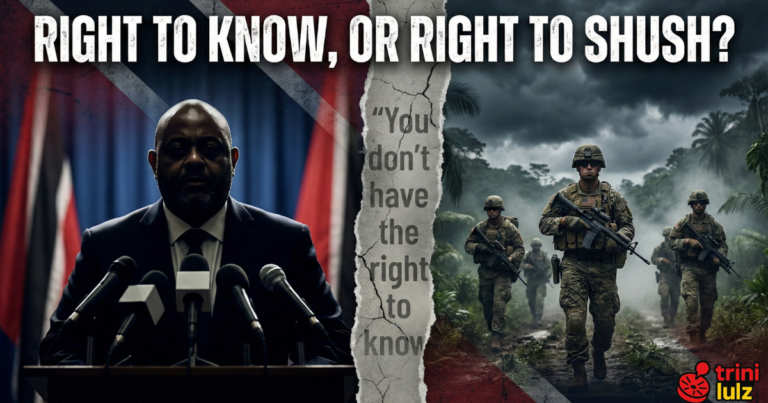
Reporting note: This explainer draws on the bill, parliamentary records, the Constitution, the Suraj judgment and attributed news reporting available on 26 September 2026. It distinguishes proposed powers from verified implementation and provides general legal information. Feature image: editorial illustration.
Want the bigger picture? Explore our Trinidad Crime & Security hub for dashboards, explainers, updates, and deeper coverage of one of the country’s most urgent ongoing stories.