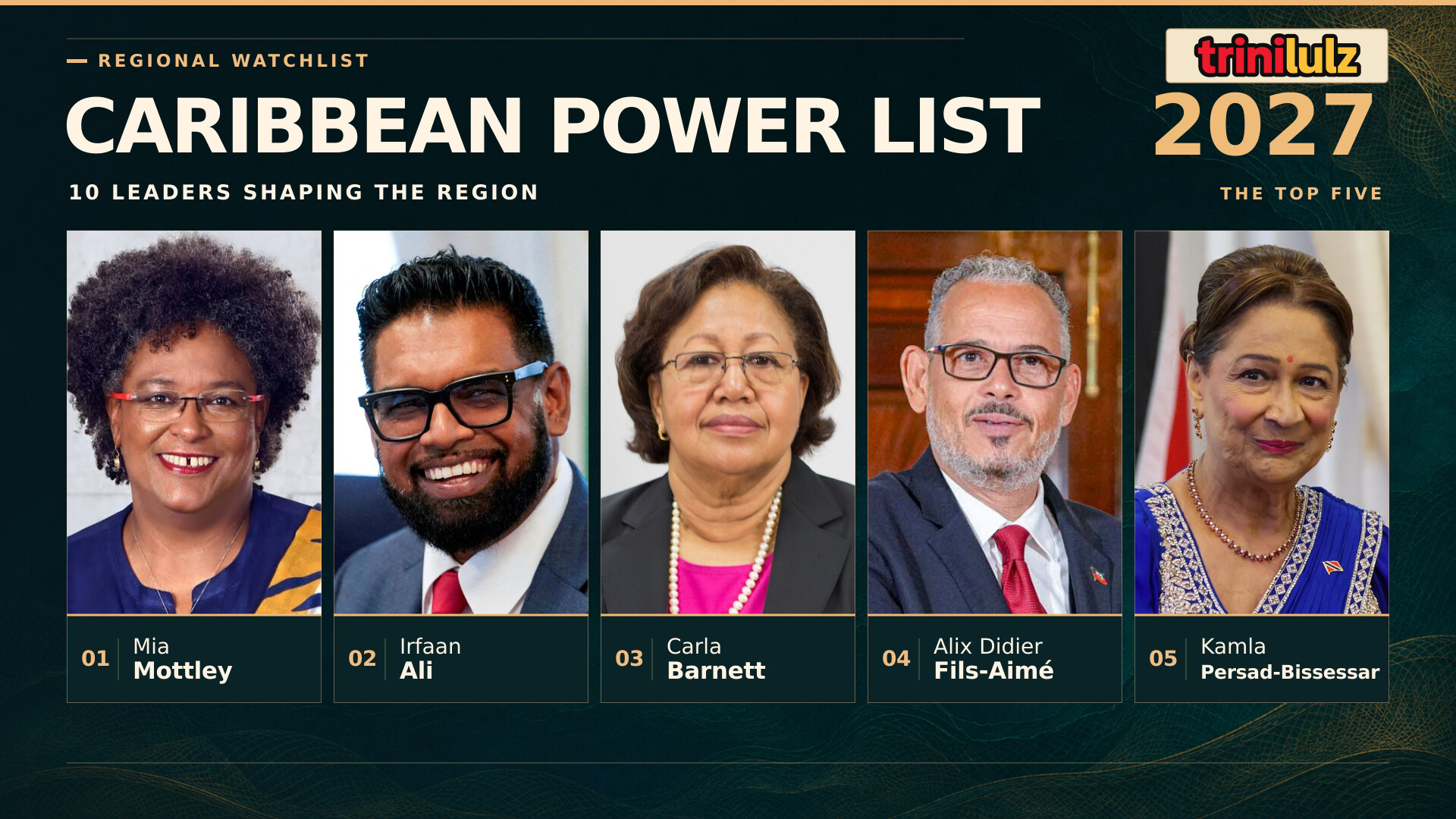
Caribbean Power List 2027: 10 Leaders Shaping the Region
The Caribbean’s biggest decisions in 2027 could show up in some familiar places: the price of food in a supermarket, the paperwork for a job on another island, or the time it takes a community to recover after a storm. Other decisions will determine which Caribbean artists reach new stages and which cricketers get a path to the international game.
The Caribbean Power List 2027 is TriniLulz’s editorial watchlist, based on reporting checked on November 27, 2026. We looked for people making decisions that reach across borders, with a recent record and something readers can watch for in the year ahead. The selection has a strong CARICOM focus and includes people whose influence comes from running institutions, building businesses and creating culture.
1. Mia Mottley — The cost of preparing for a disaster
Prime Minister of Barbados. At COP31 in Türkiye in November, Mottley pressed for cheaper financing for vulnerable countries before disaster strikes. That is the practical idea at the heart of the Bridgetown Initiative. On an island that already carries heavy debt, affordable money can determine whether a drainage project gets built before the floods or has to wait until after the damage. Her influence is in bringing that argument into rooms where lending rules are made.
Watch in 2027: Whether lenders approve and release affordable financing for Caribbean projects that reduce the risk of disaster, and how quickly borrowers can get to the money.
2. Irfaan Ali — Can Guyana’s wealth change how the region eats?
President of Guyana. Ali began a second term in September 2025. Oil gives his government resources, but the regional test is what it can build beyond oil. As CARICOM’s lead head of government for agriculture and food security, he is associated with the regional plan to cut the region’s food import bill by 25%, now extended to 2030. More food grown in Guyana will matter to regional shoppers if it can travel reliably, clear import checks and arrive at competitive prices.
Watch in 2027: New regular shipments of Caribbean produce between member states, supported by cold storage and predictable shipping rather than one-off announcements.
3. Carla Barnett — Will regional integration work at the border?
Secretary-General of CARICOM. The Belizean economist began her second term in August 2026. One practical measure of progress is the fuller free movement arrangement that Barbados, Belize, Dominica and St Vincent and the Grenadines began in October 2025. It gives eligible nationals of those four states a wider route to live and work in the participating countries. Governments decide whether to join and implement it. Barnett’s Secretariat helps coordinate the work that makes the agreement usable.
Watch in 2027: Whether more governments join and whether people already entitled to move can get consistent answers about their rights at the border and from employers.
4. Alix Didier Fils-Aimé — Haiti’s road back to elected government
Prime Minister of Haiti. In October, Fils-Aimé and CARICOM both placed Haiti’s security effort within a wider recovery agenda that includes elections and justice reform. Haiti’s Provisional Electoral Council has since issued a revised timetable that schedules the first round of presidential and legislative voting for July 18, 2027. That is a scheduled date, and the election council has its own role. The government’s job in the transition is to help create the conditions for a credible vote.
Watch in 2027: Whether registration and polling preparations advance in communities affected by violence and displacement, and whether electoral authorities can publish workable arrangements for people to vote safely.
5. Kamla Persad-Bissessar — Trinidad and Tobago’s energy and security choices
Prime Minister of Trinidad and Tobago. In April, Persad-Bissessar and Ali agreed on an agenda to deepen trade and economic ties at a meeting focused on energy collaboration. In November, she also discussed energy and regional security with a visiting U.S. assistant secretary of state, according to a ministerial statement in the House. T&T’s energy plants, suppliers and security relationships give it a stake in the choices its neighbours make. The reverse is true too.
Watch in 2027: Whether the talks with Guyana produce a signed project or supply agreement, and how T&T coordinates the regional effects of closer U.S. security cooperation with Caribbean neighbours.
6. Daniel Best — Who can afford to finance a deal?
President of the Caribbean Development Bank. A company may have a buyer on another island and still be unable to finance the shipment. In June 2026, the CDB and IDB Invest signed a guarantee facility meant to expand trade finance in smaller Caribbean markets. It lets the institutions share some of the financial risk. Best’s job is to make tools like this useful to the firms and banks that have trouble financing trade in the first place.
Watch in 2027: How many markets, local financial institutions and businesses use the facility, and whether it makes it easier for smaller firms to ship regionally.
7. Adam Stewart — The reach of Caribbean tourism investment
Executive Chairman of Sandals Resorts International. Sandals South Coast in Jamaica reopened on November 19, just over a year after Hurricane Melissa damaged the property. The company operates across the region, including in Curaçao, Saint Lucia and St Vincent and the Grenadines. Its investment decisions matter to the staff, farmers, tradespeople and service businesses that depend on resort demand. Reopening a property is one milestone; the benefits can be measured in work and spending after the guests return.
Watch in 2027: Whether investment brings stable jobs and sustained orders from local suppliers in the places where the group operates.
8. Lisa Indar — Early warnings that travel across borders
Executive Director of the Caribbean Public Health Agency (CARPHA). In November, CARPHA brought representatives of 14 member states to Trinidad for work on linking surveillance of diseases that spread through food or between animals and people. A lab result becomes more useful when agriculture and health teams can connect it with reports elsewhere. Under Indar, CARPHA is helping build that capacity across countries that each have different resources.
Watch in 2027: Whether more national teams can share comparable data, confirm problems through their labs and pass along usable alerts in time for neighbouring countries to act.
9. Kishore Shallow — Who gets a pathway into West Indies cricket?
President of Cricket West Indies. Shallow, a Vincentian, leads an institution that has to build teams from several countries and territories. For the 2026–27 season, the board awarded senior international retainers to 15 women and 15 men, as reported by the ICC. Those deals offer a window into where the board commits resources. A deeper game also requires competitive domestic seasons, coaching and chances to play before someone qualifies for an international contract.
Watch in 2027: Whether the board can match the senior contracts with regular competition and clear progression for young players, including more meaningful match time for women.
10. Machel Montano — How far can soca travel?
Trinidad and Tobago soca artist and producer. Montano’s 2026 dates included Toronto in September, Dominica’s World Creole Music Festival in October, and a Tobago show later that month. Those stages connect different audiences: residents, visitors and the diaspora. For soca, that route matters because it can keep demand for live music going beyond Trinidad Carnival and create dates for the artists and crews who help put on a show.
Watch in 2027: Which projects are made with artists and promoters from other islands, and whether those partnerships give more Caribbean performers dates outside their home markets.
The value of this list is in what can be checked a year from now. Look for money disbursed, goods shipped, workers able to take up jobs, election preparations completed and talent booked or given time to play. That is how we will know which decisions made it past the announcement.
For more rich lists, business power stories, elite profiles, and regional influence analysis, visit our Caribbean Power, Wealth & Influence hub.