CHINESE VLCC UNDER ARMED GUARD: Why Venezuela Is Escorting Oil Tankers to China
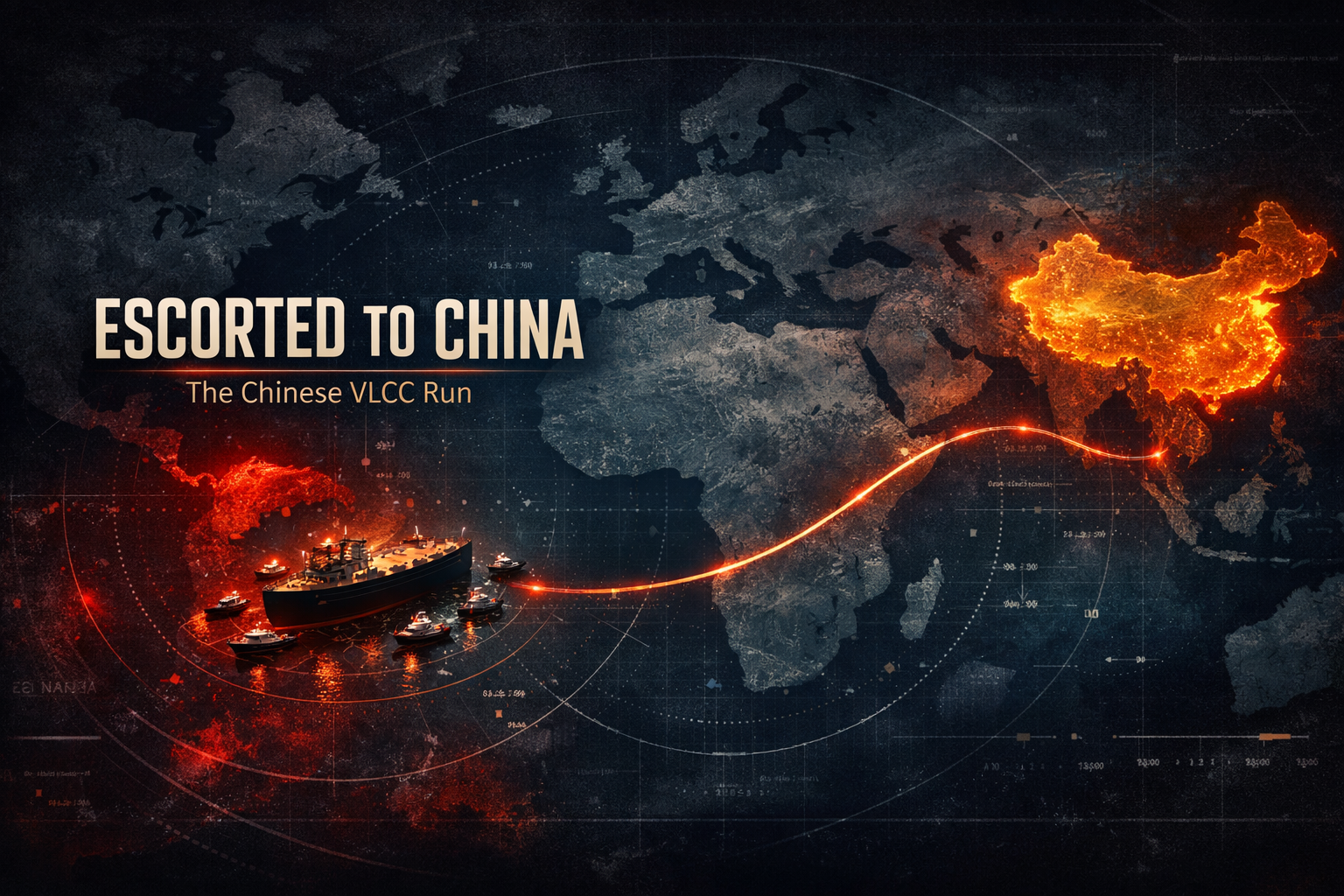
When a Chinese VLCC leaves Venezuelan waters flanked by armed patrol vessels, something fundamental has changed in how oil moves across the Caribbean. This is no longer routine energy trade. This is state power wrapped around a floating oil vault.
Off Venezuela’s coast, one of the world’s largest crude carriers, linked to Chinese buyers, began its journey under the watchful eyes of the Venezuelan Coast Guard. The imagery alone tells the story. Massive tanker. Small gunboats. Strategic silence. It looks less like commerce and more like a convoy.
And that is exactly the point.
Oil That Now Travels With Security
A Very Large Crude Carrier can haul close to two million barrels of oil. It is slow, visible, and impossible to hide. Under normal conditions, a VLCC relies on paperwork, insurers, and international maritime norms to move freely.
Sanctions changed that equation.
With U.S. pressure tightening and recent tanker seizures sending shockwaves through global shipping, Venezuela has shifted tactics. Instead of hoping its oil slips quietly through international waters, Caracas is placing state protection directly around the cargo.
The escalation point was the U.S. seizure of a Venezuela-linked tanker — a move that turned sanctions from paperwork into maritime force, as we covered in our breakdown of Trump seizing the Venezuelan tanker.
This Chinese VLCC is not being escorted because of pirates. It is being escorted because the cargo itself has become politically radioactive.
When oil needs armed guards, sanctions have left the spreadsheet and entered the ocean.
Why the VLCC Is Chinese
China sits at the center of Venezuela’s oil survival strategy. With Western buyers constrained by sanctions, Beijing has emerged as the most reliable destination for Venezuelan crude, especially discounted heavy blends.
For China, the calculation is cold and pragmatic:
- Secure energy supplies
- Buy at reduced prices
- Expand strategic leverage
For Venezuela, the stakes are existential. Oil exports fund the state. Losing shipments to interdiction is not just an economic hit. It is a political threat.
A Chinese VLCC represents guaranteed demand at the end of the route, which makes protecting the ship near Venezuelan waters a rational, if risky, move.
The Armed Escort Message
Escorting a tanker is not primarily about firepower. It is about signaling.
Venezuela’s coast guard presence sends three messages simultaneously:
- To the United States: any interception attempt risks direct confrontation.
- To China: your cargo matters enough for us to put uniforms around it.
- To the world: Venezuelan oil exports will not stop quietly.
This is deterrence by visibility. The escort is meant to be seen, photographed, tracked, and debated.
The Shadow Fleet Factor
The situation grows more volatile when combined with another tactic increasingly used in sanctioned oil trade: ships going dark.
Some tankers linked to Venezuelan exports have reportedly switched off their AIS tracking systems during parts of their journey. This “ghost ship” behavior complicates enforcement, raises safety risks, and pushes insurance costs through the roof.
U.S. sanctions authorities have explicitly flagged AIS manipulation and “going dark” as a common evasion tactic — see OFAC’s Sanctions Advisory on AIS transponder manipulation for the playbook regulators are watching for.
Pair that with an armed escort near the coast, and the choreography becomes clear. Visibility when it deters. Silence when it protects.
Oil now travels part-time as cargo, part-time as a geopolitical statement.
What This Means for the Caribbean
This is not a distant great-power drama. It is unfolding in Caribbean waters, along routes used daily by commercial shipping, fishing fleets, and energy traffic.
As escorts, seizures, and shadow operations become more common, the region faces real consequences:
- Higher insurance premiums for vessels transiting nearby
- Increased risk of miscalculation at sea
- A slow erosion of the Caribbean’s reputation as neutral commercial space
Once the sea becomes militarized, everyone sailing through it pays the price.
Sanctions Enter the Naval Phase
The armed movement of a Chinese VLCC marks a shift in how sanctions are enforced and resisted. Financial pressure alone is no longer the endgame. Physical control of cargo is now on the table.
That escalation carries danger. Intercepting a tanker is one thing. Interfering with a tanker under state escort is another entirely.
The result is a tense standoff where no side wants to blink, but every side wants to be understood.
The Bigger Reality
Oil is still flowing from Venezuela to China. The difference is how nervous that flow has become.
Escorts, dark ships, seizures, and threats all point to the same truth. Global trade is fragmenting. Energy routes are hardening along political lines.
The Chinese VLCC under armed guard is not an exception. It is a preview.
And the Caribbean Sea is now part of that preview, whether it asked to be or not.