From Oando to Indian Oil: The Guaracara Refinery Restart Is Starting to Look Like Carnival Logistics
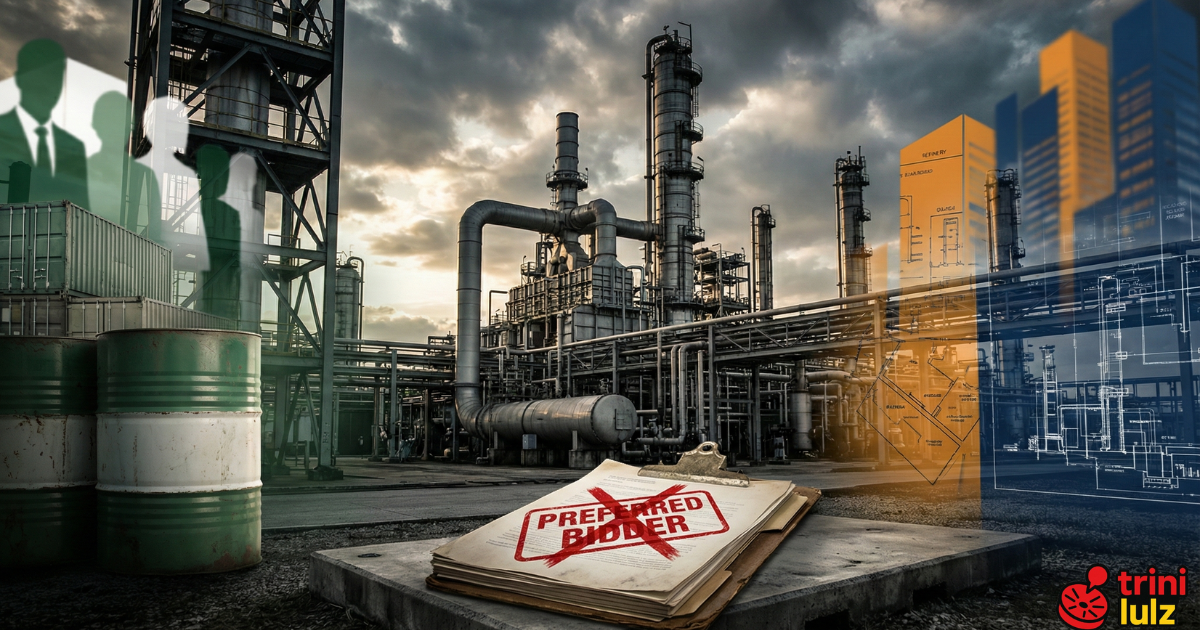
For seven years, Trinidad and Tobago’s most famous industrial relic has sat silent on the western coastline.
Steel warming in the sun. Pipes aging. Promises piling up.
The Guaracara refinery restart has been discussed so often it has become national folklore. For years we were promised it would rise again. Every year, it remains closed.
Now, in early 2026, the story has taken a turn so familiar it almost feels cultural.
We already picked a partner.
Then we changed the music.
Now we’re dancing with someone else.
And the refinery is still not running.
The Latest Plot Twist: Indian Oil Enters the Frame
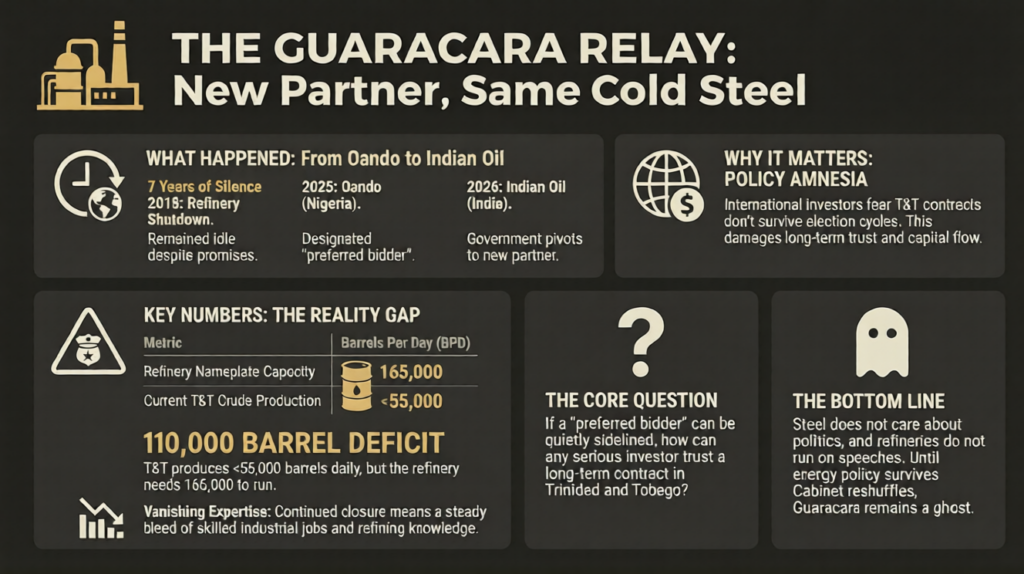
At the end of January, Energy Minister Roodal Moonilal confirmed that Trinidad and Tobago is in talks with Indian Oil Corporation to revive the mothballed refinery at Guaracara, according to reporting by Reuters.
The facility, shut since 2018, has a nameplate capacity of 165,000 barrels per day. Moonilal suggested that if talks progress, the country could see some level of production by the end of 2026. However, the UNC promised on entering government the refinery would be opened from day one.
On paper, that sounds like movement.
In context, it raises a louder question.
Because this is not Trinidad and Tobago’s first refinery courtship.
Didn’t We Already Choose Oando?
In February 2025, the then-PNM administration announced that Oando PLC had been selected as the preferred bidder to lease and operate the refinery .
“Preferred bidder” is not a casual phrase in energy policy. It signals due diligence, evaluation, and intent. It is the stage just before contracts are finalised.
At the time, the Oando announcement was sold as progress after years of paralysis.
But politics, as always, had other plans.
During the 2025 campaign period, senior figures in the incoming administration publicly stated that no refinery reopening deal negotiated by the previous government would be honoured .
So when the government changed, the Oando file quietly went into limbo.
No dramatic cancellation.
No clear explanation.
Just silence.
And now, India.
The Refinery as a Political Relay Baton
The Guaracara refinery restart is no longer just an energy project. It has become a relay baton passed between governments, each promising to run faster than the last.
The new administration’s logic is partly economic. Moonilal has acknowledged that Trinidad and Tobago’s crude oil production has fallen to under 55,000 barrels per day, far below what is needed to keep a refinery busy on domestic supply alone .
Historically, Guaracara processed imported crude from Africa, Venezuela, and even Russia. The minister has said imported crude remains an option again, including Venezuelan supply, though he emphasized that cross-border gas remains the more immediate national priority.
In that context, a state-owned refiner like Indian Oil, with scale, access to supply chains, and refining expertise, makes technical sense.
Politically, though, the optics are messier.
Investor Confidence Doesn’t Like Costume Changes
Energy investors understand risk.
They price for volatility.
They plan for politics.
What they struggle with is policy amnesia.
When a government publicly selects a preferred bidder, then a new government signals that such deals may not survive an election cycle, the message to global investors is simple and brutal:
Nothing is final until the next election.
That perception does not just affect refinery talks. It bleeds into upstream oil, deepwater exploration, gas monetisation, and even negotiations tied to regional energy diplomacy.
A refinery cannot be restarted on vibes, press conferences, or patriotic nostalgia.
It needs contracts that survive Cabinet reshuffles.
Why This Matters Beyond the Refinery Fence
The Guaracara site once employed thousands directly and indirectly. Its closure reshaped communities, fuel markets, and downstream industries.
A successful Guaracara refinery restart would matter because it could:
- Improve fuel security in an import-dependent region
- Create skilled industrial jobs
- Rebuild refining expertise that has been bleeding away
But a chaotic restart attempt risks doing the opposite. It signals instability. It scares off capital. It turns long-term infrastructure into short-term political theatre.
The Uncomfortable Question No One Wants to Ask
So here we are.
Nigeria was “preferred.”
India is now “in talks.”
The refinery remains cold.
If a preferred bidder can be quietly sidelined, what does that say about the durability of major energy decisions in Trinidad and Tobago?
And if the country wants serious players to commit billions to aging infrastructure, are we offering long-term certainty, or Carnival logistics: loud music, quick costume changes, and everyone pretending the confusion is part of the show?
Because steel does not care about politics.
Pipelines do not run on speeches.
And refineries do not restart themselves.