COST OF DOING BUSINESS: TRINIDAD’S INVISIBLE “BUSINESS TAX” KILLING STORES QUIETLY
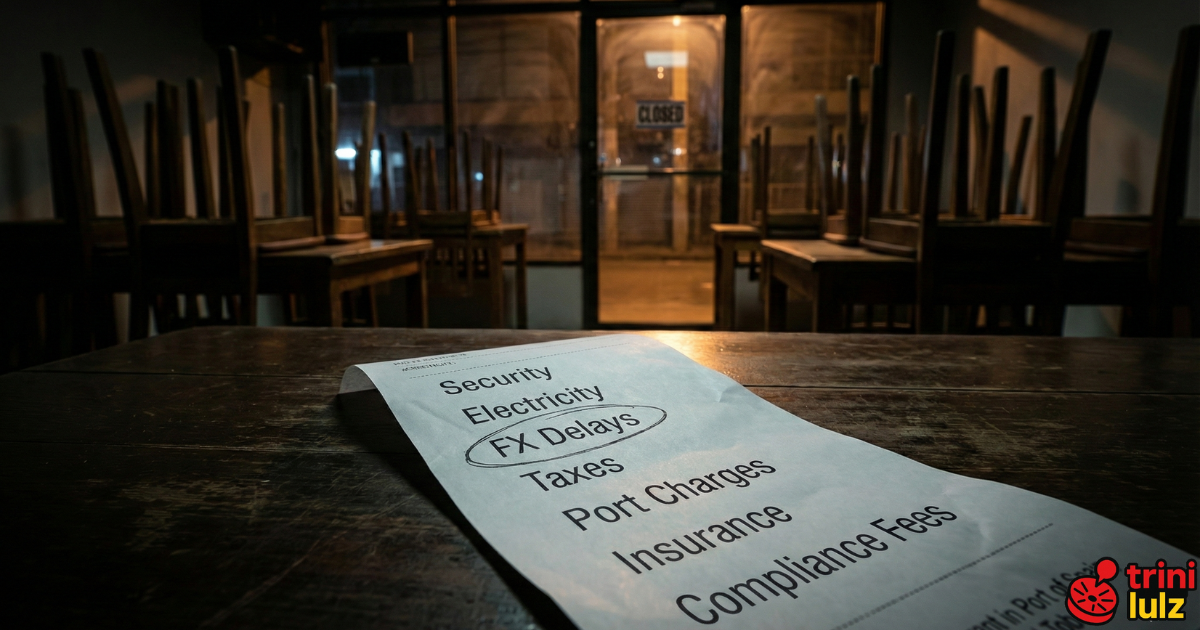
After 37 years in downtown Port of Spain, D’ Bocas closed its doors.
No scandal.
No viral meltdown.
No big press conference.
Just a short, sobering explanation: declining sales, rising taxes, post-pandemic pressure. Then silence.
And that quiet ending tells us more about the cost of doing business in Trinidad and Tobago than any glossy investment brochure ever could.
Because this wasn’t just one restaurant failing.
This was another business crushed by what many owners now call Trinidad’s invisible business tax.
Not the ones listed neatly in the budget.
The ones you only see when the bills arrive.
THE INVISIBLE BUSINESS TAX NO ONE PUTS IN THE BUDGET
On paper, Trinidad and Tobago is “business friendly.”
Corporate tax rates are published. VAT is known. Licensing fees are itemized.
But talk to anyone actually running a business and they’ll tell you the truth:
You don’t just pay taxes here.
You pay survival fees.
Security. Delays. Power uncertainty. Paperwork fatigue. Foreign exchange stress. Crime insurance. Time lost. Sleep lost.
None of it shows up in the budget speech.
All of it shows up on your balance sheet.
And slowly, quietly, it pushes businesses out.
SECURITY: THE COST OF DOING BUSINESS LIKE YOU’RE UNDER SIEGE
Security is no longer optional.
It’s a monthly subscription.
Guards. Cameras. Alarms. Bars. Gates. Shutters. Insurance premiums that jump the moment crime statistics do.
You’re paying rent and ransom.
And this isn’t just anecdotal frustration. According to the Inter-American Development Bank, crime and violence impose billions of dollars in economic costs across Latin America and the Caribbean every year, draining productivity, discouraging investment, and forcing businesses to spend heavily just to operate safely.
For small businesses in Trinidad, that “crime cost” isn’t theoretical. It’s monthly. Every business owner in Trinidad understands this one immediately.
ELECTRICITY, SURCHARGES, AND THE FEAR FACTOR
Electricity is only part of the picture.
Over the last year, businesses have also had to absorb a series of new and rebranded government charges that don’t always arrive labelled as “taxes” but hit just as hard.
In fact, as TriniLulz previously detailed in Property Tax Gone, But Meet the 4 New Stealth Taxes Hiding in Trinidad’s 2025 Finance Bill, many of these additional costs quietly shifted onto businesses under the guise of adjustments, fees, and surcharges, expanding the real cost of doing business without ever triggering a national conversation.
Individually, each charge looks manageable. Together, they become suffocating.
FOREIGN EXCHANGE: THE TAX OF UNCERTAINTY
There’s no line item called “FX Stress” in your accounts.
But every business owner knows it exists.
Delayed US payments mean delayed stock.
Delayed stock means lost sales.
Lost sales mean fixed costs eating you alive.
So businesses over-order when they finally get access. Or pay higher prices. Or lose suppliers entirely.
This isn’t inefficiency.
It’s a hidden cost of doing business that punishes the small operator first and hardest.
PORTS, CUSTOMS, AND THE COST OF TIME
Time is money everywhere.
In Trinidad, time is extra money.
Delays at ports and in processing don’t just inconvenience businesses. They create storage costs, spoilage losses, missed seasons, and higher financing expenses.
A delay doesn’t show up as a tax.
It shows up as a slow bleed.
And small businesses don’t have the blood supply to spare.
“In Trinidad, you don’t just run a business.
You also run Security Ltd, Stress Management Inc, and Please-Let-This-Bill-Not-Jump Co.”
POST-PANDEMIC REALITY: SAME COSTS, SOFTER SALES
Here’s the cruel math:
Operating costs rose.
Consumer spending didn’t recover evenly.
People lime less. Eat out less. Shop tighter. Choose cheaper. Delay spending.
So while expenses climb like they training for Carnival, revenue limping behind with a pulled hamstring.
That squeeze is exactly what long-standing businesses like D’ Bocas described before closing. Not failure. Exhaustion.
WHY BUSINESSES AREN’T FAILING. THEY’RE LEAVING.
This is why the business “exodus” conversation keeps coming back.
Owners aren’t always bankrupt.
They’re burned out.
They look at the invisible business tax and ask a simple question:
“Why am I fighting this hard just to survive?”
And then they quietly exit.
Close.
Relocate.
Or pivot into something smaller and safer.
No drama. Just gone.
THE REAL CONVERSATION TRINIDAD NEEDS
If Trinidad and Tobago wants to talk honestly about growth, investment, and job creation, it must confront the true cost of doing business, not just the official one.
Because taxes can be adjusted.
But invisible costs kill confidence.
And confidence, once gone, is the hardest thing to reopen.