HANDS UP, STILL SHOT: The Joshua Samaroo Case Is Why ZOSO Powers Should Scare You
There are moments when a single video detonates an entire national conversation.
The killing of Joshua Samaroo is one of those moments.
Not because police shootings are new in Trinidad and Tobago. They are not.
Not because public outrage is new. That, too, is familiar.
This moment matters because of the timing.
It happened just as the Government is asking the country to accept expanded ZOSO powers as the solution to crime.
And the video appears to show something deeply uncomfortable: a man with his hands raised, moments before being shot by police.
If this is what happens under existing police powers, the obvious question writes itself.
If surrender does not stop bullets now, what happens when the law gives police even more discretion?
The Samaroo Case and the Trust Problem
According to public reporting, the incident followed a police pursuit, a crash, and then gunfire. What ignited public anger was not rumor or hearsay. It was CCTV footage circulating online, footage that many viewers interpreted as showing Samaroo with his hands up at the moment shots were fired.
The Police Service maintains that officers responded to a dangerous situation. That claim will be tested by investigations.
But here is the problem no press conference can fix.
Trust is already thin.
In a country where police-involved killings are frequent, where investigations take years, and where accountability often feels theoretical, video evidence does not calm the public. It radicalizes doubt.
This is the environment in which ZOSO powers are being proposed.
What ZOSO Powers Actually Mean in Real Life
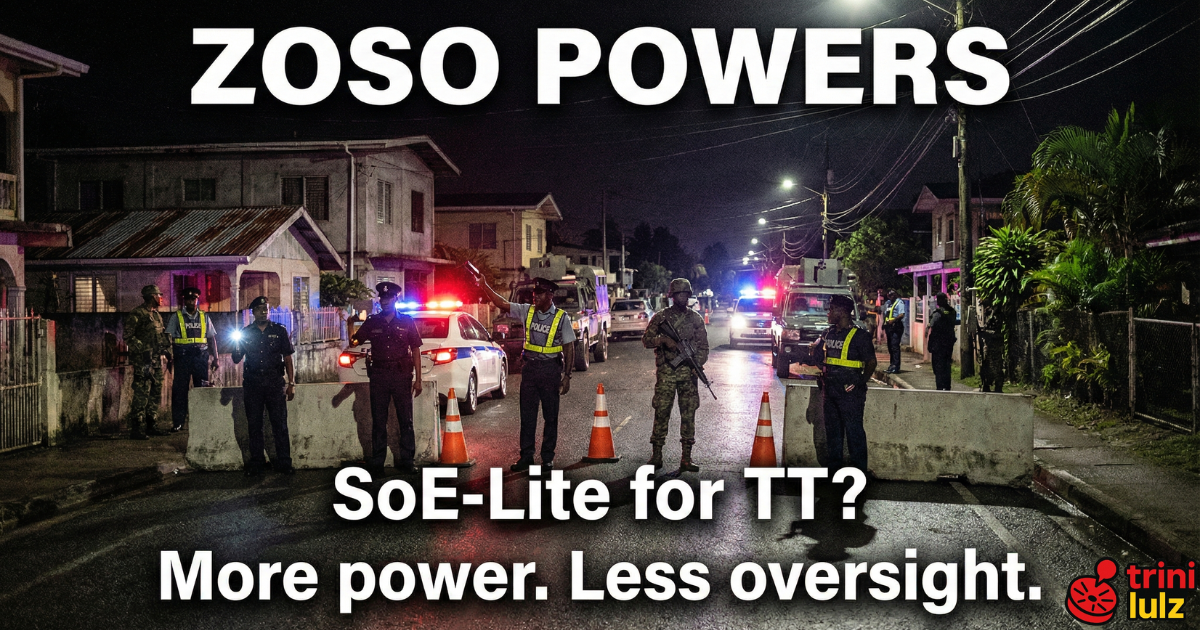
Zones of Special Operations are being sold as a smarter, more targeted alternative to a nationwide State of Emergency. On paper, the language sounds restrained.
For readers who have not followed the fine print, we previously broke down exactly how Zones of Special Operations function, what powers they unlock, and why critics describe them as “SoE-lite” for Trinidad and Tobago. That explainer is essential reading for understanding why ZOSO powers fundamentally change the balance between security and civil liberties.
In practice, ZOSO powers allow the State to:
• Impose curfews lasting up to 72 hours
• Restrict movement into and out of designated areas
• Conduct searches without a warrant within the zone
• Deploy joint police-military operations
• Detain individuals under expanded suspicion thresholds
These are not small tweaks. They are extraordinary powers, geographically concentrated.
The argument is that criminals exploit normal policing limits and that ZOSOs remove those limits where crime is worst.
But laws do not operate in a vacuum. They operate through people.
And people bring habits with them.
A Pattern We Can No Longer Pretend Is Isolated
The Samaroo case is not occurring in isolation. Over the past five years, Trinidad and Tobago has repeatedly confronted troubling patterns involving police use of force.
Fatal police shootings have remained persistently high. Independent oversight bodies have raised alarms about backlogs, delays, and the difficulty of securing evidence. In multiple cases, civilian video footage has contradicted official police accounts, forcing revisions, inquiries, or prolonged silence.
Perhaps most troubling, oversight agencies have publicly stated that body-camera footage, when it exists at all, is often unavailable to investigators.
That matters, because ZOSO powers increase discretion, and discretion without reliable oversight is how abuse scales.
Power does not correct behaviour. It amplifies it.
Why ZOSOs Change the Risk Equation
Under normal policing, questionable encounters are at least bounded by warrants, time limits, and movement freedoms.
Inside a ZOSO, those friction points are weakened.
These concerns are not coming from activists or armchair critics alone. The Law Association of Trinidad and Tobago has publicly warned that the proposed ZOSO framework lacks sufficiently strong safeguards, including clearer limits on detention, mandatory accountability mechanisms, and stronger protections against abuse of discretion. When the country’s top legal body starts raising red flags, it signals that the risk is not hypothetical.
• A curfew reduces witnesses
• A cordon limits outside scrutiny
• Warrantless searches reduce documentation
• Military presence raises stakes, not accountability
In other words, a ZOSO is not just a crime-fighting tool. It is a pressure cooker.
And pressure cookers do not forgive mistakes.
If an officer misjudges a threat today, the consequences are severe. Under ZOSO powers, the same misjudgment happens in an environment with fewer civilian eyes, fewer legal barriers, and greater operational urgency.
That is not theory. That is systems thinking.
“Not Anti-Police” Is Not the Same as Blind Trust
This argument is often derailed with a false choice: support ZOSOs or support criminals.
That is nonsense.
A society can demand safety and accountability. In fact, safety depends on accountability.
Most police officers do not wake up intending harm. But institutions shape behaviour. When consequences are slow, unclear, or rare, bad decisions become normalized.
ZOSOs assume that expanded authority will be used wisely.
The Samaroo case forces a harder question.
What if the problem is not lack of power, but lack of restraint?
The Question Parliament Cannot Dodge
The debate over ZOSO powers is not really about crime hotspots.
It is about whether the State has earned the trust required to wield extraordinary authority.
When citizens see hands raised and shots fired, that trust erodes.
When investigations drag on for years, it collapses further.
When oversight bodies complain publicly, the warning lights are flashing.
Expanding police powers under these conditions is not bold leadership.
It is a gamble.
And the currency at stake is not politics. It is human life.
ZOSOs don’t fix broken trust. They test how broken it already is.
Until that trust is repaired, ZOSO powers are not just a policy choice.
They are a risk multiplier.
And the Samaroo case is the warning Trinidad and Tobago cannot afford to ignore.
Want the bigger picture? Explore our Trinidad Crime & Security hub for dashboards, explainers, updates, and deeper coverage of one of the country’s most urgent ongoing stories.