From Diplomatic Crown Jewel to Costly Relic: Why Hilton Trinidad May Be Near the End of the Road

There was a time when Hilton Trinidad was not just a hotel. It was the flex. It was the place that told the world Trinidad and Tobago had arrived, dressed properly, and was ready to host presidents, diplomats, celebrities and summits with a straight face and a strong rum punch nearby. Opened in 1962, the same year this country stepped into Independence, the hotel was conceived as part showpiece, part statecraft, and part international calling card. Newsday notes it was hand-picked by Conrad Hilton and became one of the earliest international Hilton properties, perched dramatically above the Queen’s Park Savannah with that famous “upside-down” design where the lobby sits at the top and the rooms cascade down the hillside.
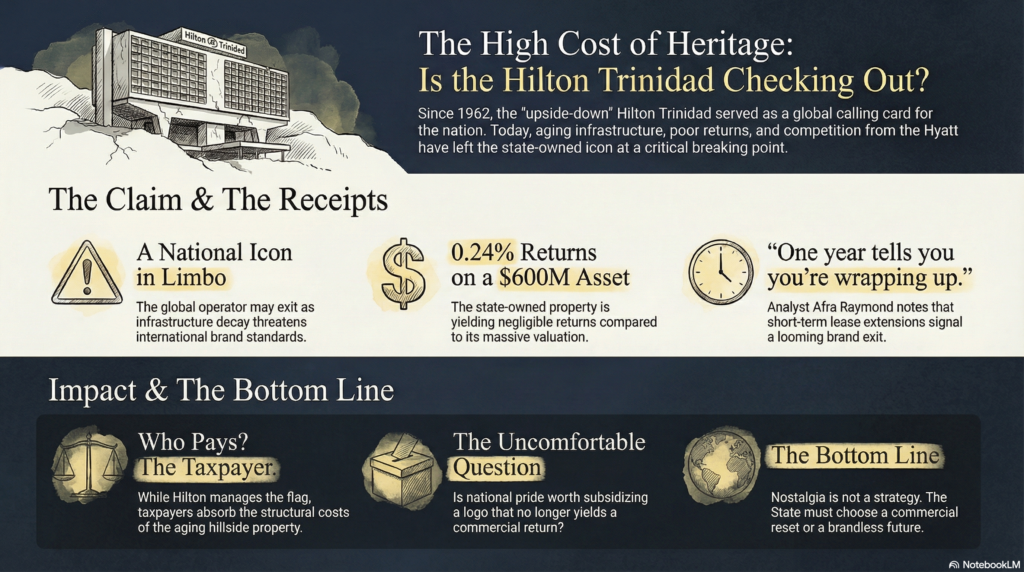
Today, that same iconic property is facing a very modern Trinidad problem: everybody loves the symbolism until the maintenance bill lands on the desk. Guardian Media reported recently that Hilton is considering exiting the state-owned property after years of financial underperformance, delayed capital works and mounting concerns over whether the Government is willing to spend what is needed to keep the hotel up to Hilton brand standard. The reported trigger is not some billion-dollar rescue fantasy either. It is a relatively modest but still politically awkward capital requirement of about US$600,000, money that Guardian says was not budgeted in the current fiscal year.
Hilton Trinidad was built to impress the world. In 2026, it may be too expensive to impress Hilton.
The hotel that helped sell Trinidad to the world
To understand why this story hits such a nerve, you have to understand what Hilton Trinidad meant. This was not some random private resort that happened to do well in Carnival season. It was part of the post-Independence imagination. A young nation wanted a flagship hotel that could host global visitors, stage major events and project confidence. The site on Lady Young Road gave it views, prestige and a kind of theatrical grandeur that ordinary city hotels could not match. Even now, Hilton’s official listing still sells that hilltop vantage point over the Savannah as a signature feature.
For decades, that formula worked. The hotel became one of the big rooms in the national memory. Weddings, conferences, Carnival fetes, diplomatic hosting, political networking, society events, all roads somehow passed through that hillside fortress at some point. It also built a reputation as one of the country’s premier conference venues, with tourism material listing tens of thousands of square feet of meeting and event space and capacity for large banquets and receptions. Even on the technical side, the property remains deeply integrated into the international travel system, with active GDS codes and continued global bookability.
But nostalgia does not balance accounts. And that is where the old glamour starts to look less like an asset and more like a line item with emotional blackmail attached.
Why Hilton Trinidad is not printing money like before
The central business problem is not mysterious. Hilton Trinidad was built for a market in which it could dominate. That market changed. Guardian’s reporting, drawing on analysis by Afra Raymond, points to a sharp shift after the Hyatt Regency opened in 2008. Once a newer, waterfront, State-backed property entered the market and became a magnet for official functions and premium demand, older Port of Spain hotels were pushed onto the back foot. Raymond says some hotels saw revenue declines of about 40 percent after Hyatt’s arrival.
Then there is the building itself. The “upside-down” layout is iconic, yes, but it is also the sort of thing that makes engineers, maintenance managers and accountants develop stress rashes. Bridges, terraces, steep-site infrastructure, unusual circulation, aging systems, all of that costs money. Guardian reports that the State, through eTecK, still carries responsibility for major capital works, while Hilton manages operations and enforces brand standards. That means the operator protects the flag, but taxpayers absorb the heavy structural pain.
The returns have reportedly become embarrassingly thin. Guardian says Raymond estimated returns of just 0.24 percent to 0.76 percent on an asset valued at more than TT$600 million. Read that again and breathe slowly. A national landmark, a prime site, a globally recognised flag, and the State is reportedly scraping returns that sound less like investment strategy and more like a bank account you forgot existed.
The problem with Hilton Trinidad is simple: the view is five-star, the economics are increasingly not.
Why Hilton may want to walk away
This is the part some people will take personally, but business is not feelings. Hilton is not in Trinidad because it loves our history lessons. Hilton is in Trinidad because a branded property is supposed to protect standards, generate revenue and strengthen the chain’s reputation. If the owner is slow on capital works, the product is aging, occupancy is weak and the contract only gets extended in short nervous bursts, a global operator starts asking whether the badge is worth the headache. Guardian reported that the original 2003 lease operatorship expired in 2023 and was only extended to September 30, 2024 through a Deed of Variation. Raymond’s blunt summary was even harsher: “You don’t negotiate for one year. One year tells you you’re wrapping up.”
There are also warning signs at the human level. The Communication Workers’ Union has raised concerns about weak occupancy and the effect on staff, with reports that some workers are getting very limited shifts. That is what decline looks like before the press release arrives. Not dramatic movie music. Just a famous hotel slowly becoming a less reliable place to earn a living.
And if Hilton leaves, the symbolism will be ugly. It would not just be a hospitality story. It would read like a verdict on how the State handles legacy assets: keep talking, delay the work, then act shocked when the brand starts backing toward the exit.
Tobago already gave us this warning once
Anyone pretending this could never happen in Trinidad should glance across to Tobago. The former Tobago Hilton did not remain a Hilton forever either. Travel Weekly reported that Hilton managed that beachfront property from its opening in 2000 until Hilton terminated the contract in May 2008. The Government later acquired the property, and it reopened in 2011 as the Magdalena Grand Beach Resort.
The Tobago case matters because it shows two things. First, losing the Hilton name is not automatically the end of the world. A property can survive beyond the brand. Second, survival without the brand does not magically solve deeper business weaknesses. Rebranding can buy time, but it does not erase structural issues, market misalignment or the cost of keeping a large tourism asset competitive. Tobago’s story should have taught policymakers that a Hilton flag is not a substitute for a sustainable strategy.
That is why the Trinidad debate should not be reduced to a sentimental cry of “save the Hilton.” Save it for what? Save it how? Save it to do what differently?
Should Government spend the money or cut its losses?
Here is the uncomfortable answer: yes, the Government should invest in Hilton Trinidad only if it is prepared to do more than slap on a cosmetic patch and beg Hilton to stay. The logic for renovation is real. The hotel still has a prime location, powerful name recognition, conference infrastructure, tourism value and national heritage significance. It can still anchor a serious meetings-and-events strategy. It is also still being actively marketed by Hilton, with 405 rooms on Hilton’s own events page and Travel Weekly.
But if the State is not ready for a disciplined commercial reset, then throwing money at the place just to preserve the Hilton logo would be foolish. A proper reset would mean funding the capital works, negotiating a longer-term agreement, upgrading the physical product aggressively, and repositioning the property around premium conferences, heritage tourism and event-led demand. Without that, the renovation becomes another expensive national coping mechanism.
If the Government decides not to do the renovations, there are still options. It could seek a different operator. It could rebrand the property as a locally anchored conference and heritage hotel. It could pursue a public-private partnership. It could even split the concept, keeping the site’s event and cultural value while redesigning the accommodation strategy around a more commercially realistic model. None of those choices are painless. But pretending the current limbo is a strategy would be the dumbest option of all. That is how national icons quietly become expensive ghosts.
In the end, Hilton Trinidad still stands where it always stood, overlooking Port of Spain like it knows it was built for bigger moments. The cruel twist is that its next big moment may be a national argument over whether preserving prestige is worth the price. History built the legend. Economics is now asking for receipts.