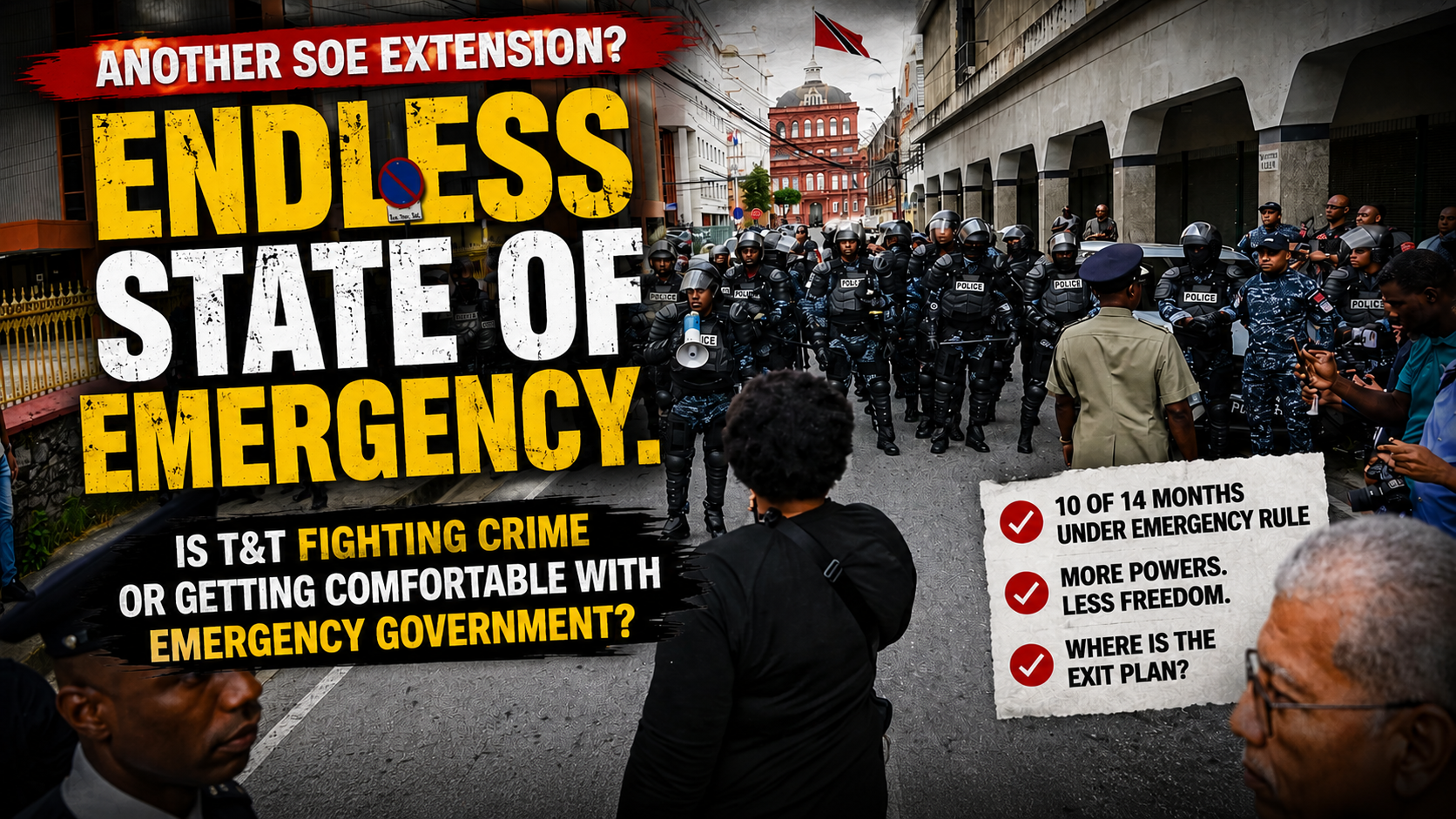
Endless State of Emergency. Is T&T Fighting Crime or Getting Comfortable With Emergency Government?
State of Emergency Again? T&T Wants Safety, But at What Price?
A State of Emergency is supposed to feel like a fire extinguisher.
You break the glass in a crisis. You use it when the flames are spreading. You hope it saves lives. Then you put it back, repair the damage, and make sure the building does not keep catching fire every three months.
But in Trinidad and Tobago, the fire extinguisher is starting to look like furniture.
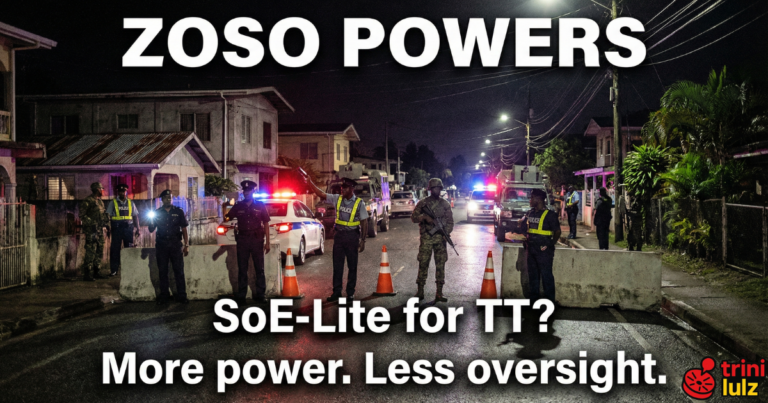
The current State of Emergency is due to expire at midnight on June 17, 2026, but Government is already heading back to Parliament seeking another three-month extension. The official argument is simple: crime remains too serious, the threat is still present, and law enforcement needs the tools to keep pressure on criminals.
Many citizens will hear that and nod. Because fear in this country is not theoretical. It is not an academic debate. It is parents checking windows twice at night. It is business owners closing early. It is families praying their children reach home safely. It is communities living with the exhausting knowledge that one wrong place, one wrong time, one wrong vehicle passing could change everything.
So yes, people want action.
But they also want answers.
Because after months and months of emergency powers, the country has a right to ask a simple question:
If the State of Emergency is working, why do we still need more of it? And if it is not working, why is it still the main answer?
Crime Is Not Normal, So Government Says the Response Cannot Be Normal
To be fair, no serious discussion about the State of Emergency can begin by pretending Trinidad and Tobago’s crime problem is normal.
It is not.
Violent crime has eaten into public confidence. Illegal firearms have changed the character of criminal violence. Communities that once felt tense now feel trapped. Ordinary people are tired of hearing explanations while the body count rises and the fear spreads.
Government’s case is that extraordinary crime requires extraordinary tools.
A State of Emergency gives law enforcement wider powers. It allows the State to move faster. It can disrupt criminal networks, increase arrests, support searches, and create breathing room for security agencies. For citizens who feel abandoned by normal policing, that can sound like the first sign that somebody is finally taking things seriously.
And that is why the Government’s argument will resonate with many people.
They are not interested in fancy constitutional language when bullets are flying. They do not want a lecture on civil liberties when they are scared to stop at a traffic light. They want criminals held. They want guns found. They want gangs pressured. They want the State to stop looking like it is asking criminals nicely to behave.
That emotion is real. It must not be dismissed.
But emergency powers come with a democratic price tag. And when the bill keeps coming due, citizens are entitled to inspect the receipt.
Where Are the Receipts?
The biggest problem with another State of Emergency extension is not that Government wants to fight crime.
The problem is that citizens still need a clearer explanation of what exactly the emergency powers have achieved and what happens next.
What has improved?
How many serious criminal networks have been disrupted?
How many illegal firearms were seized because of emergency powers rather than normal policing?
How many high-risk offenders were removed from the streets?
What measurable decline in violent crime can be directly linked to the State of Emergency?
What permanent reforms are being implemented while the emergency powers are in place?
And most importantly, what is the exit plan?
Because “give us three more months” cannot become a national security strategy.
A State of Emergency should be a bridge back to normal, not a new address. It should create space for deeper reforms, stronger intelligence work, faster prosecution, better border control, improved forensic capacity, community intervention, and actual police transformation.
If all the country gets is another extension, another debate, another press statement, and another promise that this time the pressure will work, people will eventually ask whether the Government is fighting crime or simply renting time.
Emergency Powers Are Not Normal Powers
This is where the democracy issue comes in.
A State of Emergency is not ordinary government. It is not just another policy tool sitting in a Cabinet folder next to potholes, water woes, and school repairs.
Emergency powers shift the balance between the citizen and the State.
They give authorities powers that would not normally apply in peacetime governance. They can affect movement, protest, search, detention, and the general relationship between people and power. That may be justified during a genuine crisis, but it should never become casual.
You cannot keep telling citizens, “Give up a little freedom for safety,” without eventually explaining when they are getting the freedom back.
That is the heart of the matter.
This is not about defending criminals. This is not about pretending the police do not need tools. This is not about sitting in air-conditioned comfort and telling people in frightened communities to be patient.
It is about remembering that democracy is not only tested when things are calm. Democracy is tested when people are afraid.
And fear is exactly when citizens must be most careful about giving the State more power without demanding more accountability.
The Opposition Smells Political Blood
The Opposition has rejected the Government’s push for another extension, describing it as an “extension of oppression” and arguing that a State of Emergency was never meant to become permanent governance.
That line will land with people already uneasy about repeated emergency rule.
But the Opposition also has a challenge of its own.
It is not enough to say no. The country also needs to hear a serious alternative. If the Government is wrong to keep extending the State of Emergency, then what exactly should replace it? What would the Opposition do differently next week, not in some glossy crime plan launched three months before an election?
That is where both sides must be pressed.
Government must show results.
Opposition must show alternatives.
Citizens should not have to choose between emergency rule and political slogans.
They deserve a real crime strategy, one that does not depend forever on extraordinary powers and one that does not collapse the moment the State of Emergency ends.
The Real Test Comes After the State of Emergency
The real test of this Government is not whether it can govern under emergency powers.
The real test is whether it can keep people safe without them.
Can the police maintain pressure after the SoE ends?
Can the courts move cases faster?
Can bail concerns be addressed without trampling rights?
Can intelligence-led policing replace broad emergency control?
Can the State attack gun trafficking, gang financing, corruption, and organised crime without making emergency governance the default setting?
Can communities feel safer without feeling like the country is permanently under siege?
Those are the questions that matter.
Because criminals will not wait politely for Parliament to finish debating. Citizens cannot live forever under suspense. Businesses cannot plan around endless national anxiety. Families cannot build normal lives in a country where emergency powers keep returning like a bad habit.
At some point, the Government must show that the SoE was a temporary weapon, not a permanent crutch.
T&T Cannot Live Forever in Panic Mode
The Government may well believe another State of Emergency extension is necessary. Many citizens may agree. Crime is serious. Fear is real. The demand for action is urgent.
But urgency does not cancel accountability.
If Parliament is being asked to approve another three months, then the public deserves more than “trust us.” Citizens deserve clear targets, public reporting, measurable outcomes, and an honest explanation of how the country gets back to normal governance.
Because a democracy cannot keep living in emergency mode and pretend nothing has changed.
A State of Emergency can be justified.
A State of Emergency can be useful.
A State of Emergency can even be necessary.
But endless emergency government is a different thing entirely.
That is when citizens must start asking whether the country is fighting crime with temporary extraordinary powers, or whether the State is slowly becoming comfortable with ruling through crisis.
And that question should worry everyone.
Not just the Opposition.
Not just civil society.
Not just lawyers, journalists, business groups, or activists.
Everyone.
Because today, some people may support emergency powers because they believe it is aimed at criminals. Tomorrow, the same machinery can shape how ordinary citizens protest, move, gather, speak, and challenge power.
So yes, fight the criminals.
Pressure the gangs.
Find the guns.
Disrupt the networks.
Protect the people.
But show the country the plan.
Show the country the results.
Show the country the exit.
Because Trinidad and Tobago did not ask to live forever in panic mode.
And a Government serious about safety must also be serious about returning the country to freedom.
Want the bigger picture? Explore our Trinidad Crime & Security hub for dashboards, explainers, updates, and deeper coverage of one of the country’s most urgent ongoing stories.