Dickon Mitchell Wins a Second Term: Grenada’s 14–1 Mandate and the Test of Scrutiny
Preliminary results put Dickon Mitchell’s NDC at 14 of 15 elected seats. What can a one-seat opposition still do, and what should Trinidad and Tobago watch?
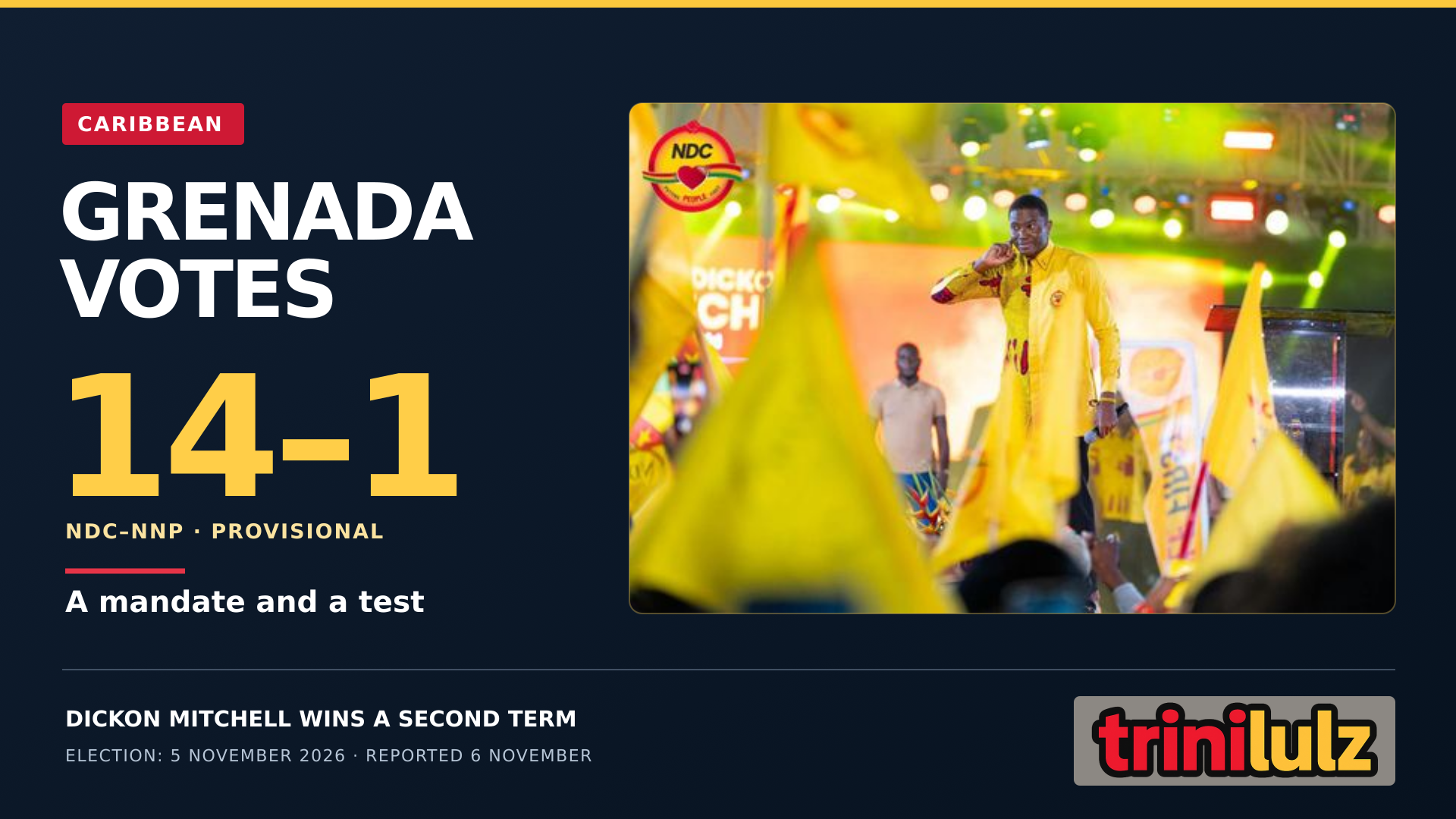
Dickon Mitchell has won a second term in Grenada with preliminary results from the November 5, 2026 Grenada election giving his National Democratic Congress (NDC) 14 of the 15 elected seats. Reporting on November 6 put the New National Party (NNP) at one seat. The figures remain provisional for this analysis.
Four years after winning office with nine seats, the NDC now has room to set its agenda with little risk of losing a vote in the House. The test will be how it uses that room: to deliver on healthcare, jobs and reconstruction, and to give Parliament enough time and information to challenge decisions before they are made.
A landslide in seats, a wider electorate
| Party | 2022 seats | 2026 seats (provisional) | 2026 vote share (approx.) |
|---|---|---|---|
| NDC | 9 | 14 | 61.0% |
| NNP | 6 | 1 | 36.8% |
| Others | 0 | 0 | 2.2% |
NOW Grenada’s November 6 report put the NDC at 37,369 votes and the NNP at 22,567, with turnout at about 63.3%. The NDC’s roughly 61% of valid votes translated into more than 93% of elected seats. In a constituency system, each race produces one winner. Votes cast for runners-up do not carry into a separate national allocation of seats. A landslide in the House can therefore coexist with substantial support for the party across the aisle.
The NNP’s sole projected win was Adrian Joseph in St George North West, the constituency long held by former prime minister Keith Mitchell. NNP political leader Emmalin Pierre lost St Andrew South East to the NDC’s David Andrew. That leaves the party facing two different jobs: rebuilding outside Parliament and covering the work of an opposition inside it with one elected member.
The result improves on the NDC’s nine-to-six win in June 2022. It also marks the party’s first back-to-back general election victories, according to Caribbean Media Corporation reporting. For the governing party, that means voters can now judge a second term against a first-term record as well as a fresh set of promises.
CARICOM’s observer mission described polling as peaceful and orderly in its preliminary assessment, dated November 6 and published November 7. That assessment concerns how the vote was conducted. The seat and vote figures used here come from provisional results reporting.
The second-term agenda: health, jobs and recovery
The NDC published a national programme under its Vision 75 agenda and separate plans for all 15 constituencies. The most revealing test of those plans may be in St George North West, the seat it did not win. The NDC’s plan there identifies demand for practical training and pathways into employment. That is a useful standard for the new administration: a young person’s access to training should depend on need and eligibility, regardless of who won the constituency. Read the NDC’s 2026 manifesto and constituency plans.
Healthcare. Project Polaris, the proposed new general hospital at Hope Vale, is already under development. The government’s project office recorded a March 2026 groundbreaking and an initial US$30 million OPEC Fund financing agreement signed in January. Those are milestones, not an opening date. The next questions are when the main construction contract is awarded, how its costs change, and how the health service will staff the hospital while maintaining care at existing facilities. The 2026 budget also discusses national health insurance; the financing and practical terms of coverage deserve scrutiny of their own.
Youth employment and the economy. Mitchell has pledged to modernise the economy and reduce youth unemployment. The 2026 budget points to training, mentorship and support for enterprise as ways into work. A practical measure would be to report how many participants complete training, find a paid placement and are still employed six or twelve months later. Counting enrolments alone leaves the most important question unanswered.
Recovery and resilience. The finance ministry’s 2026 midyear review identifies additional financing needs for repairs to homes, infrastructure and community recovery in Carriacou and Petite Martinique after Hurricane Beryl. For residents, the useful figures are homes completed, water and power restored, and projects that can withstand the next storm. Reporting by island and community would help show where rebuilding is moving and where delays remain.
The IMF’s January assessment estimated 2025 growth at 4.4%, driven by investment and construction. The assessment also pointed to savings from citizenship-by-investment revenues as a source of room to fund development after the disaster. A strong construction year does not tell households what will happen to wages or living costs. It also makes it worth distinguishing one-off financing for construction from recurring funding for staff, maintenance and services.
What a one-seat opposition can still do
The 14–1 division applies to the elected House of Representatives. Grenada also has a 13-member appointed Senate. Under section 24 of the Constitution, seven senators are appointed on the prime minister’s advice, three on the opposition leader’s advice, and three on the prime minister’s advice after consultation with the interests those senators are meant to represent.
There is a distinction between winning a constituency and becoming Leader of the Opposition. Section 66 gives the Governor-General the appointment. Joseph’s reported result makes him the obvious prospective appointee if the tally holds. The seat result alone does not confirm the appointment. Pierre’s role as NNP political leader is separate from the parliamentary office. Read the Constitution of Grenada.
The House’s published Standing Order 69 gives the Public Accounts Committee work that matters even when the government has ample votes: examining audited public accounts and those of government-appointed bodies, requesting records and hearing witnesses. The rules provide for the Leader of the Opposition to chair it if willing, and allow members from both chambers. The Constitution separately provides for the Director of Audit to report on public accounts. The questions to watch are whether reports are tabled promptly, whether the committee meets, and whether ministries follow up on findings.
The size of the majority also matters when constitutional changes are proposed. Section 39 sets a two-thirds threshold in the House for bills altering the Constitution, with further requirements for specified entrenched provisions, including referendum approval. A large House majority makes that first threshold easier to meet. It does not remove the other steps.
The new Parliament can make scrutiny work in practical ways: publish bills early enough to read, give clear answers at question time, release committee reports and explain what changed after consultation. Senators, backbench MPs, journalists and civic organisations can raise questions a single opposition MP cannot cover alone. Their influence is greatest when they can work from documents and figures rather than announcements.
Why Trinidad and Tobago should pay attention
Prime Minister Kamla Persad-Bissessar congratulated Mitchell and pointed to cooperation through CARICOM. The relationship also runs through families. In 2024, Newsday reported that members of 33 families signed onto a Point Fortin ancestry initiative intended to reconnect people with relatives in Grenada. That gives regional policy a practical meaning: what it costs to make a family visit, how easily people can travel and how communities stay connected after a hurricane.
Caribbean Airlines markets travel between Port of Spain and St George’s. The election itself changes no route or fare. For families and small businesses, reliable air and cargo links matter more than ceremonial statements. They affect whether a visit is affordable, a shipment arrives on time or assistance reaches relatives after a storm.
There is a trade stake too. World Bank WITS, using UN Comtrade data, records about US$10.9 million in T&T exports to Grenada in 2025 in a category covering non-crude petroleum oils and preparations. That is one product category, not total bilateral trade. It shows why transport costs, supply reliability and energy policy can matter on both sides of the relationship. Any new agreement should be judged on its terms and delivery rather than inferred from the election.
What to watch next
The first benchmarks are the formal election returns, appointments to the opposition leadership and Senate, and the organisation of the new House. Then come the budget and delivery tests: what is funded, who gets the contracts, how rebuilding is progressing and how ministers respond when costs rise or deadlines slip.
Mitchell has the numbers to move his programme through the House. His second term will show whether a commanding majority can deliver for Grenada, Carriacou and Petite Martinique while keeping Parliament a place where government decisions are tested.
This story is part of our wider Caribbean Geopolitics & Global Affairs coverage. Explore the full hub for regional security updates, diplomacy, migration, energy politics, and deeper analysis of how global power plays shape Caribbean realities.