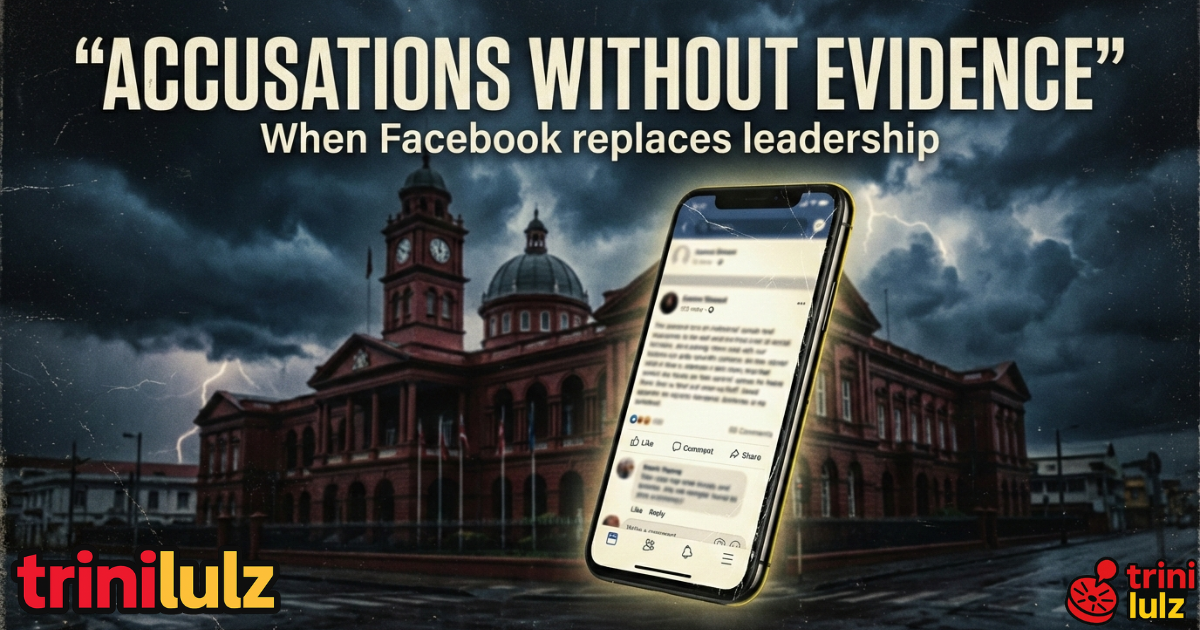
Accusations Without Evidence: When Facebook Posts Replace Leadership
In moments of national uncertainty, words matter. Tone matters. And above all, truth matters.
Yet once again, the Prime Minister has chosen a dangerous shortcut. Instead of addressing a nervous country directly, she reached for insinuation. On official party social media channels, she sought to associate the People’s National Movement with drug trafficking. No evidence. No documentation. No referral to law enforcement. Just accusation, floated into the digital bloodstream and left to do its damage.
This is not leadership. It is deflection masquerading as courage.
From Governance to Innuendo
Serious allegations demand serious process. In any functioning democracy, claims of criminal financing are not trial balloons launched on Facebook or X. They are matters for police investigations, prosecutors, and courts.
There is a simple rule here, one understood everywhere except apparently at the highest levels of our Government:
If you have evidence, you take it to the authorities.
If you do not, you stay silent.
The Prime Minister did neither. Instead, she relied on insinuation and political theatre, dragging the country into a reckless narrative that places Trinidad and Tobago itself at risk.
This tactic is not new. It is resurrected precisely when scrutiny tightens elsewhere.
Why Now? The Politics of Distraction
Timing is never accidental in politics. This accusation surfaced at a moment when citizens are anxious and looking for answers.
The region is unsettled. Venezuela remains volatile. Energy markets are uncertain. Crime continues to stalk communities. Families are struggling with rising prices while jobs disappear.
In moments like these, leaders are expected to steady the ship. Across the Caribbean, governments have addressed their populations directly, explaining risks, outlining plans, and taking questions.
Here at home, we get something else. Abruptly ended press conferences. Long silences. Carefully curated social media posts. And now, a manufactured enemy.
Creating a villain is easier than confronting failure.
The Dangerous Cost of Reckless Accusations
Alleging that a major political party is tied to narco-activity is not harmless political bacchanal. It has real consequences.
International observers do not separate party politics from state stability. Investors, ratings agencies, foreign governments and multilateral institutions all assess governance through one lens: institutional credibility.
When a Prime Minister casually suggests that her political opponents are funded by drug traffickers, without evidence or prosecution, she signals instability. She tells the world that accusations replace institutions, and that politics trumps the rule of law.
Today the target is the PNM. Tomorrow it could be any group, business, journalist or citizen who dares to question power. That is how democracies erode, not with coups, but with carelessness.
If the Evidence Exists, Act Like a Leader
There is a lawful path here, and it is not complicated.
If the Prime Minister possesses credible evidence of criminal financing involving any political actor, including the United National Congress or the Opposition, she has a duty to submit it to law enforcement and allow due process to take its course.
Anything less is cowardice dressed up as bravado.
Hiding behind Parliamentary privilege and social media smears is not strength. It is weakness. And in a fragile regional environment, weakness at the top is dangerous.
While the Noise Grows, Reality Bites
While accusations fly online, the lived reality of Trinidad and Tobago grows harsher by the day.
Tens of thousands of workers have been displaced, abruptly cut loose with little warning or support.
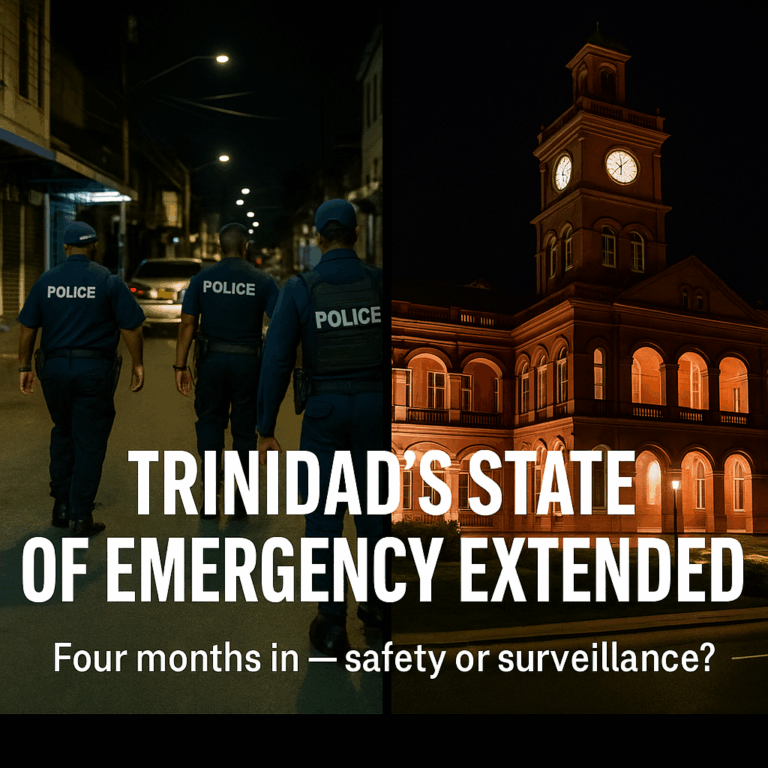
Crime and violence continue to rise, even under extended states of emergency that have yielded few tangible results.
The economy has been flagged internationally for declining performance and policy uncertainty.
The cost of living keeps climbing, driven by fiscal decisions that hit ordinary households hardest.
The energy sector, long the backbone of national revenue, drifts without clear direction.
State boards groan under the weight of political appointments, while competence takes a back seat to loyalty.
Local government corporations outside the ruling party find themselves starved of resources, unable to maintain basic services.
Communities are overgrown and neglected following the reckless closure of employment programmes, while workers who remain are paid late, if at all.
Citizens dependent on government assistance wait weeks, sometimes months, for relief that once arrived on time.
These are not Opposition talking points. They are facts on the ground.
Leadership Is Accountability, Not Accusation
In difficult times, leadership is measured by restraint, transparency and respect for institutions. It is measured by a willingness to face the press, answer uncomfortable questions, and speak plainly to the nation.
What we are witnessing instead is a politics of evasion. A politics that trades truth for theatre. A politics that hopes noise will drown out scrutiny.
It will not. Lies will not replace facts. And reckless accusations will not erase the failures of governance now etched into daily life.
Trinidad and Tobago deserves better than fear-mongering, deception and political desperation. It deserves leadership equal to the seriousness of the moment.
This story is part of our wider Trinidad Politics Explained coverage. Explore the full hub for political analysis, key background, major controversies, and the latest updates.