USER-PAYS GOVERNMENT: Are We Now Renting the State By the Minute?
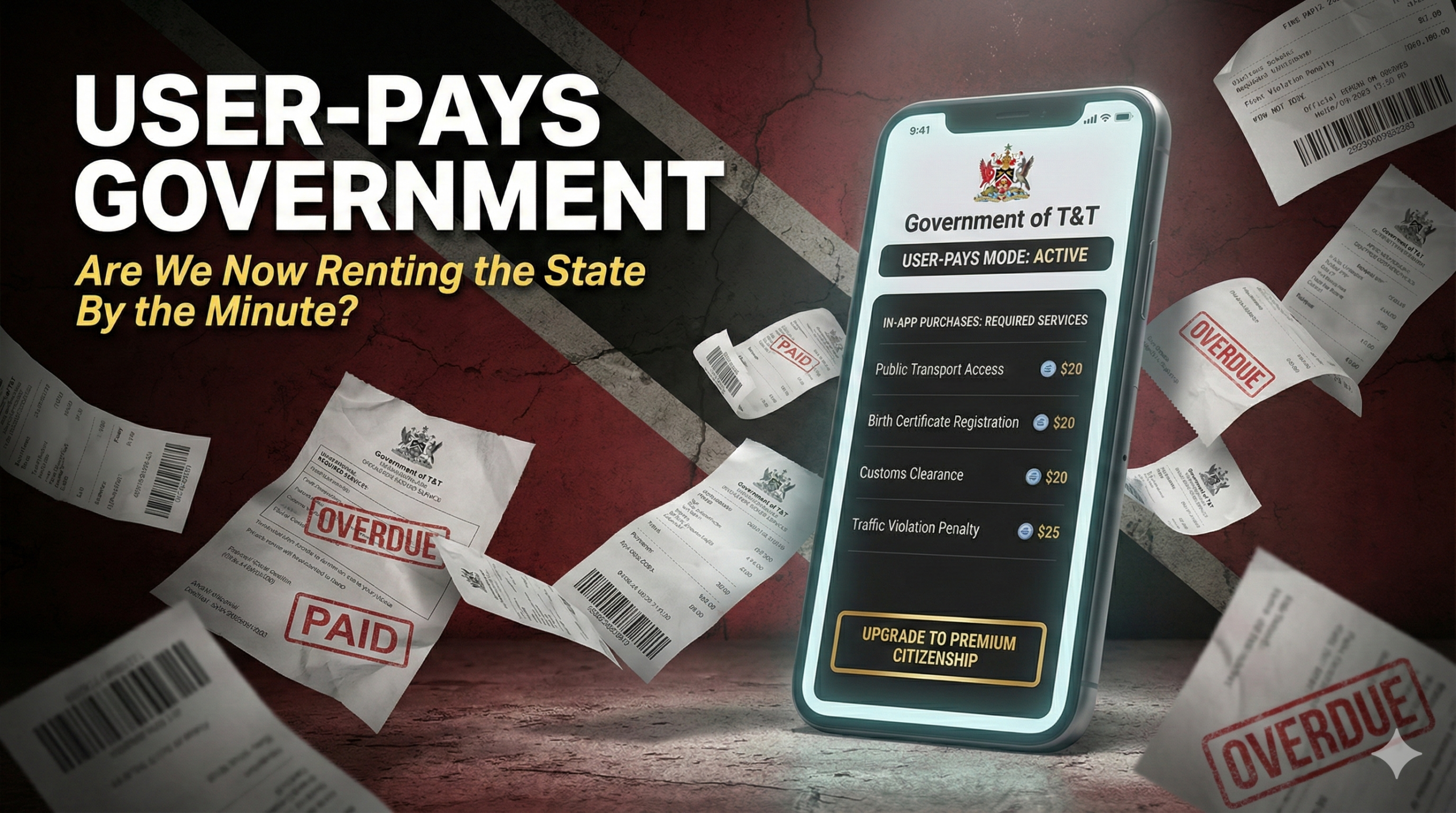
Trinidad and Tobago woke up this week to a new governing philosophy—one that sounds less like a republic and more like a billing department.
Defending higher customs charges, increased birth and death registration fees, and sharply escalated traffic penalties, Kamla Persad-Bissessar doubled down on the argument that taxes shouldn’t subsidise others. If you use a service, you should pay for it. If you do not, why should your taxes carry someone else?
On the surface, it sounds tidy. Responsible. Almost moral.
But once you apply that logic consistently, the entire idea of the modern state begins to wobble, hard.
Because if Trinidad and Tobago is now “user-pays,” then we are not citizens anymore. We are customers. And the country has quietly become a subscription service.
A State With In-App Purchases
The Prime Minister’s defence of the new fees leaned heavily on examples meant to feel intuitive.
Why should a teacher subsidise a bus route he does not use?
Why should a police officer subsidise birth certificates if he has no children?
Why should a nurse subsidise customs fees for a businessman importing goods to sell at a profit?
Framed that way, the argument feels logical. Even fair.
But logic has a weakness: it must work in every direction.
If we accept that taxes shouldn’t subsidise others, then government services stop being shared public goods and become itemised transactions. The State turns into a meter that starts running the moment you interact with it.
Bus ride? Swipe.
Paperwork? Swipe.
Road mistake? Heavy swipe.
At that point, governance stops being collective problem-solving and starts looking suspiciously like a pay-per-use app where the penalties are mandatory and the terms cannot be declined.
When government starts talking like a billing system, the citizen quietly becomes a customer.
The Oil Money Problem Nobody Wants to Touch
Here is where the philosophy runs head-first into Trinidad and Tobago’s economic reality.
For decades, a substantial portion of state revenue has come from oil and gas production, a sector employed by a small fraction of the population and dominated by a handful of multinational companies. That revenue does not stay offshore. It funds roads, schools, hospitals, security, subsidies, salaries, and social programmes across the entire country.
By definition, that is redistribution.
So if taxes shouldn’t subsidise others, an uncomfortable question emerges.
Should oil and gas revenue only be spent on oil and gas things?
By the same logic now being promoted:
- Oil taxes should only fix refinery roads and offshore platforms
- Energy revenue should only fund pipelines, flare monitoring, and Ministry of Energy air-conditioning
- Public hospitals, police stations, and schools outside the energy sector? Not your industry, not your benefit
Taken seriously, the argument collapses into absurdity. But that absurdity reveals the truth: the State only functions because money from one group is pooled to serve everyone.
That is not corruption. That is not waste. That is the basic operating system of government.
If oil money cannot subsidise citizens, then the country itself has no business model.
Taxes Aren’t Charity. They’re Infrastructure
There is a quiet sleight of hand happening in the rhetoric.
Subsidy is being framed as indulgence, something reckless, something that enables “negative lifestyles” and “ruinous behaviours.” But most taxation is not about indulgence at all. It is about shared infrastructure.
You may not have children, but you benefit from living among educated people.
You may not use public transport, but you benefit from fewer cars on the road.
You may never file a birth certificate, but you benefit from a functioning civil registry that establishes identity, inheritance, and legal rights.
This is why serious public finance does not operate strictly on a receipt basis. Many benefits are indirect, collective, and preventative. You do not wait until society collapses to invoice people for fixing it.
Calling all of that “subsidy” cheapens the idea of citizenship itself.
Politics, Lawlessness, and Selective Reality
The political edge of the debate sharpened quickly, with the Prime Minister describing Trinidad and Tobago as a “lawless dump” and laying responsibility squarely at the feet of the People’s National Movement and its constituencies.
Opposition Leader Pennelope Beckles criticised the fee increases as government overreach and punishment of citizens.
But strip away party colours and one truth remains: rhetoric matters. When leaders describe the State as something people should only pay into if they personally benefit, trust erodes. Solidarity weakens. The social contract becomes transactional.
And transactional societies do not heal lawlessness. They invoice it.
You cannot shame people into order while charging them admission to the State.
Are We Renting Citizenship Now?
The danger here is not the fees themselves. Governments adjust fees all the time. The danger is the philosophy being normalised beneath them.
Once the idea takes hold that the State is something you “use” rather than something you belong to, everything becomes negotiable—except the bill.
Today it is bus routes, birth certificates, customs, and traffic fines. Tomorrow it may be access, compliance, or silence.
Because a rented State does not serve citizens. It serves accounts.
And in that system, missed payments are not just penalties. They are exclusion.
Trinidad and Tobago does not need a subscription government. It needs a functioning one—honest about trade-offs, serious about reform, and clear about the fact that shared responsibility is not weakness.
It is the price of living together.
This story is part of our wider Trinidad Politics Explained coverage. Explore the full hub for political analysis, key background, major controversies, and the latest updates.