WRECKING OR ROBBERY? THE LAW SAYS ONE THING. THE TOW TRUCK DOES ANOTHER.
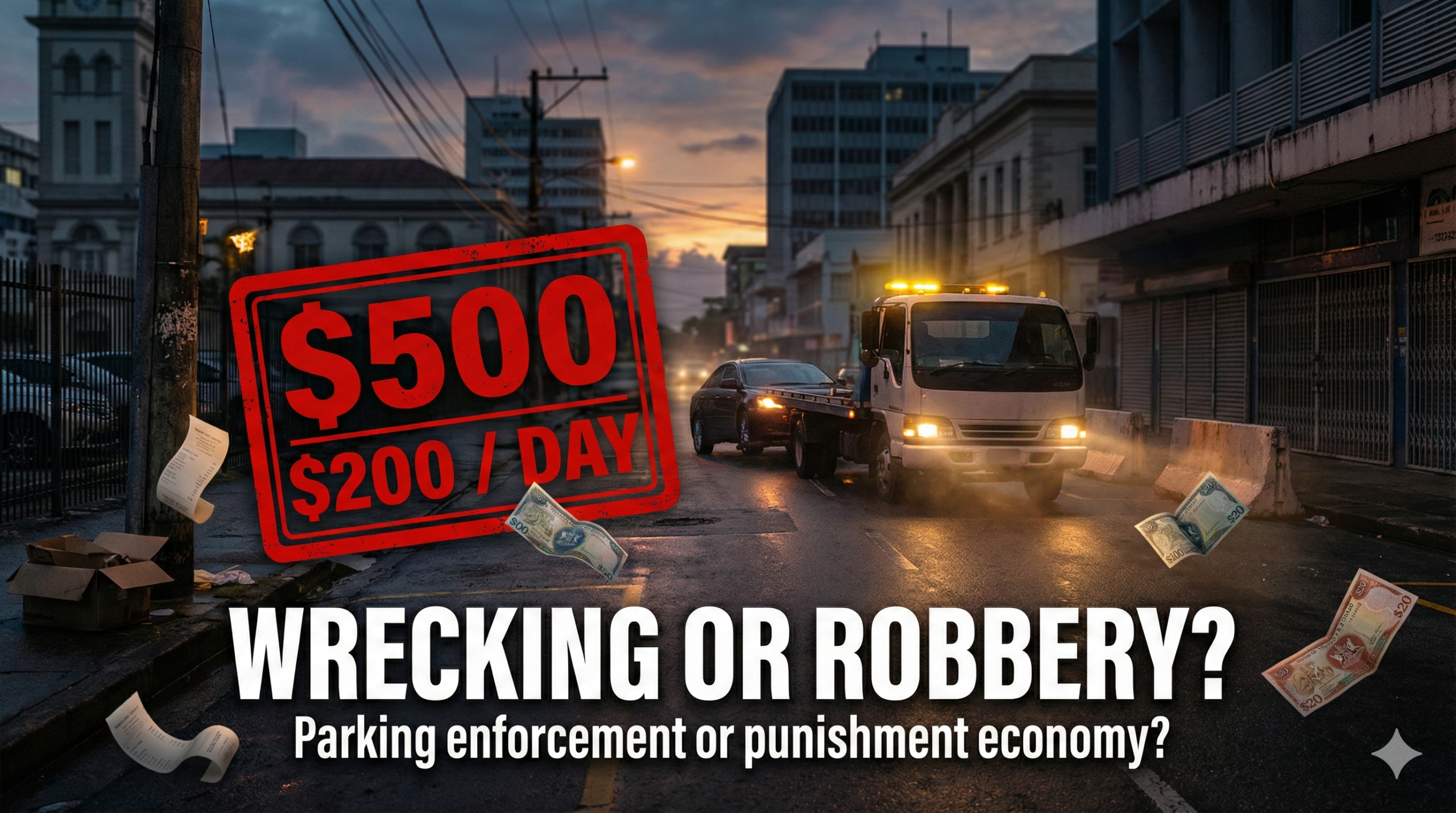
According to the law, wrecking a vehicle in Trinidad and Tobago is supposed to be a last step, not a reflex. Before a tow truck hooks up and hauls your car off to the impound yard, police are expected to make brief enquiries in the immediate area to locate the driver. If the driver appears, they should be allowed to move the vehicle after being ticketed. Even if the tow truck is already hooking up, the guidance says once the driver shows up and claims the vehicle, it should be released.
That is the law on paper.
On the pavement, in Port of Spain, San Fernando, Chaguanas, and anywhere parking anxiety lives rent-free in your chest, wrecking feels like something else entirely.
It feels final.
It feels rushed.
And to many drivers, it feels suspiciously efficient.
The Law Trinidad: How Wrecking Is Supposed to Work
In theory, wrecking is not meant to be a “gotcha” moment. It is supposed to be corrective. The steps are simple and sound reasonable:
Those steps were recently outlined by police officials responding to public backlash, as detailed in a Trinidad Express explainer on what officers are required to do before a vehicle can be wrecked.
Police observe an illegally parked vehicle.
They make brief enquiries nearby to locate the driver.
If the driver is found, the driver is charged and asked to move the vehicle.
If the driver refuses, then wrecking becomes an option.
Even when a tow truck is already on scene, the guidance says that if the driver appears before the vehicle is removed and claims it, the vehicle should be released.
On paper, this system assumes something important: time, communication, and good faith on all sides.
That assumption is where the system begins to wobble.
“According to the rules, wrecking is supposed to follow an attempt at reason. According to drivers, reason rarely gets a turn.”
The Tow-Truck Trinidad: How Wrecking Feels in Real Life
Ask drivers about wrecking and you’ll hear the same stories repeated with different license plates.
No enquiries.
No warning.
No grace period.
Just the sound of chains tightening and the sudden realization that you’re about to spend the rest of your morning chasing your own car across town.
Drivers describe scenes where they are within shouting distance, sprinting back from a pharmacy, a bank, a doubles stand, or a government office, only to be told it’s “too late” even though the vehicle hasn’t moved an inch yet.
This is where the lived experience diverges sharply from the law.
Because once the tow truck commits, the system snaps shut. What follows is not just enforcement. It is logistics, fees, and stress stacked on top of each other:
- A $500 release fee, cash only.
- $200 per day if the vehicle stays overnight.
- A limited window to retrieve the vehicle.
- A working day effectively destroyed.
For many people, wrecking is no longer about illegal parking. It becomes an instant financial penalty that lands hardest on people who cannot afford surprise expenses.
When Enforcement Starts to Feel Like Extraction
Here is the uncomfortable question Trinidad is now asking out loud:
If the law allows discretion, why does the system feel designed to move faster than discretion can be exercised?
Nobody is arguing that illegal parking should be ignored. Port of Spain cannot function if cars block lanes, corners, and sidewalks. Enforcement matters. But drivers have seen this movie before. From parking enforcement to traffic fines, Trinidad has been wrestling with whether punishment is about changing behaviour or generating revenue — a question that exploded into public outrage after a coconut vendor was slapped with a massive traffic bill, as explored in our earlier piece, Road Safety or Road Robbery? The TT$19,000 Coconut Vendor Bill That Have Trinidad Talking.
But enforcement without visible flexibility breeds resentment.
When drivers see wrecking happen while they are physically present and pleading to move the vehicle, the message they receive is not “follow the law.” The message is “the process has already decided.”
And once the process decides, it is expensive to reverse.
“Wrecking teaches road discipline the same way a sledgehammer teaches fine motor skills.”
The Real Issue Isn’t Parking. It’s Trust.
This debate is not really about cars. It is about trust in how authority is exercised.
If police guidance says one thing, but daily experience suggests another, the public stops listening to the guidance and starts preparing for the worst. That is how you get panic-parking, frantic clock-watching, and people running down the street like Olympic qualifiers every time they hear a diesel engine idle too long.
Clear enforcement should feel predictable.
Fair enforcement should feel human.
Right now, wrecking feels like roulette.
Until the gap between Law Trinidad and Tow-Truck Trinidad is closed, every clarification will sound like theory, and every tow truck will look like a cash register on wheels.