IMF Gives T&T a Reality Check: Debt Up, FX Tight, Deficit Still Big
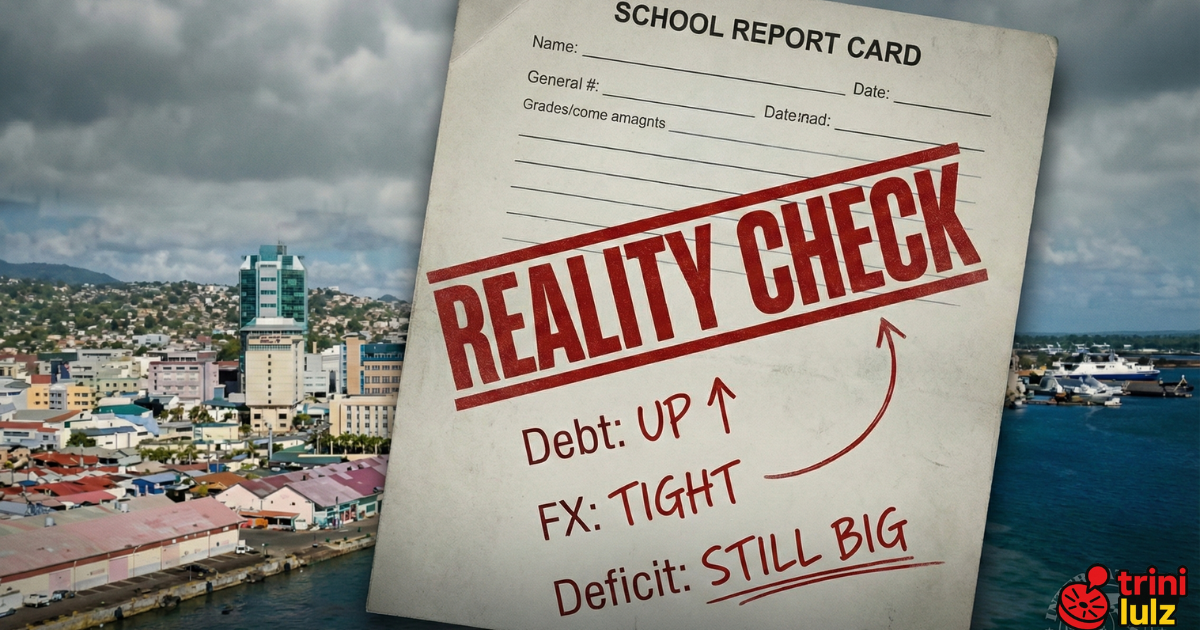
Trinidad and Tobago did not get scolded by the IMF.
It got something far more uncomfortable.
A calm, clinical, numbers-heavy reality check.
In its 2026 Article IV concluding statement, the International Monetary Fund (IMF) lays out what many businesses, analysts, and ordinary citizens already feel every day. The economy may be growing again, but the country’s finances remain tight, foreign exchange is still hard to access, and the budget deficit is much larger than official projections suggest.
Debt is rising.
US dollars are still scarce.
And closing the gap will require more than optimism and rebranding.
This is not political rhetoric.
It is the IMF reading Trinidad and Tobago’s balance sheet out loud.
The IMF’s Scorecard: Growth Is Back, But the Risks Didn’t Leave
To be fair, the IMF does not paint a picture of collapse.
Economic growth has returned, helped by a stabilising energy sector and modest recovery in non-energy activity. Inflation has cooled from post-pandemic highs, and financial sector risks are described as contained. On the surface, things look better than they did a few years ago.
Then the numbers arrive.
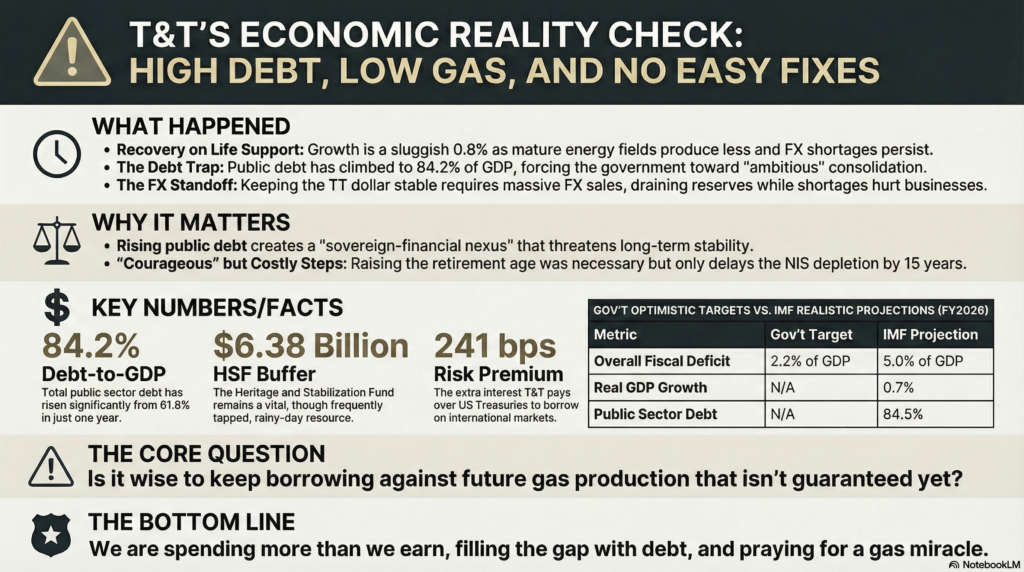
The IMF estimates Trinidad and Tobago’s overall fiscal deficit for FY2025 at about 5.5 percent of GDP, well above what the public narrative suggests. Central government debt has climbed to roughly 67.8 percent of GDP, while total public sector debt is now above 84 percent.
That matters because debt narrows choices.
High debt limits policy flexibility.
And limited flexibility is dangerous in a small, import-dependent economy with persistent foreign exchange pressures.
The IMF’s baseline outlook is blunt. Without additional fiscal measures, deficits remain elevated and debt continues to rise.
Growth alone is not paying the bills.
You Can’t Cut Your Way Out of a Revenue Problem
This is where the report quietly collides with recent political decisions.
Since coming into office in April 2025, the government has reversed two of the most controversial revenue-related reforms of the last decade. The Trinidad and Tobago Revenue Authority was scrapped. The Property Tax regime was repealed.
Both moves were popular.
Both were politically expedient.
And both removed tools that were designed, however imperfectly, to strengthen revenue administration and broaden the tax base.
What followed, however, was not a reduction in the state’s appetite for revenue, but a reshuffling of how it is collected. As previously detailed by TriniLulz in Property Tax Gone? Meet the 4 New Stealth Taxes Hiding in Trinidad’s 2025 Finance Bill, the fiscal burden did not disappear. It changed shape.
The IMF does not editorialise on local politics. It simply states the math.
According to IMF staff, meeting the government’s own fiscal targets would require additional adjustment of roughly 2.8 percent of GDP through new revenue measures or spending restraint.
In plain terms, after eliminating two major revenue mechanisms, the country still needs more money or deeper cuts.
The politics changed.
The arithmetic did not.
FX Tight, Reserves Slipping, Businesses Still Choking
No IMF assessment of Trinidad and Tobago is complete without confronting the foreign exchange problem, and the 2026 report does not dodge it.
The IMF notes that foreign exchange shortages persist, constraining private sector activity and weighing on non-energy growth. International reserves remain adequate by traditional metrics, but they are gradually declining, supported by regular Central Bank foreign exchange injections.
This is the contradiction Trinidadians live with every day.
An energy-exporting country.
A positive current account position.
And businesses still struggling to access US dollars to import inputs, pay suppliers, or plan ahead.
The IMF hints at what policymakers rarely say openly. Maintaining the current exchange rate arrangement requires ongoing intervention and supportive policy settings. Over time, that becomes increasingly costly.
This is not abstract economics.
It shows up in grocery prices, construction delays, medical imports, tuition payments, and stalled investment.
The Deficit Nobody Wants to Say Out Loud
The government’s FY2026 budget targets an overall deficit of around 2.2 percent of GDP. The IMF’s projection is closer to 5 percent.
That gap is not academic.
It is the difference between stability and slow drift.
To close it, the IMF points to familiar tools. Broadening the VAT base. Rationalising subsidies. Strengthening tax compliance. Improving public sector efficiency.
None are easy.
None are politically painless.
And none are solved by removing institutions without replacing their function.
Fiscal credibility is not built on announcements.
It is built on execution.
The IMF Isn’t the Enemy. Arithmetic Is.
The IMF is often treated as a villain in Caribbean politics. This report is not ideological, punitive, or dramatic.
It is arithmetic.
Trinidad and Tobago has room to grow. It has energy resources, human capital, and regional opportunity. But it cannot outrun debt dynamics, FX pressure, and structural deficits indefinitely.
The IMF’s 2026 message is delivered quietly, which is what makes it dangerous to ignore.
The reality check has been issued.
What happens next is no longer about reports.
It is about choices.