Legalise Prostitution in Trinidad and Tobago? The Government Already Knows the Current System Is a Mess
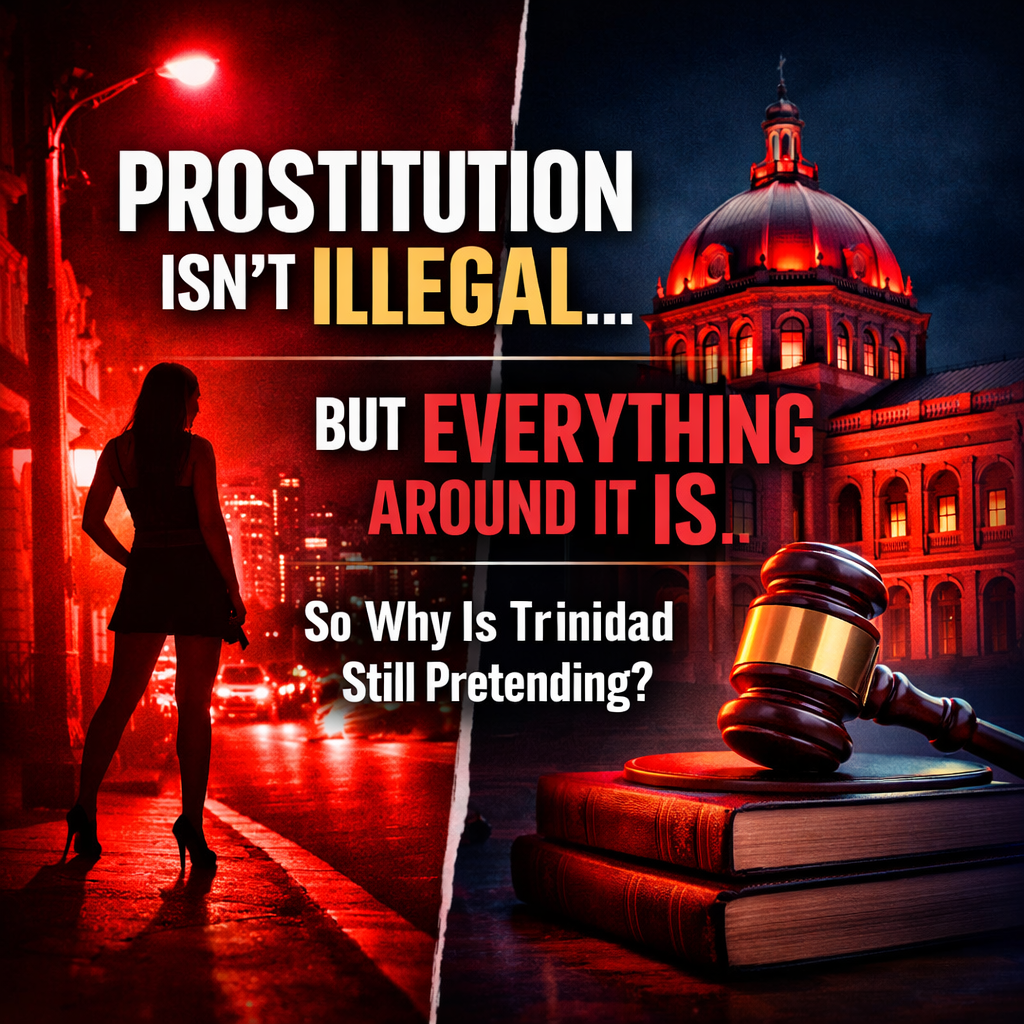
The Country Already Has Prostitution. What It Doesn’t Have Is Honesty.
Let’s start with the uncomfortable truth.
Trinidad and Tobago already has prostitution.
It exists in Port of Spain, San Fernando, Chaguanas, and along certain well-known highways where everyone pretends not to see anything. It exists in bars, massage parlours, apartments, hotel rooms, and WhatsApp chats. The question the country keeps dodging isn’t whether prostitution exists.
The real question is this:
Why is Trinidad and Tobago still pretending the current system works?
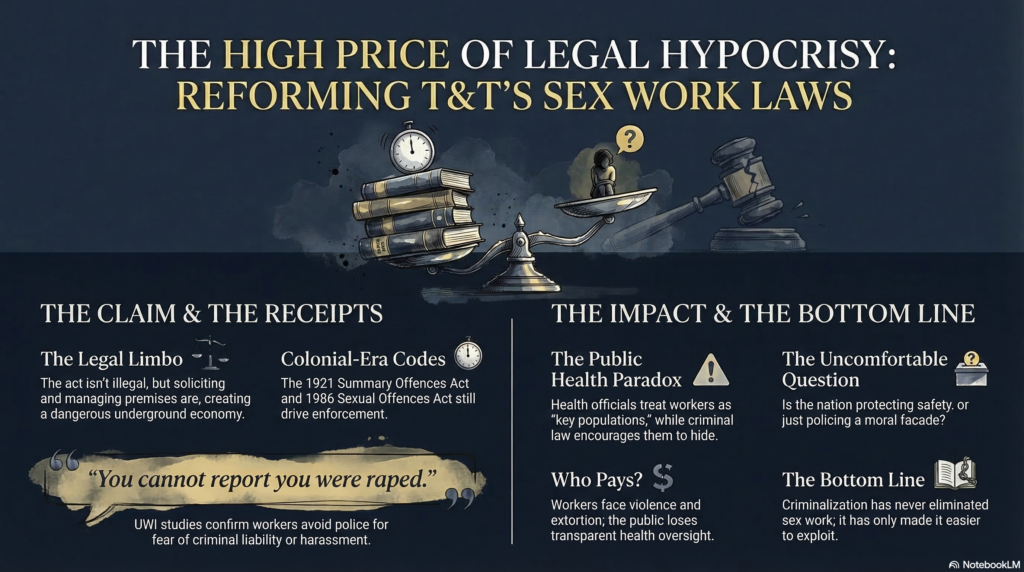
Right now, the law creates a bizarre contradiction. The private act of exchanging sex for money is not directly illegal. But almost everything around it is criminalised — soliciting, running a brothel, living off the earnings, or managing premises where sex work occurs.
In other words, prostitution technically exists in a legal grey zone where it is not fully illegal, yet practically impossible to do legally.
This legal limbo has created exactly the kind of underground economy policymakers claim they want to avoid. And that is why the debate over whether to legalise prostitution in Trinidad and Tobago is not just a moral argument anymore.
It is a policy failure that the country keeps refusing to fix.
“Everybody knows it happening. The only thing illegal in Trinidad is admitting it.”
The Colonial Laws Still Running the Show
Many of the laws governing prostitution in Trinidad and Tobago are rooted in colonial-era morality codes.
The Summary Offences Act of 1921 makes it an offence for a woman to solicit for prostitution, carrying a possible prison sentence. Meanwhile, the Sexual Offences Act of 1986 criminalises brothel-keeping, procurement, and living on the earnings of prostitution.
The result is a legal maze where the act itself is ambiguous but the surrounding activities are criminal offences.
That contradiction creates a dangerous environment for sex workers.
If a worker is robbed, assaulted, or raped while working, reporting the crime can mean exposing themselves to criminal liability or stigma. Researchers studying the sex trade in Trinidad and Tobago have documented cases where workers avoid police entirely for fear of harassment or disbelief.
One participant in a University of the West Indies study put it bluntly:
“You cannot go to any station in Trinidad and report that this is the job you are doing and you were raped.”
When the law forces people underground, it doesn’t eliminate the industry. It simply removes the safety nets.
The Public Health Paradox
Here’s where things get even more absurd.
The Ministry of Health already recognises sex workers as a key population in the national HIV response strategy.
For over a decade, public-health officials have acknowledged that reaching sex workers with testing, treatment, and prevention programs is essential for controlling HIV transmission.
Yet the same government structure maintains laws that push the industry into secrecy.
This contradiction creates a dangerous policy clash:
- The Ministry of Health wants outreach and harm reduction.
- The criminal law encourages hiding and avoidance.
You cannot build trust with a population while simultaneously criminalising the conditions in which they operate.
Globally, health experts have repeatedly warned that criminalisation increases the risk of sexually transmitted infections because it weakens workers’ ability to insist on condom use or seek medical services. According to the World Health Organization, decriminalising sex work could significantly reduce HIV infections among sex workers over time.
In other words, the current legal framework undermines the very public-health goals the government claims to support.
“You cannot run HIV prevention policy on Monday and moral panic on Tuesday.”
Countries That Tried Something Different
Trinidad and Tobago is far from the first country to wrestle with this issue.
Around the world, governments have experimented with different models ranging from full criminalisation to regulation and decriminalisation.
Some of those experiments offer important lessons.
New Zealand – Decriminalisation Model
New Zealand decriminalised sex work in 2003 through the Prostitution Reform Act.
The law treats sex work as legitimate labour while maintaining strict penalties for trafficking, coercion, and underage exploitation.
Government reviews of the policy found that decriminalisation improved working conditions and increased workers’ ability to refuse unsafe clients without dramatically expanding the size of the industry.
The Netherlands – Regulated Legalisation
The Netherlands legalised and regulated prostitution in 2000, with brothels operating under licensing systems and labour rules enforced by authorities, according to the Dutch government’s official policy framework.
Brothels operate under licensing systems, and authorities conduct inspections to ensure health and labour standards.
However, Dutch officials also acknowledge ongoing challenges with trafficking and criminal networks attempting to exploit the industry.
Legalisation did not eliminate those risks entirely — but it brought much of the sector into a regulated environment where oversight is possible.
Belgium – Labour Rights Approach
Belgium took things a step further in recent years by recognising sex work as legitimate labour and extending labour protections.
Workers can sign contracts, access social protections, and work under regulated conditions.
The approach treats sex work less as a moral issue and more as a labour and human-rights question.
The Advantages of Legalising Prostitution
If Trinidad and Tobago were to legalise prostitution or move toward decriminalisation, several potential benefits could emerge.
Safer Working Conditions
Legal frameworks can allow workers to operate in safer environments, collaborate with others, and report abuse without fear of criminalisation.
Public Health Improvements
When workers can access healthcare openly, it becomes easier to promote testing, condom use, and preventative care.
Reduced Police Corruption
Grey-zone industries are fertile ground for corruption. When laws are ambiguous, enforcement becomes selective.
Clear regulation can reduce opportunities for extortion, bribery, and informal protection networks.
Economic Transparency
A regulated industry can move economic activity out of the shadows, making it subject to taxation, licensing, and labour oversight.
“Criminalising prostitution has never eliminated it. It has only made it easier to exploit.”
The Real Concerns Trinidad Must Confront
Of course, legalisation is not a magic solution.
Critics raise legitimate concerns about trafficking, exploitation, and organised crime. Some countries with legalised systems still struggle with illegal brothels and coercive networks operating alongside the regulated market.
There are also cultural and religious objections that remain deeply rooted in Trinidad and Tobago’s social fabric.
For many citizens, prostitution represents moral decline rather than labour rights.
Those views cannot simply be dismissed.
But ignoring the issue altogether is also a choice — and that choice has consequences.
When policy is driven by denial rather than evidence, the people most affected are usually the ones with the least power.
The Question Trinidad and Tobago Must Finally Answer
Trinidad and Tobago has been living with a quiet contradiction for decades.
The country tolerates the existence of prostitution while maintaining laws that pretend it does not.
The result is an underground industry where workers face violence, stigma, and limited legal protection.
So the real debate is not whether prostitution exists.
It does.
The debate is whether the country is prepared to confront that reality honestly.
Because pretending the problem doesn’t exist hasn’t made it disappear.
It has only made the system messier, more dangerous, and far more hypocritical.
And at some point, the nation will have to decide whether it wants to keep policing morality — or start writing smarter laws.
Want the bigger picture? Explore our Trinidad Crime & Security hub for dashboards, explainers, updates, and deeper coverage of one of the country’s most urgent ongoing stories.