The 10 Most Powerful Caribbean Passports in 2026 — Barbados Still Reigns
In 2026, the Most Powerful Caribbean Passports are not just about who can breeze through an airport with less hassle. They are about prestige, diplomacy, leverage, and which Caribbean states have managed to convince the world they are stable, trusted, and worth opening doors for. That is why this year’s rankings hit a little harder than a routine travel story. Barbados is still king. Again. And while several Caribbean neighbours climbed, Trinidad and Tobago stayed exactly where it was.
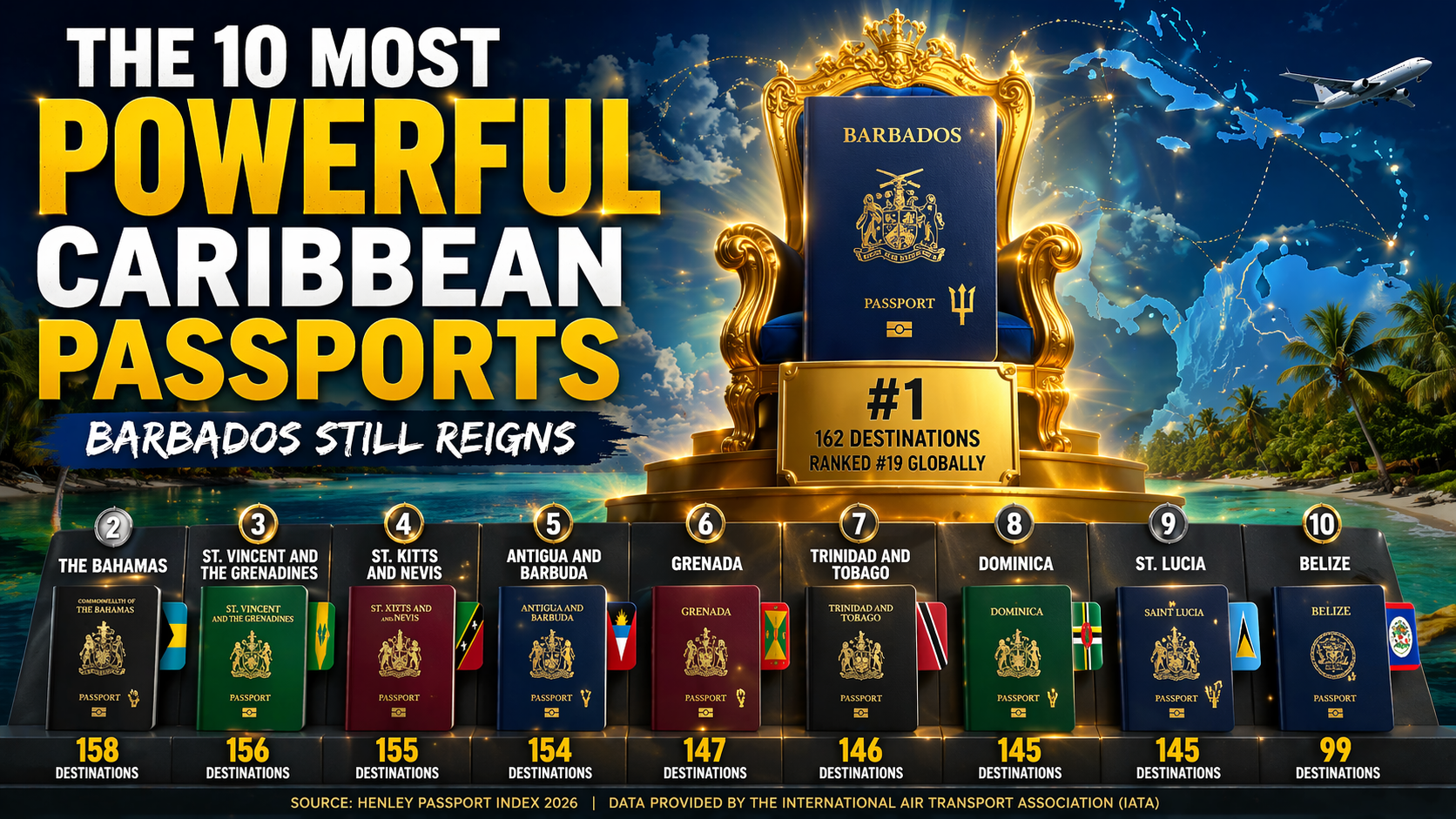
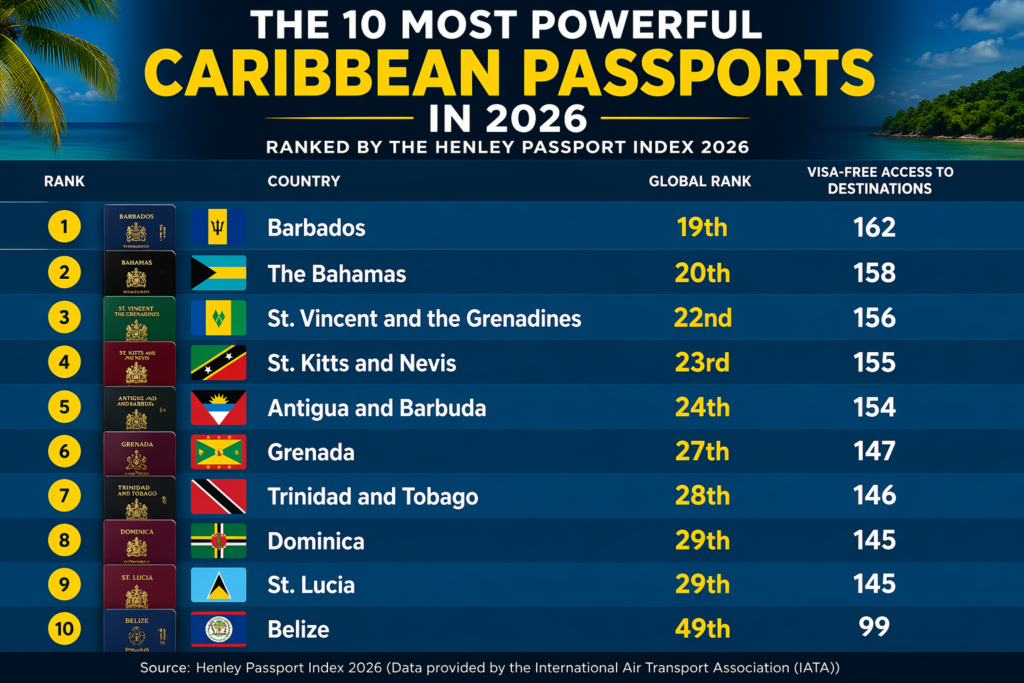
According to the 2026 Henley Passport Index reporting cited across regional coverage, Barbados ranks 19th globally with access to 162 destinations, making it the top Caribbean passport for the 11th consecutive year. The Bahamas is next at 20th, St Vincent and the Grenadines at 22nd, St Kitts and Nevis at 23rd, and Antigua and Barbuda at 24th. Trinidad and Tobago sits 28th with access to 146 destinations, behind Grenada and tied to none of the region’s major upward movers.
That is the real bacchanal here. This is not just a list. It is a regional scoreboard.
Barbados keeps the crown, and that should make the rest of CARICOM uncomfortable
Barbados has now held the top Caribbean passport spot for 11 straight years. Eleven. At this point, that is no longer a fluke or a lucky cycle. That is policy. That is reputation. That is a country quietly stacking diplomatic wins while others are still arguing over who should get the microphone at the press conference. Regional reporting ties Barbados’ position to its steady global standing and long-term diplomatic credibility, while the Henley index itself says its rankings are based on visa-free access using IATA travel data across 199 passports and 227 destinations.
And here is where the story gets interesting for ordinary Caribbean people. A strong passport is not just nice for business-class people and conference junkies. It affects students looking for opportunities, professionals trying to move faster, entrepreneurs scouting markets, and families trying to navigate a global system that gets harsher the weaker your passport becomes. The briefing behind this story correctly frames passport strength as a sign of diplomatic capital and global integration, not merely vacation convenience.
In 2026, a passport is not just a travel document. It is your country’s international report card.
The Most Powerful Caribbean Passports list tells a deeper story than tourism ever could
Here is the top 10 for 2026 as reported in regional coverage of the Henley rankings: Barbados, The Bahamas, St Vincent and the Grenadines, St Kitts and Nevis, Antigua and Barbuda, Grenada, Trinidad and Tobago, Dominica, St Lucia, Belize, and Guyana rounding out the 10th position depending on formatting of the tie structure in the source list. Barbados leads with 162 destinations, while Guyana sits at 88. That is a major spread inside one region.
The full ranking shows something else too. Several Caribbean countries improved between 2025 and 2026. Barbados moved from 21st to 19th. The Bahamas climbed from 22nd to 20th. St Vincent and the Grenadines rose from 24th to 22nd. St Kitts and Nevis moved from 24th to 23rd. Antigua and Barbuda jumped from 27th to 24th. Grenada, Dominica, and St Lucia also improved. Trinidad and Tobago did not. It remained at 28th.
That stagnation matters because passport power usually reflects how well a country manages relationships, negotiations, trust, and consistency. Put plainly, if your neighbours are moving and you are standing still, people will ask questions.
Why Trinidad and Tobago’s flat ranking should sting
For Trinidad and Tobago, this is the part that should spark the comments section. We are not talking about a microstate with limited reach or a country with no diplomatic footprint. T&T is one of the Caribbean’s most visible energy players, one of CARICOM’s larger economies, and a country that regularly talks big on regional and international affairs. Yet when the latest mobility league table came out, T&T stayed parked at 28th while smaller states edged forward.
That does not mean the Trinidad and Tobago passport is weak. Far from it. Access to 146 destinations still places it in the upper global tier compared with much of the developing world. But in a Caribbean context, this ranking raises an awkward question: how are some of our smaller neighbours proving more nimble, more effective, or simply more successful at turning diplomacy into practical mobility gains?
This is where the regional story becomes a governance story. Passport strength is soft power made visible. It is foreign policy you can literally carry in your pocket.
When smaller islands keep climbing and T&T stays still, that is not just travel news. That is a diplomacy story.
The global mobility gap is growing, and the Caribbean cannot afford complacency
The wider 2026 context makes the rankings even more important. Regional reporting on the Henley data says the gap between the world’s most mobile and least mobile populations is widening. At the top, more powerful passports are clustering together with extraordinary access. At the bottom, weaker passports remain boxed in.
Globally, Singapore leads with access to 192 destinations, while other top-tier countries sit deep into the 180s. In that context, Barbados at 162 is impressive by Caribbean standards, but it also shows how competitive the upper end of global mobility has become. Caribbean states are doing well regionally, yes, but the race is getting tougher internationally.
That is why governments across the region cannot afford to treat passport strength as a vanity metric. It has implications for trade, education, migration, investment appeal, and even national branding. In a world where movement is opportunity, the countries that open more doors for their citizens are giving them a real advantage.
So what does Barbados have that others do not
At a minimum, Barbados has consistency. It has managed to maintain a reputation strong enough to keep the top Caribbean spot for more than a decade. That suggests a foreign policy machine that works, a national image that travels well, and a level of diplomatic steadiness that other Caribbean governments should be studying instead of ignoring.
The 2026 Most Powerful Caribbean Passports ranking is therefore about much more than bragging rights. It is about who is converting sovereignty into influence. Barbados still reigns. The Bahamas is pushing hard. Smaller states are proving that size does not automatically limit diplomatic results. And Trinidad and Tobago, while still strong by regional standards, has been handed a quiet reality check.
Because in this game, your passport does not lie. It tells the world how much your country can get done.