“Worried About War? You Must Be a PNMite!” — How Fear Turned Into Partisan Paranoia
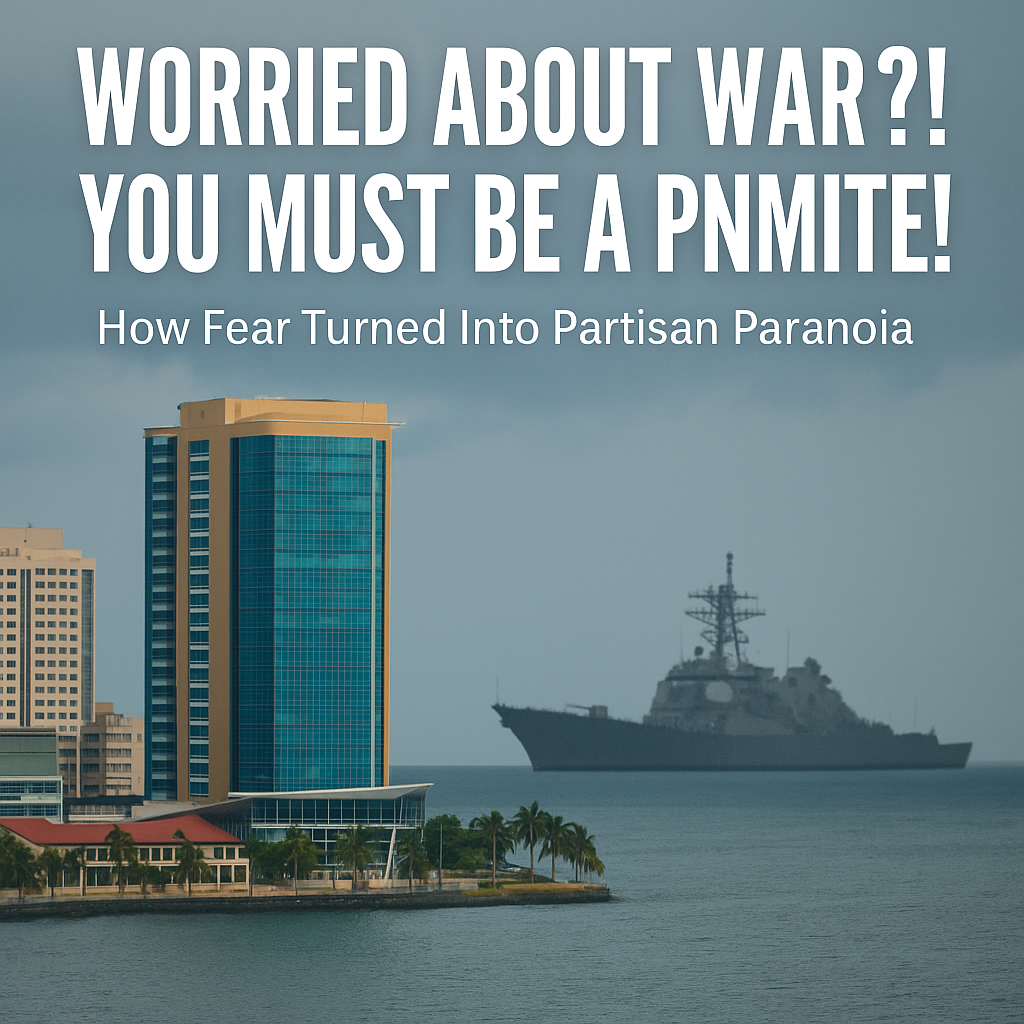
Something dangerous brewing in Trinidad.
The minute anyone expresses concern about the U.S.–Venezuela conflict creeping closer to our shores, they’re branded a PNM supporter, a sympathizer, or even worse an ally of traffickers.
So now, being worried about a war makes you a political agent?
When Worry Became a Party Colour
Let’s get this straight:
- The BBC, CNN, MSNBC, and Al Jazeera are all reporting on U.S. military operations off Venezuela.
- The U.S. has confirmed air and naval strikes on boats in the Caribbean.
- Venezuela has publicly threatened retaliation if neighbouring countries assist.
- Russia has said it will stand by Venezuela.
So asking, “Could this reach us?” isn’t paranoia, it’s just common sense.
But in today’s Trinidad, common sense is apparently “partisan propaganda.”
Ministers Talking in Circles while Citizens Left Confused
On Friday, things took a weird turn.
When asked why the Trinidad and Tobago Defence Force (TTDF) was called out in Parliament, the Minister of Defence invoked Section 27(1)(g), a clause that lets a minister refuse to answer if it’s “against the public interest.”
Translation: “We can’t tell you.”
Fine. Sensitive information, maybe.
But then the Minister of National Security says calling out all TTDF members is “normal.”
Normal? During a weekend when half the hemisphere on edge?
And just as citizens trying to decode what’s happening, the Ministry of Foreign and CARICOM Affairs drops a statement saying “there’s no change to the security environment.”
No change? After Defence and Security just sounded the alarm?
When the media asked for clarity, the Minister accused journalists of publishing fake news, effectively calling the nation’s eyes and ears liars.
So which is it: calm seas or red alert?
Because from where citizens sitting, those two stories don’t add up.
Trinidad Is Small And People Talk
This isn’t Washington or Moscow. This is Trinidad.
Everybody has a cousin in the Defence Force, a brother in the Coast Guard, or an aunty who “does admin in Chaguaramas.”
So when soldiers getting unexpected call-outs and overnight briefings, the word travels faster than an official press release.
That’s not “rumour.” That’s the national grapevine and oftentimes it’s right.
A War on the Doorstep
The timing matters.
- The U.S. President already announced his intent to conduct land strikes in the region.
- The world’s largest warship, the USS Gerald R. Ford, is now operating in Caribbean waters.
- Venezuela warned twice: if Trinidad lends itself to a U.S. attack, it becomes a target.
- Russia has openly pledged military and diplomatic backing to Caracas.
That’s not Twitter speculation — that’s the international security brief.
So, yes, calling out the TTDF makes sense.
Any government worth its salt should have contingency plans ready.
The problem isn’t the mobilisation. It’s the mixed messaging that came after.
The Moment We Missed
Instead of explaining that the call-up was precautionary — a sensible move to keep the country secure — officials chose to scold the public.
Imagine how differently this could’ve gone:
“Yes, we are aware of the regional situation. Yes, we’ve called up the TTDF. It’s part of our readiness plan to keep citizens safe.”
That’s leadership. That builds confidence.
Instead, we got finger-pointing and political shade — at a moment when citizens needed clarity, not classification.
TriniLulz Verdict: Fear, Not Facts, Running the Show
Nobody’s asking for state secrets or military blueprints.
People just want to know: are we safe, and are you ready?
What we got instead was spin, denial, and confusion, the exact ingredients that breed mistrust in a crisis.
This wasn’t a partisan issue until politicians made it one.
Now, genuine concern is mistaken for propaganda, and public reassurance replaced by sarcasm.
When the seas are this rough, citizens don’t need slogans — they need steady hands at the wheel.
Because preparedness shouldn’t be a political act.
It should be national sense.
This story is part of our wider Trinidad Politics Explained coverage. Explore the full hub for political analysis, key background, major controversies, and the latest updates.