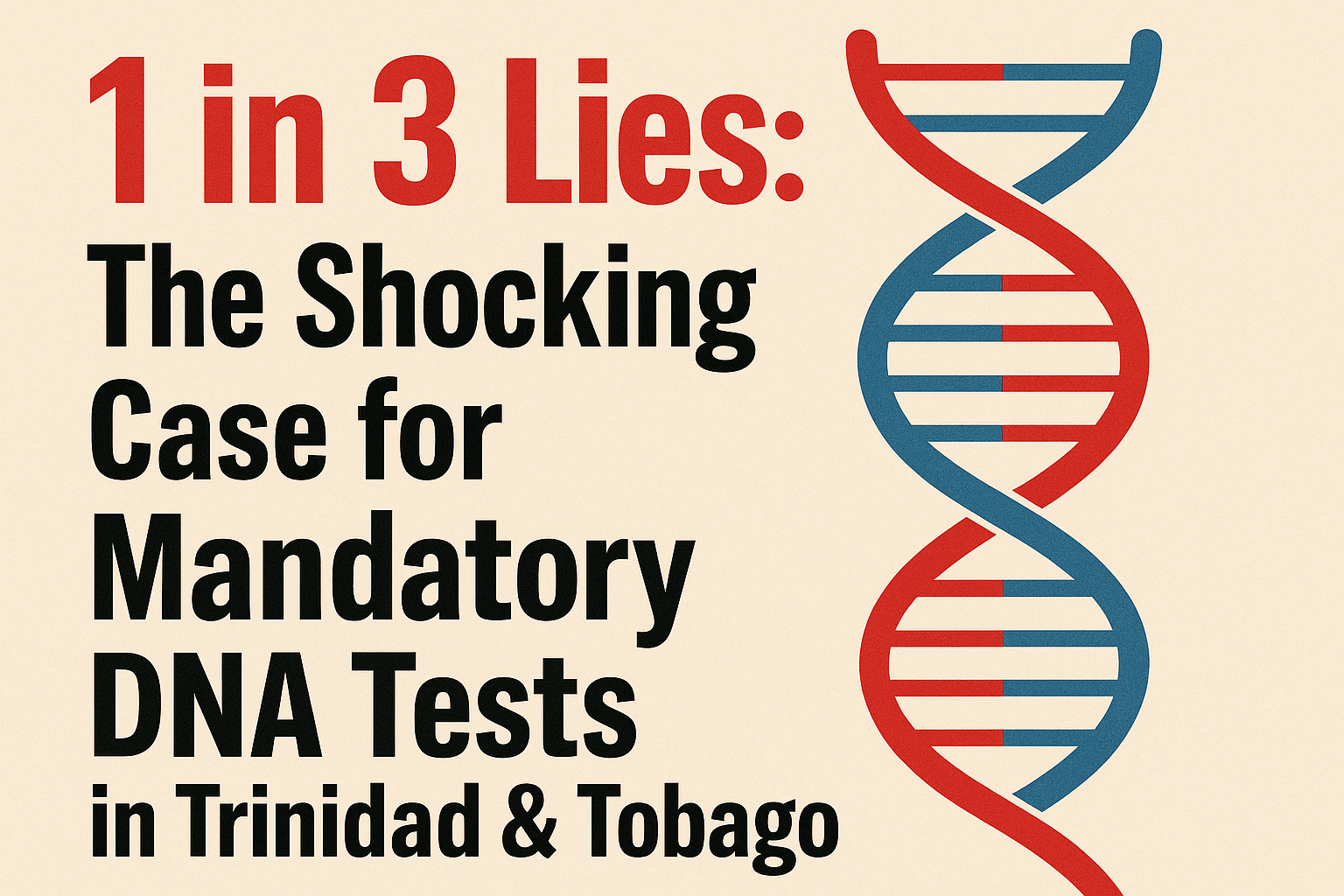
1 in 3 Lies: The Shocking Case for Mandatory DNA Tests in Trinidad & Tobago
Introduction
When the Fathers’ Association of Trinidad & Tobago (TFATT) dropped its bombshell survey, jaws dropped across the islands: of 440 paternity DNA tests between January 2020 and September 2025, 143 (32.5 %) revealed the man thought to be the father wasn’t the father. As a result suggestions for mandatory DNA tests sounds like a reasonable demand.
The numbers don’t lie
- Of the 440 tests: 82 were done under legal proceedings, and 24 of those (29.27 %) came back “not father”.
- The remaining 358 tests were voluntary by fathers, and 119 (33.24 %) of them found the child wasn’t theirs.
- In 2020 alone: only 13 legal-proceeding tests, but 8 (61.5 %) were “not father”.
“Can you imagine with a ratio of one in every three, how rampant this can be?” — TFATT’s president, Rhondall Feeles.
These are big, unsettling numbers for fathers, children, families — and the legal system.
Why the uproar?
TFATT says the current system lets a man be locked into paying child-maintenance without verification of biological fatherhood. For example, in one case a man had to pay $35,000 in maintenance for a child later proven not biologically his.
Behavioural therapist Wendell De Leon warned of the mental-health impact:
“One of the critical ingredients of suicide is hopelessness … you’d released love and support for 15, 16 years, only to find this child is not yours.”
So the Fathers’ Association is pushing hard for mandatory DNA tests before courts issue maintenance orders.
The asks on the table
TFATT has written to both the Attorney-General and the Chief Justice with these demands:
- Mandatory paternity DNA test for all maintenance hearings.
- A law that criminalises “paternity fraud” (a woman intentionally misleading a man into believing the child is his).
- Compensation, counselling for affected fathers & children, and police referral in proven fraud cases.
The Chief Justice’s chambers replied on Oct 17 saying the matter is “receiving consideration.”
The big questions
- Should every father have to submit to a DNA test before maintenance orders? Does that imply distrust of women/mothers?
- Who pays for the test? TFATT suggests yes, the state should pay. In other regional examples one panel said the roughly US$800 cost should be borne by the state.
- What about the child’s best interest, legal costs, potential stigma? A heavy subject.
- How does the legal system adapt? Will implementation slow or speed resolution of maintenance cases?
Why this matters for Trinidad & Tobago
If roughly one-third of tests are coming back negative, the implications are massive: legal, emotional, financial. Fathers trapped in maintenance for children not biologically theirs, children caught in the middle, courts processing huge numbers of applications (TFATT pointed out 6,838 maintenance applications between 2016-2021) with some percentage potentially “false paternity” unknown.
And in a society where father-child relationships are culturally rich and complex, trust and identity weigh heavy.
“When one in every three paternity tests comes back negative, maybe mandatory DNA tests aren’t just an option — they’re a necessity.”
Final thought
The idea of mandatory DNA tests invites tension: between fairness and privacy, between protection and presumption, between legal clarity and human complexity. On one hand: protecting men from paying for children that are not theirs. On the other: ensuring children, mothers and families are treated fairly and compassionately.
In the coming weeks we’ll see if the courts or legislature move. Until then the question hangs in the air: should fatherhood be legally verified before fatherhood is financially enforced?
IFor global context on mandatory paternity testing debates, see this legal/ethical overview. cynthiahernandezlaw.com