Tourism vs. The Great Atlantic Sargassum Seaweed Belt: 2026 Is the Stress Test
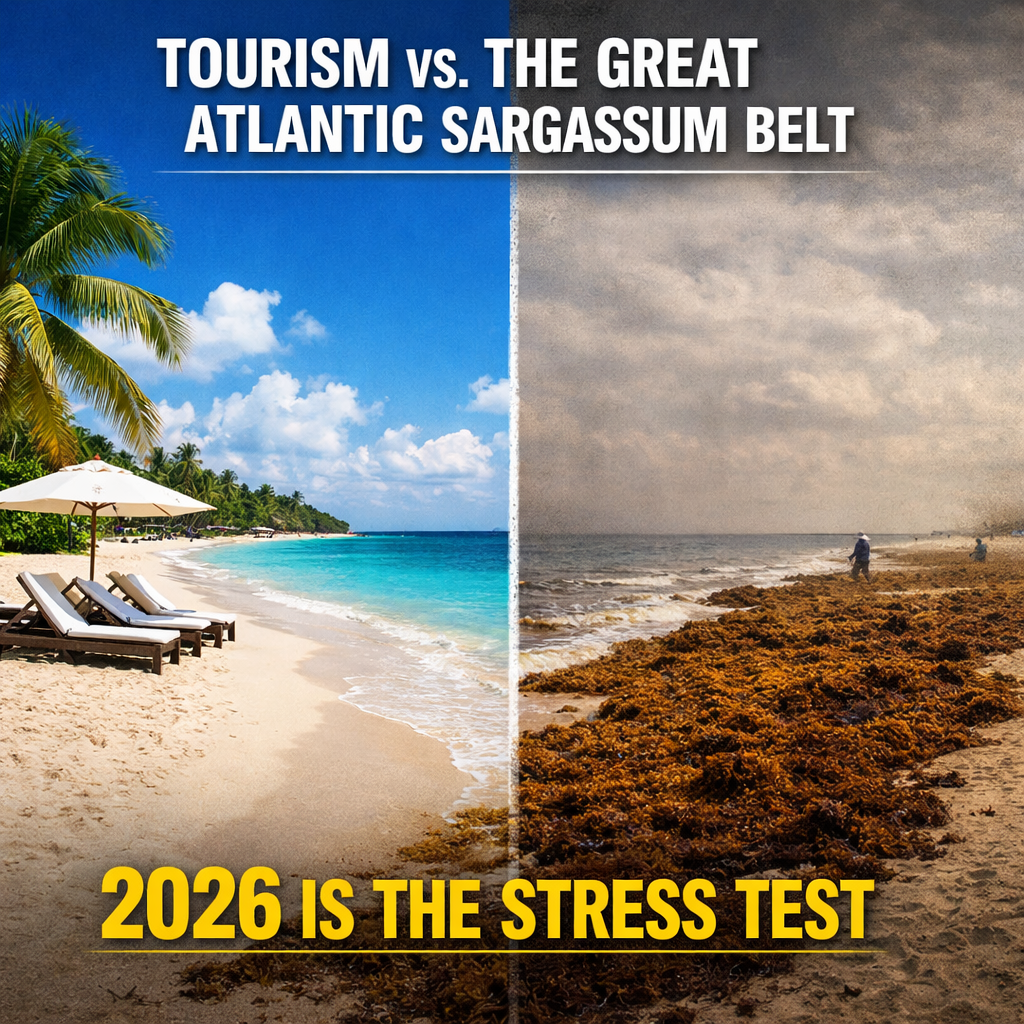
The Caribbean built a global brand on white sand and turquoise water. But in 2026, sargassum seaweed is staging a full-scale takeover — and tourism-dependent economies are discovering that paradise now comes with a brown subscription.
Oceanographers are no longer describing this as a bad year. They’re calling it something more structural. Monitoring data from the University of South Florida’s Sargassum Watch System shows record-high winter biomass and confirms 2026 is shaping up as a “major sargassum year.” That matters because winter used to be the quiet season.
It isn’t anymore.
“We appear to be witnessing a regime shift from a macroalgae-poor ocean to a macroalgae-rich ocean.”
— Chuanmin Hu, USF College of Marine Science
This isn’t seasonal inconvenience. It’s a system recalibrating itself.
The Year the Seaweed Didn’t Leave
In December 2025, Caribbean biomass stood at 0.45 million tons. By January 2026, it had surged to 1.7 million tons. Western Atlantic levels climbed from 4.1 to 5.5 million tons over the same period.
That kind of winter acceleration signals something deeper than weather.
For over a decade, scientists have tracked what is now called the Great Atlantic Sargassum Belt — a 5,000-mile stretch of floating algae fed by nutrient runoff from the Amazon and Mississippi basins and warmed by rising sea surface temperatures. Historically, sargassum seaweed arrived between March and October. We covered its 2025 arrival here.
In 2026, it never really clocked out.
Beaching risks are already elevated across Belize, Honduras, the Mexican Caribbean, and parts of the Lesser Antilles. That means hotel operators, tour guides, and municipal crews are now working year-round response cycles instead of seasonal cleanups.
Paradise just became a permanent operations budget.
Tourism Economics Meets Biology
The Caribbean economy runs on perception as much as reality. Beaches are not just geography. They are infrastructure.
Research from the Woods Hole Oceanographic Institution and the University of Rhode Island estimates that sargassum-related impacts can cost U.S. and Caribbean beach economies up to $1 billion in some years. That includes lost bookings, reduced visitor spending, and cleanup costs running into the tens of millions.
This is not abstract modeling. In Quintana Roo alone, authorities recorded nearly 93,000 tons collected during the 2025 season. And 2026 started stronger.
Now layer this onto an Atlantic hurricane forecast projecting 14 named storms, 7 hurricanes, and 3 major systems, with an ACE index slightly above the historical average.
Seaweed on the shoreline. Storms offshore. Marketing departments caught in the middle.
“White sand” is not just a slogan. It is GDP.
It’s Not Just Ugly. It Can Be Hazardous.
When sargassum seaweed piles up and begins to decay, it releases hydrogen sulfide and ammonia. The Environmental Protection Agency warns that exposure to these gases can cause respiratory irritation, headaches, cardiovascular stress, and neurological symptoms.
For residents in hard-hit coastal zones, this isn’t a one-week inconvenience. In some communities, exposure is now becoming semi-permanent.
That raises an uncomfortable question: what happens when the Caribbean’s economic engine starts conflicting with public health?
Tourists may cancel trips. Residents cannot cancel geography.
From Seasonal Cleanup to Permanent Strategy
Reactive raking is dead. The scale now demands systems.
Mexico’s Navy has deployed containment barriers stretching nearly 9,500 meters and operates surface collection units offshore. The strategy shift is clear: intercept at sea before beaching.
Other islands are watching closely.
But interception is expensive. Maintenance is expensive. Storage is expensive. Disposal is expensive.
So governments are exploring something bold: turning the problem into fuel.
Can Sargassum Become an Industry?
The promise sounds seductive. Convert sargassum seaweed into biogas. Power communities. Create jobs. Transform nuisance into revenue.
Pilot projects have begun. Private equity groups have floated billion-dollar industrial ambitions. But scaling from pilot to plant is not a straight line.
“The transition from a pilot plant to an industrial plant is a very delicate matter.”
— Óscar Rébora, Quintana Roo Secretary of Ecology
There are geochemical hurdles. Heavy metal concentrations vary. Gas emissions during processing pose health risks. Feasibility studies remain ongoing.
In other words: the Caribbean may be sitting on a resource. Or it may be sitting on an engineering headache.
2026 Is the Stress Test
The uncomfortable truth is this: the Great Atlantic Sargassum Belt is no longer a headline event. It is a structural feature of the ocean basin.
Tourism-dependent economies must now operate as if sargassum seaweed is permanent. That means:
• Year-round monitoring coordination
• Offshore interception infrastructure
• Public health air-quality tracking
• Regional funding mechanisms
• Serious evaluation of industrial reuse
And perhaps most critically, honest communication with travelers.
Because denial is not a mitigation strategy.
The Caribbean has survived hurricanes, oil shocks, pandemics, and political upheaval. The question for 2026 is whether it can survive a brown tide that doesn’t respect the calendar.
Paradise is resilient. But resilience requires planning.
And the seaweed is not waiting.
For more destination guides, travel warnings, tourism updates, and plain-English Caribbean travel coverage, visit our Caribbean Travel hub.